Short answer: yes, you can fly a drone across most of Latvia. But "where exactly" is not something to keep in your head. The answer depends on the specific spot and is checked the same way every time. Here is how to get that answer fast and without mistakes.
Start with the official map
There is one official source for "can I fly here". CAA states plainly that the only official and legally binding map of airspace restrictions in Latvia is:
https://www.airspace.lv/drones/
CAA separately warns that a manufacturer's built-in geo-awareness can be incomplete or out of date. So the map on your controller is a handy hint, not the final answer. You can also open the live map on our airspace map page.
Three things decide "can I fly here"
The answer for any spot comes down to three checks.
1. Which zone you are in. CAA splits the airspace into UAS geographical-zone types — from informational to prohibited. When several zones overlap at one point, their conditions add up and the strictest set applies. The zone types and the restriction map are both covered in the no-fly zones overview.
2. Whether you fit the Open-category limits. Even outside zones, the baseline always applies: a height of up to 120 m above the surface and flight within visual line of sight (VLOS). The distance from people depends on the subcategory: A1 (under 250 g) — never over assemblies of people. A2 — no closer than 30 m horizontally. A3 — no closer than 150 m from residential, commercial, industrial, and recreational areas. If you are unsure which category your flight is, run the category chooser.
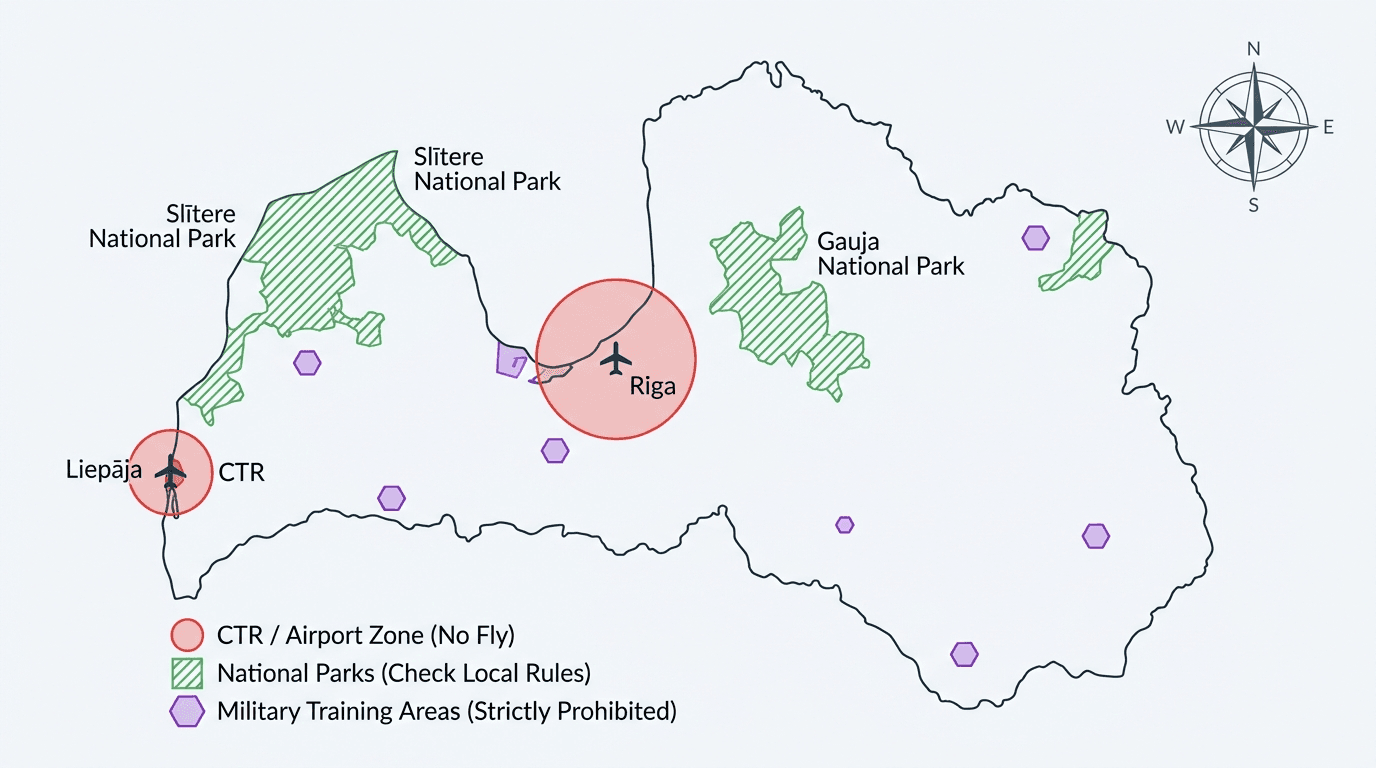
3. Whether there is a nature-protection layer. In protected nature areas, environmental rules apply alongside the aviation ones. Before filming in parks and reserves, check whether a separate local permission is required.
Do you need to file a flight
Outside zones, a standard Open-category flight needs no permission. But since 2025-01-01, flights in UAS geographical zones, where this applies, must be filed in BGKIS before the flight or series of flights. Some zones additionally require coordination or notification.
Keep one thing in mind: coordination clears the specific zone restriction but does not waive the baseline — the 120 m height and VLOS.
The fast way to check a spot
So you don't have to reason it out by hand each time, use our can I fly here calculator: it tells you what to check for a given address and sends you to the official map.
The cost of getting it wrong
Breaking airspace and drone rules in Latvia carries administrative penalties — more in the 2026 fines breakdown. Checking the map in advance is almost always easier and cheaper.
Specific places
The check is the same everywhere. What changes is the practical risk.
Over water
A river, lake, or the sea is not an automatic ban. The limit that bites is VLOS: over glare, in haze, or in low sun a drone is far harder to judge than over a field. A lake shore, a river bend, or a harbour approach can sit inside a UAS geographical zone. Stay off boats and swimmers, and expect extra nature-protection rules over coastal wetlands.
Over a beach
The answer turns on how dense the people below are. Regulation 2019/947 bans Open-category flight over assemblies of people, and an assembly is not a head count — it is a density. If people cannot easily step away from a falling drone, do not fly over them; a sub-250 g drone does not lift that ban. Stop flying when the beach fills up. Parts of the coast are bird-sensitive or protected areas.
Over a city
"City" is not a legal category — your subcategory decides. A1 with a C0 or a suitable sub-250 g drone is usually the workable option, and even that must not fly over an assembly of people. A2 requires horizontal distance from uninvolved people. A3 rarely works in a city at all, because it requires 150 m from residential, commercial, industrial, and recreational areas.
In Jūrmala
One municipality, very different situations: quiet streets, a beach that fills up in summer, hotel terraces, private homes, and coastal nature. The town name answers nothing — check the actual take-off point and route. In summer the beach turns into an assembly of people quickly, and alongside the aviation rules the privacy risk stays.
Over roads
CAA local conditions say flights over vehicles in motion are to be avoided as far as possible. Cars, cyclists, and pedestrians realistically cannot react to a falling aircraft. A short perpendicular crossing can be acceptable when the airspace is legal and it is the safest route; hovering over traffic for the shot is a different risk entirely. Take off from a car park or a field edge, not the roadside.
Over private property
A property boundary does not by itself create a restriction in the airspace above it. But the CAA local condition asks you to cross someone else's property by the shortest, safest trajectory: no hovering over a garden, yard, terrace, or windows. The bigger risk is often the camera — once the footage shows identifiable people, private activity, or repeated shots of a house, meeting the aviation rules is not enough.
Near power lines
Wires are not scenery, they are infrastructure. Distance to them is hard to judge on a wide-angle camera, and obstacle sensors are exactly the systems that miss thin cables. CAA local conditions call for avoiding flight over infrastructure as far as possible: do not run the line at low height, and do not fly between conductors and pylons. A professional inspection is not ordinary Open-category filming — it may need coordination, a controlled ground area, or the Specific category.
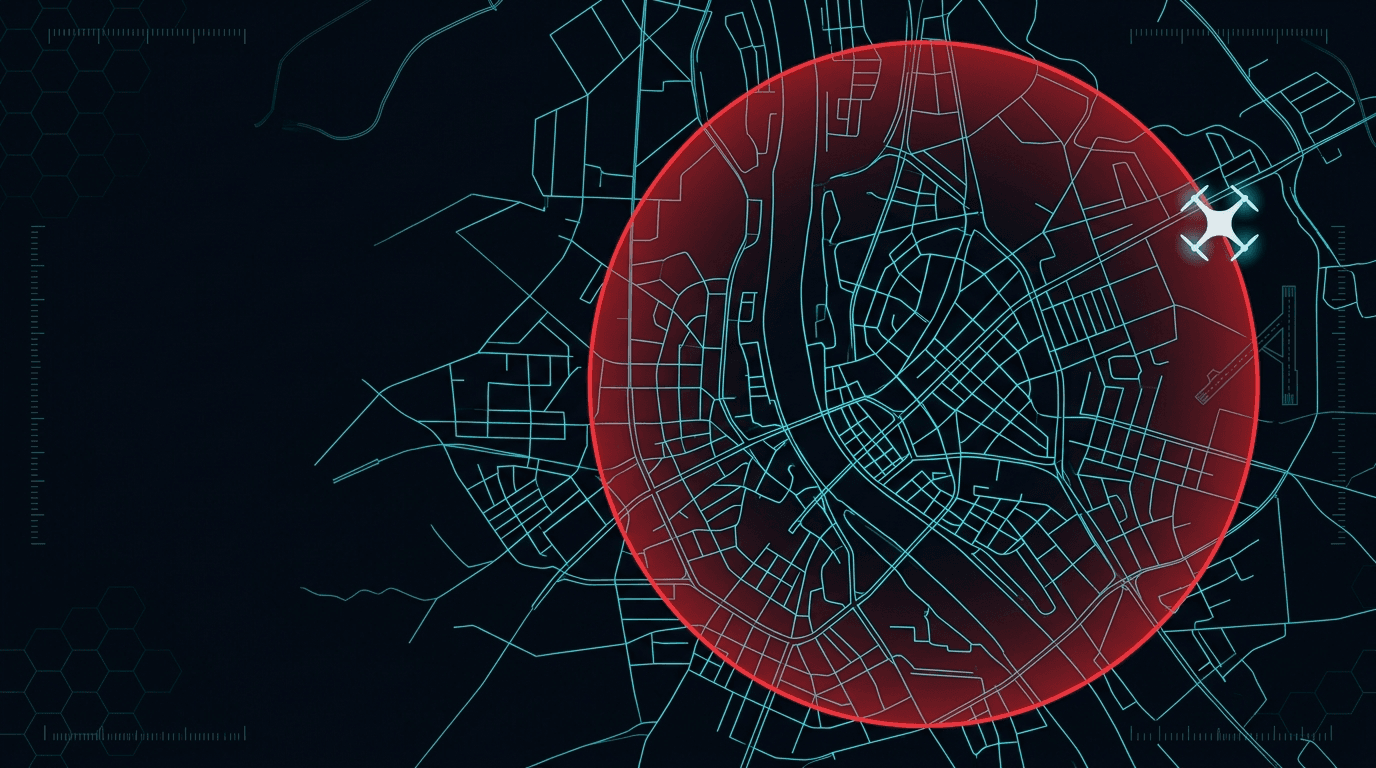
Near an airport
Memory, a rough distance, or an in-app warning are not the answer here. Airports and airfields can be covered by zones with different conditions: some prohibit flight, some require notification, others an authorisation. Read the zone condition rather than inferring from its colour. File before take-off, and check the map again right before you fly — CAA notes that airspace conditions can change.
Separate contexts are covered for protected nature areas, night, and assemblies of people.
To fly legally anywhere
Choosing a legal spot is easier when you also know which certificate, registration, and category rules apply to your drone. If your operation requires A1/A3, online prep lives on the course page, and the whole path from buying a drone to a prepared first flight is laid out in the step-by-step guide. For the capital specifically, see where you can fly a drone in Riga.