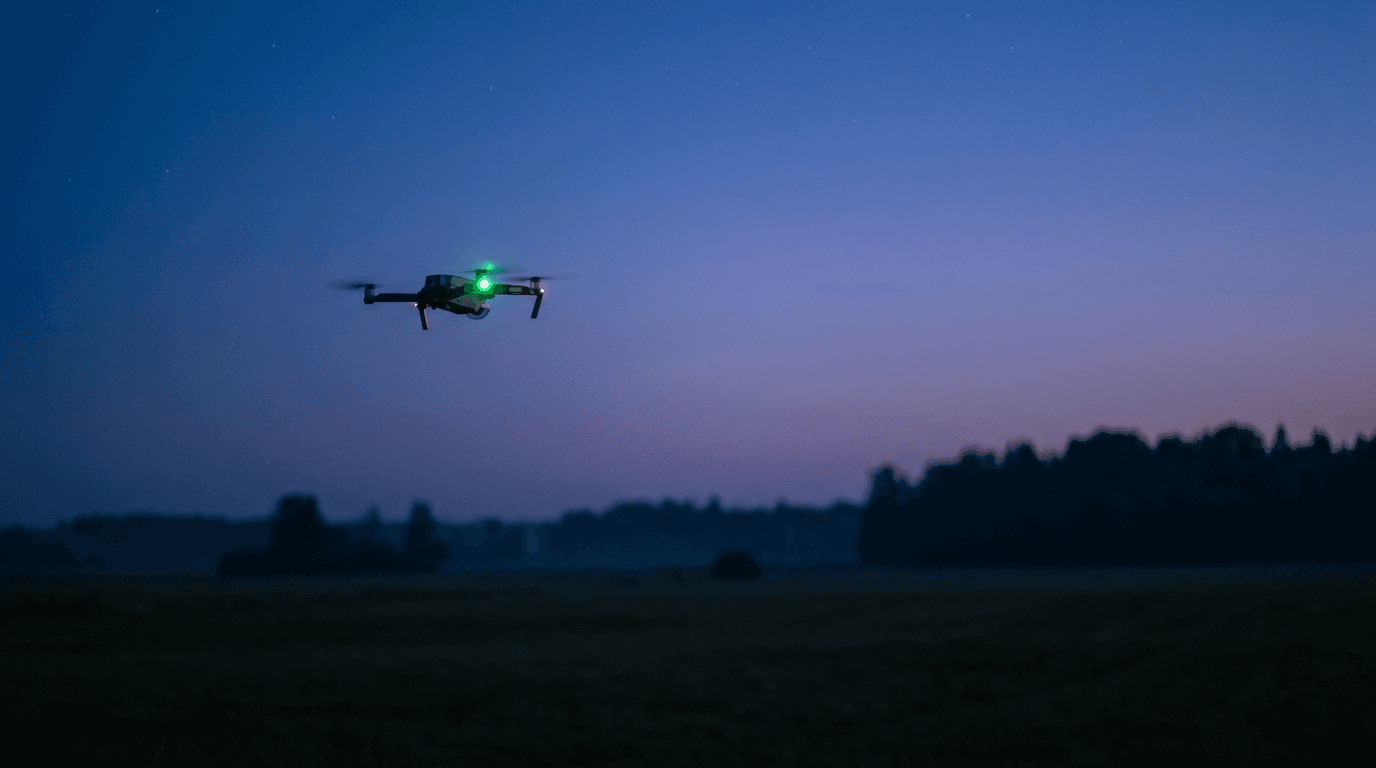
In the Baltics, daylight swings between two extremes. In summer, white nights stretch twilight across half the sky and it never really gets dark. From October to February, though, it's dark by five in the afternoon, and any evening flight is effectively a night flight. So for a pilot in Latvia, "can I even fly at night" isn't a theoretical question — it's just part of planning a shoot.
The short answer: yes, night flights are allowed in the open category. But not unconditionally — a few requirements have to be met.
What counts as night
Regulation (EU) 2019/947 doesn't leave "night" to the eye. It defines night as the period between the end of evening civil twilight and the start of morning civil twilight. That definition is tied to civil twilight, not sunset — so formal "night" starts later than it feels once it's already dark outside.
One important point: there is no general ban on night flights in the open category. After the 2020 amendment (Implementing Regulation (EU) 2020/639), night flights are explicitly allowed — but with a mandatory technical requirement attached.
The green flashing light
The main condition: the drone must have an active green flashing light. This is a direct operational requirement in the open category (UAS.OPEN.060). Aircraft with a C1, C2, or C3 class mark that are rated for night operation already carry this light by design.
If you're flying an older drone with no C-class mark, equipping it is on you — you need to fit a compatible green flashing beacon that's actually visible in the air. The light doesn't make a flight "more legal" on its own; it helps you keep the aircraft in sight and read its orientation in the dark.
VLOS still applies
At night, the open category's basic rule — visual line of sight (VLOS) — is the hardest thing to hold onto. By day, a drone reads as a silhouette; at night, you're navigating by lights alone, and it's easy to lose track of both distance and orientation. So a night flight isn't "the same flight, just in the dark" — it's a more demanding mode where your margins on height, distance, and battery all need to be bigger than usual.
Latvia's position
The CAA applies the EU regulation directly. There is no separate "night permit" for the open category: if the drone has the light, you're keeping VLOS, and you're not breaching any geographical zone, you're clear to fly.
Extra approvals are needed for the same reasons they'd be needed by day — restricted or prohibited zones, controlled airspace near aerodromes, the 50 km border strip — not because it's night. Night doesn't add a new permit requirement, but it doesn't remove any existing one either.
Practical tips
- Confirm the green flashing light is on before take-off and visible from where you'll be standing.
- Scout the site in daylight — at night it's easy to miss wires, antennas, and branches.
- Shorten your working distance: the closer the aircraft, the more reliable your VLOS.
- Keep a battery margin: cold weather drains batteries faster, and a night-time landing takes longer.
- If you're unsure about a zone or how close you are to an aerodrome, coordinate the flight in advance, same as you would by day.
Checklist: a legal night flight
- It's the open category, and your subcategory and aircraft mass fit.
- The drone has an active green flashing light.
- You are genuinely maintaining VLOS in the dark.
- Geographical zones are checked, controlled airspace and the border strip are accounted for.
- The site has been scouted in daylight, with margin on both battery and altitude.
Need the bigger picture on subcategories? See our breakdown of A1, A2, and A3 and the guide to getting an A1/A3 licence.