Sadales tīkls, Latvia's electricity distribution operator, plans to survey roughly 10,000 km of its 90,000+ km grid with drones this year — work that used to mean walking the line through forest or flying it by helicopter. For a certified A1/A3 pilot reading that, the question is concrete: is this a job I could take? Answering it means separating two different things — what the company is actually doing in the air, and what a person holding an Open-category certificate is allowed to do today.
What Sadales tīkls is actually doing
By the company's own account, reported by LSM, the program is already operational, not a pilot trial:
| Metric | Value |
|---|---|
| Total grid length | more than 90,000 km |
| Planned drone survey in 2026 | roughly 10,000 km |
| Drone pilots employed by the company | more than 50 |
| Drones in service | 29, across four types |
| External service provider | still involved for now, described by the company as an early-stage arrangement |
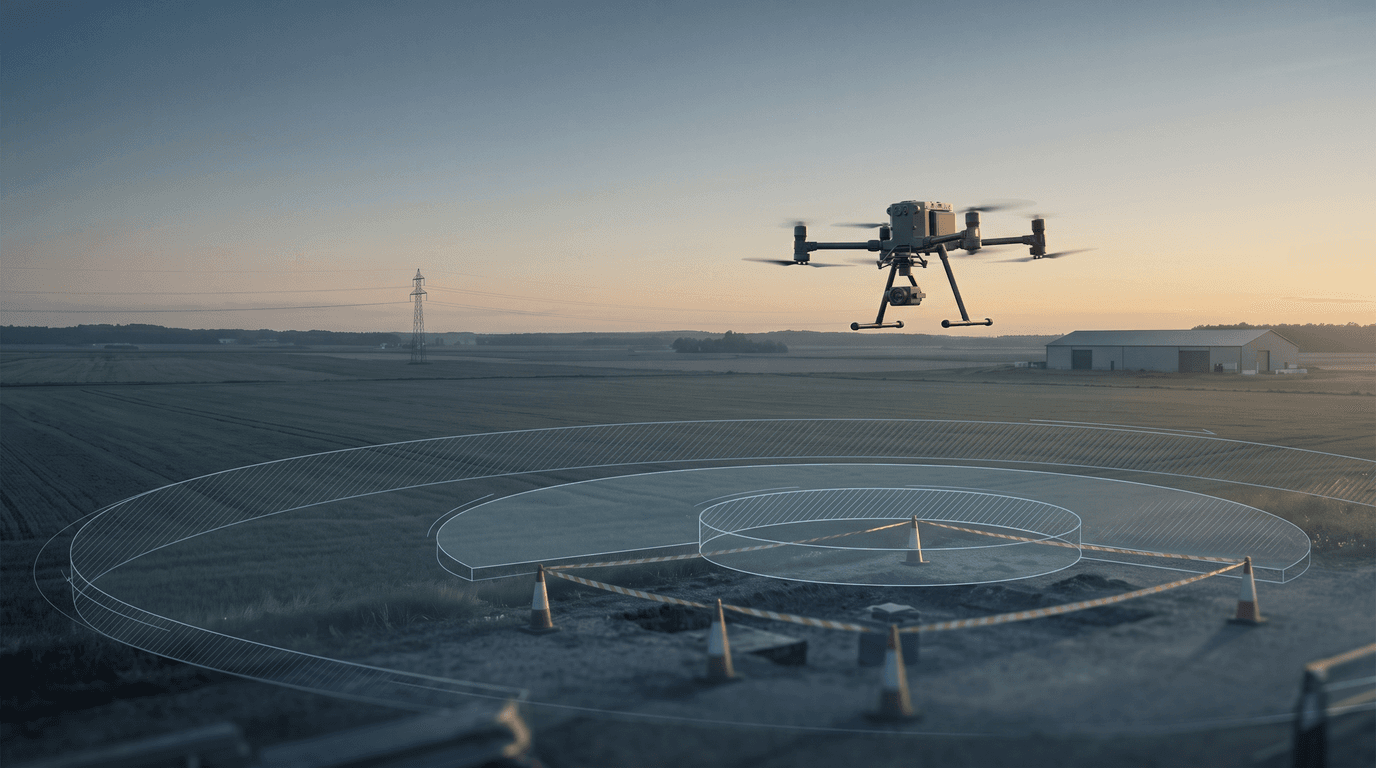
The operational split is clear: smaller drones respond to incidents — for example, checking a damaged section after a storm — while the larger drones, fitted with interchangeable cameras, fly planned, largely automated routes on a regular schedule. A company representative describes staff who used to walk these routes now learning to fly the drones instead, a transition the company itself frames as still early.
The economic driver is direct, not abstract. A stretch of line that used to require walking through forest now takes a few minutes in the air. That speeds up fault detection and cuts staff time in hard-to-reach terrain — a concrete saving in travel time and access, not a vague "digital transformation" story.
Why this is specific-category work, not open-category work
Here is the line that's easy to miss reading the headline: the fact that a large infrastructure company flies drones near power lines does not mean an A1/A3 certificate authorizes an individual pilot to do the same. As covered in where you can fly a drone in Latvia, CAA guidance already asks Open-category pilots to avoid flying over civil engineering structures wherever possible, and a professional power-line inspection typically crosses that line — it is not a routine filming flight with a safe margin.
Systematic, scheduled network inspection at the scale Sadales tīkls describes — regular routes, partly automated flights, likely BVLOS segments over long forest stretches — fits the Specific category under Regulation (EU) 2019/947, not the Open category. That means the operator (the company or its contractor) works under either a pre-defined risk assessment (PDRA) or a full risk assessment (SORA), not simply an A1/A3 certificate. What those terms mean in practice, and how the process runs in Latvia, is covered in what is STS, PDRA and SORA.
Worth stating plainly: an A1/A3 certificate does not authorize this kind of commercial inspection work. It is an entry point into the Open category, not a qualification for Specific-category operations. Where exactly that line sits — altitude, distance, flight type — is laid out in when do you need the Specific category.
What an individual A1/A3 pilot can do today
A pilot holding an Open-category certificate can film or photograph power lines from a safe distance, in VLOS, keeping to the 120 m ceiling and the CAA's recommendation to avoid flying directly over the structure. That is a different job from a systematic network inspection aimed at detecting faults or planning maintenance — the latter typically needs both technical readiness (thermal or optical payload, flight-planning software) and a legal basis outside the Open category.
The practical difference also shows up in liability. In the company's program, the operator — not an individual pilot — is responsible for flight safety and authorizations; before takeoff there's a process of flight clearances, restrictions and a pre-flight checklist that Sadales tīkls itself describes as mandatory for every flight. An individual pilot attempting the same work without that authorization would be missing exactly that legal cover.
What this says about the commercial market in Latvia
It would be tempting to read the Sadales tīkls program as a sign of open job slots for A1/A3 pilots — that would not be accurate. The company is largely training its own staff and using an external provider as temporary support, not opening a broad freelance-pilot market. What the story does show is something else: a real, already-running example of what industrial inspection looks like in Latvia, not just a concept or a pilot project.
The useful signal for a pilot seriously weighing the path from A1/A3 to commercial inspection work is not to look for a vacancy at Sadales tīkls, but to understand what qualification and operator status would be needed to offer such a service directly, or to work at a company that already holds that authorization. On where industrial inspection in Latvia and Europe is heading more broadly, see drone inspection for infrastructure and industry; on the practical steps to start that path legally and financially, see how to start a drone business.
What matters now
The Sadales tīkls story is a good, concrete example of what real industrial drone inspection looks like in Latvia — not proof that an A1/A3 certificate on its own opens this job market. Between the two sits the Specific category: a PDRA or SORA process, operator liability, and additional pilot qualification. For anyone seriously interested in this path, the logical next step is to work out which category — and which route within it (STS, PDRA or SORA) — matches the specific type of work.
Not sure whether your flight actually needs the Specific category? Read when do you need the Specific category, or start with the basics — the A1/A3 course.