Lost link and emergency landing
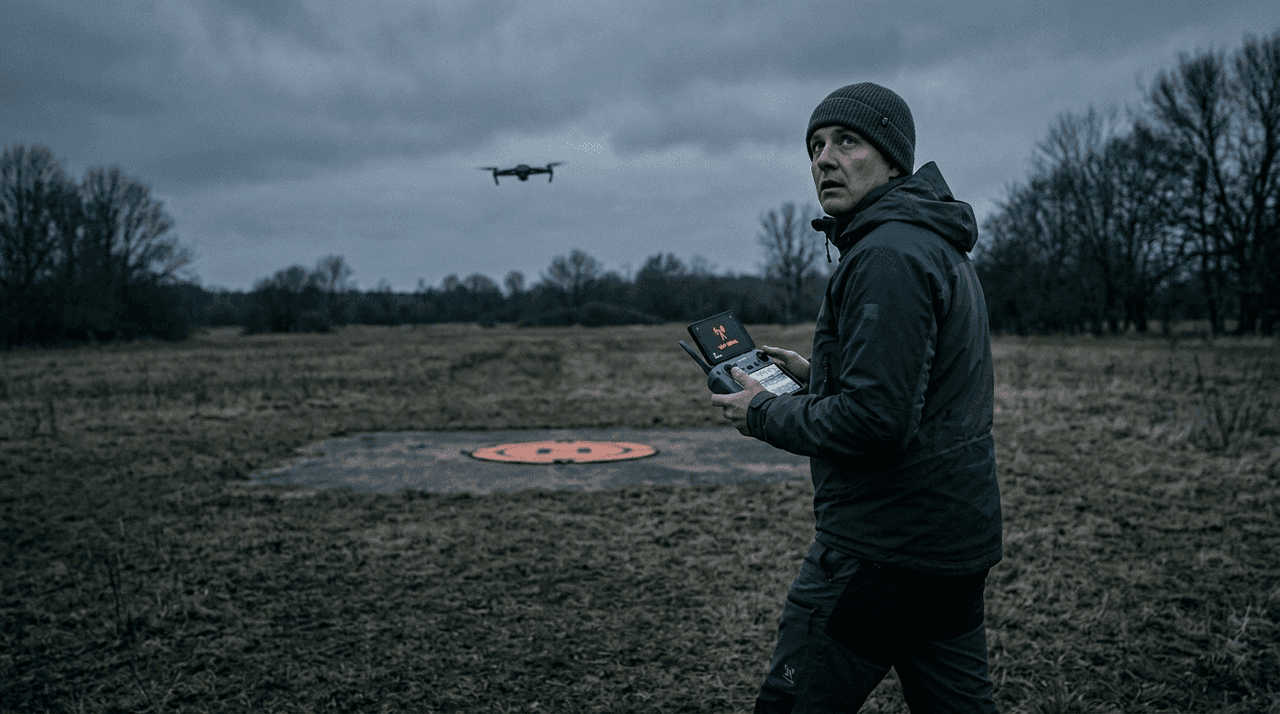
What “lost link” means in practice
The trouble can hit one part of the control chain or several at once:
- control link — the aircraft responds late or not at all;
- video link — the image freezes or breaks up while the aircraft may still be controllable;
- telemetry trust — values update incorrectly, too slowly, or implausibly.
Your job isn't to diagnose everything perfectly in the air. Your job is to decide one thing: is the aircraft still safely manageable?
Three-state emergency logic: degraded but manageable, unstable and worsening, lost confidence completely. Each state has a different action threshold.
The right priorities
Once the link starts to slip, the list of priorities gets short fast:
- fly the aircraft first;
- stop all non-essential camera or mission tasks;
- bring the aircraft closer and simpler;
- use the pre-identified landing area;
- land before the situation gets worse.
The usual mistake is waiting for proof that the failure is “real.” Wait that long and your options have usually gone downhill too.
When return-to-home helps — and when it does not
Return-to-home earns its keep when:
- the home point is correct;
- GNSS is trustworthy;
- the route back is obstacle-safe;
- the aircraft is still behaving normally.
Lean on it blindly, though, and it lets you down when location data is suspect, obstacles are nearby, or the aircraft is already flying erratically. Automation is only as good as the data feeding it.
Emergency landing is a professional action
Some pilots read an emergency landing as failure. It isn't. It's controlled risk reduction.
Scenario
You are filming near a treeline. The live image freezes twice, then returns. Telemetry still shows position and battery, but stick response feels slightly delayed. What is the correct reaction?
Treat it as degraded, and assume it may get worse.
So stop filming, pull the range in, give the trees a wide berth, point toward the safest landing area, and put it down promptly. Don't carry on with the shot just because the image came back. One channel recovering tells you nothing about the rest of the link.
Common mistakes
- Continuing the mission because the picture came back once.
- Trying to troubleshoot menus while the aircraft is still airborne.
- Trusting return-to-home automatically when GNSS or home-point quality is uncertain.
- Delaying the landing because the client wants “one more pass.”
Debrief
You now have a working emergency logic for weak or lost link: simplify early, trust only what's still reliable, and land while the options are still good.
Next: fold this into broader air safety discipline — most emergencies are handled best long before they turn dramatic.