Distance from uninvolved persons
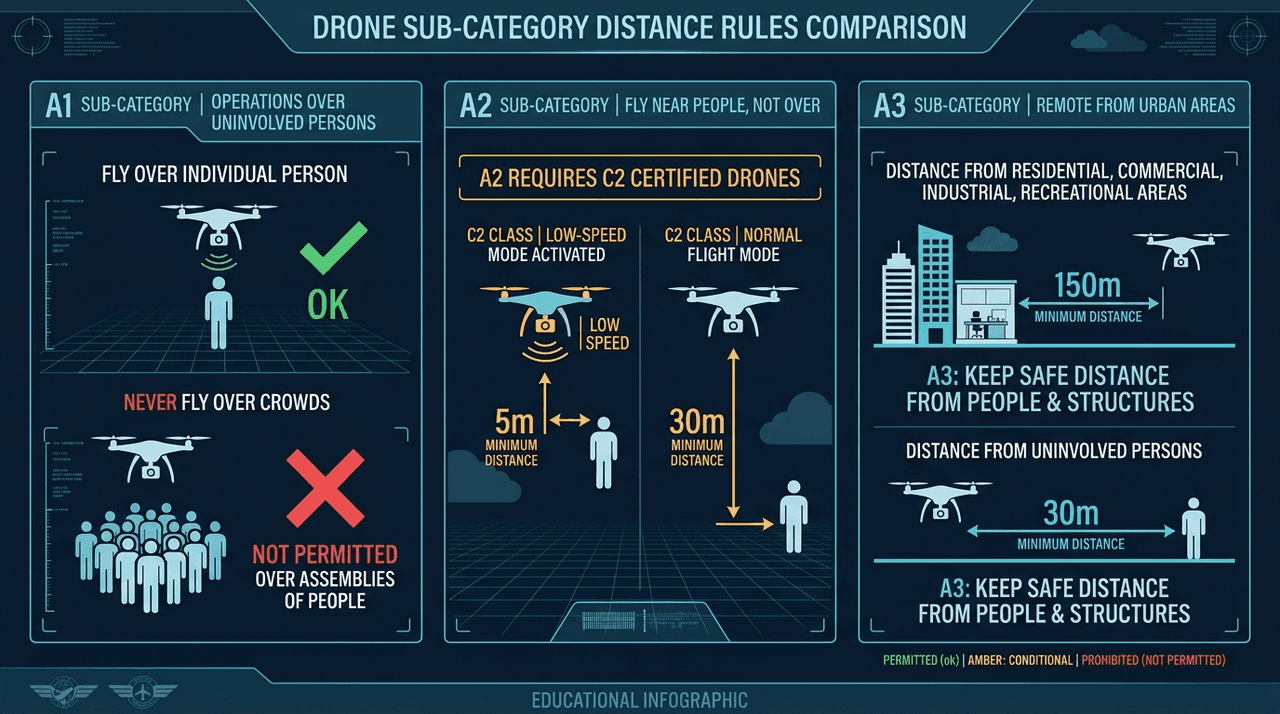
A1 — The closest you can get
A1 is built for light drones that do little harm if they fall. But no sub-category lifts the crowd rule.
| Class | Max weight | Distance to individuals | Assemblies |
|---|---|---|---|
| C0 | < 250 g | Over individuals — OK | Never |
| C1 | < 900 g | "Reasonably expected not to fly over" | Never |
"Reasonably expected" comes down to this: if there's a person ahead, you route around them. If someone walks into your path, you abort. C1 is no licence to hover over a sunbather.
A2 — When you need to get closer
A2 is there for professional work near people. It calls for a separate competence certificate (theory plus a practical declaration) on top of A1/A3.
| Mode | Minimum horizontal distance |
|---|---|
| C2 in low-speed mode (≤ 3 m/s) | 5 m |
| C2 normal speed | 30 m |
Low-speed mode is a mandatory hardware feature of C2 drones. Switch it on before you close to 5 m, never after.
A3 — Far from civilisation
A3 covers larger drones (up to 25 kg) working away from people, in places that are genuinely uninhabited.
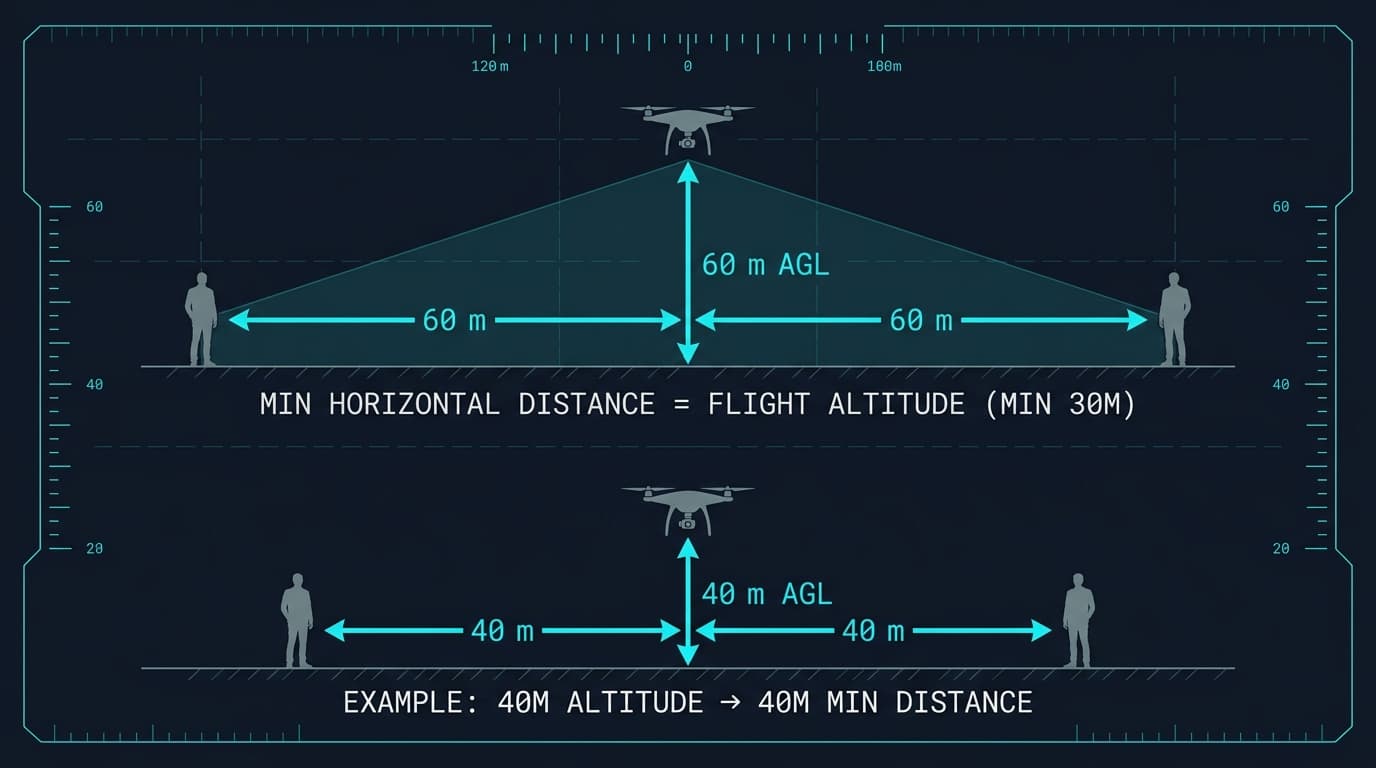
Diagram showing drone at 60m AGL with 60m horizontal distance on each side to uninvolved persons. Second example: 40m altitude gives 40m distance requirement.
Three limits run at once, and all three have to hold:
- 1:1 rule — horizontal distance to uninvolved persons ≥ flight altitude, minimum 30 m
- 150 m from any residential, commercial, industrial, or recreational area
- 2-second flight distance at max speed — at 15 m/s that's 30 m, a buffer to let you stop or divert before reaching people
At 80 m altitude, the 1:1 rule wants ≥ 80 m to people. Drop very low and the 30 m floor still holds.
Interactive · distance from uninvolved persons
- A1 — C0 (<250 g)—Overflight of individuals OK · never over assemblies
- A1 — C1 (<900 g)—Plan around people · no expected overflight
- A2 — C2 low-speed (≤ 3 m/s)≥ 5 mActivate low-speed mode BEFORE closing to 5 m
- A2 — C2 normal speed≥ 30 mFlat 30 m horizontal
- A3 — C2 / C3 / C4 / legacy≥ 60 m1:1 rule active · 60 m altitude → 60 m distance
Remember: the 1:1 rule in A3 means horizontal distance ≥ flight altitude, with a 30 m floor. The crowd prohibition applies in every sub-category regardless of altitude or distance.
The one rule that never changes
An "assembly of people" has no legal head count attached to it. Courts read it as any gathering where people can't easily step away from a drone overhead: a street market, a sports game, a concert, even a packed café terrace.
Scenario
A wedding photographer asks you to fly a C1 (780 g) over the ceremony for an overhead shot. Is this permitted?
No. A wedding ceremony is an assembly of people, and C1 in A1 is still bound by the "no overflight of assemblies" rule. The drone's weight doesn't buy you out of it.
The only legal overhead shot of a crowd would sit in the Specific category, behind an operating permit, which is a different regulatory path altogether.
Common mistakes
- Thinking C0 (< 250 g) allows flights over crowds — the assembly rule applies to all Open sub-categories.
- Confusing the 1:1 rule with a 1 m per kg formula — it has nothing to do with drone weight.
- Activating low-speed mode mid-approach to 5 m instead of before.
- Applying A1 rules while operating a C2 drone — your drone class determines which sub-category applies, not what you prefer.
- Thinking 150 m from residential areas means 150 m from every individual building — it means the area, not the fence line of a single house.
Debrief
You now hold the complete distance matrix for A1, A2, and A3, and you know why the crowd rule stands regardless of drone weight.
Next: the 1:1 rule deep-dive shows how to judge distances in the field without a tape measure, and what the 150 m residential zone really means for urban work.