Giving way to manned aircraft
Why the rule is strict
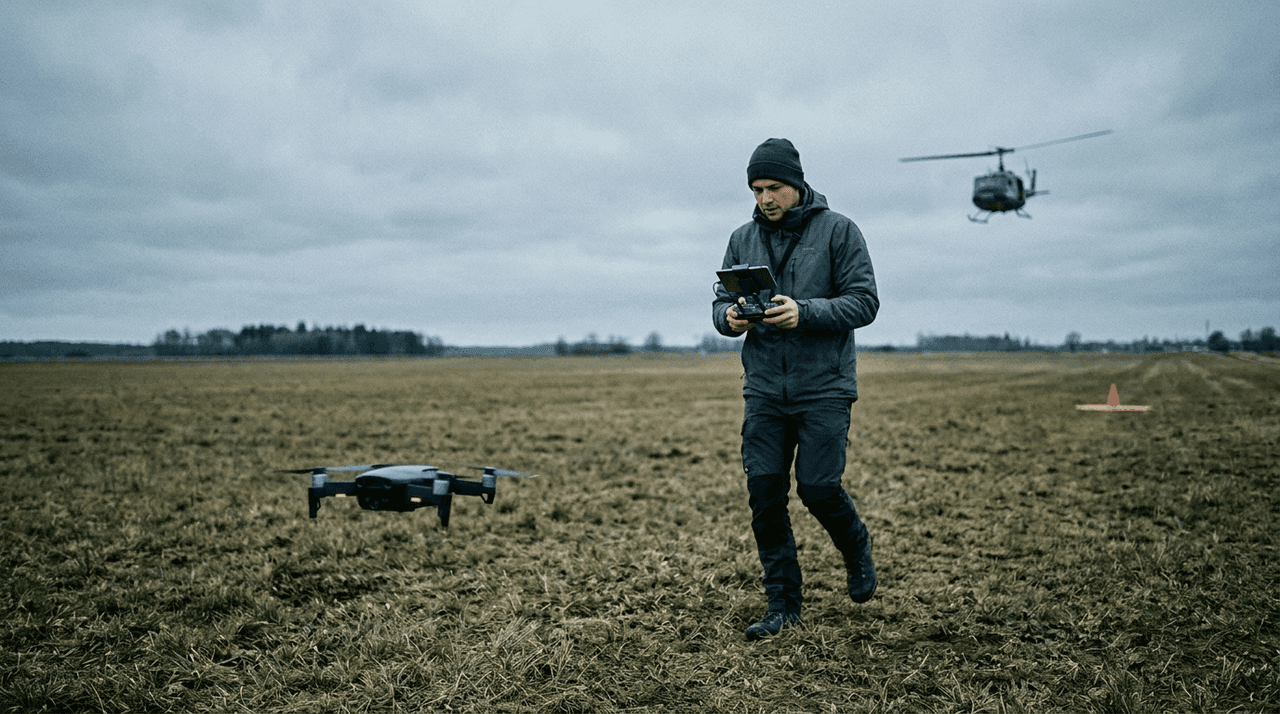
In the Open category, the remote pilot must avoid creating conflicts with other airspace users. In plain terms: a UAS gives way to manned aircraft.
This isn't symbolism. A helicopter or light aircraft:
- moves faster than your UAS
- may be task-loaded or flying low for a reason you can't see
- may not spot a small drone early enough to avoid it safely
A pilot who assumes “they'll see me” has pinned the entire safety case on the other aircraft's luck.
Detect
Spot the aircraft early: sound, movement, approach path, observer warning, or visual contact.
Separate
Reduce altitude, move away from the conflict path, and stop all non-essential camera or mission tasks.
Land
If there is any doubt about separation, land. The cost of an interrupted mission is trivial compared with a conflict in the air.
Three-step conflict response cards: detect, create separation, and land if needed.
What not to do
When a manned aircraft turns up, the wrong instincts are common:
- climbing higher “to be seen”
- flying closer to identify it
- finishing the shot first
- staring at the map instead of flying visually
Every one of those raises the risk. The priority here isn't curiosity or footage. It's cutting the number of variables in the air.
The practical decision
If you can hold obvious separation and continue safely, do so conservatively. If there's any doubt, land.
This is one of those moments where a decisive landing beats a continuation you could technically argue for.
Scenario
You are flying at 55 m AGL over open ground. You hear a helicopter before you can identify its direction. Your observer points left and says it is approaching low, but still far away. What is the correct response?
Stop the task right away, bring the drone lower, move it off the likely path if needed, and stand ready to land at once. If the approach path is uncertain, land without delay.
The point isn't to “win” the separation call. It's to defuse the conflict while the situation is still easy.
Common mistakes
- Treating empty terrain below as if it removes conflict risk with aircraft above.
- Climbing to “make the drone more visible.”
- Trying to finish the shot instead of ending the conflict.
- Waiting for perfect identification of the aircraft before acting.
Debrief
You now have a working rule for mixed-airspace conflicts: separate first, explain later.
Next: back to privacy on the ground, where a perfectly legal flight can still turn into illegal publication if people are identifiable in the footage.