Visual line of sight (VLOS)
What VLOS means
The pilot sees the aircraft unaided. Prescription glasses or contact lenses are fine. Binoculars and zoomed cameras are not. You have to be able to make out the aircraft's attitude and direction, not just confirm there's a dot in the sky.
How far that reaches in practice depends on the aircraft's size and the weather. A small drone might vanish at 200 m on a hazy day; a larger one might stay trackable at 500 m on a clear one. There is no fixed metre value for VLOS distance. The only test is "can the pilot still tell which way it's pointing?"
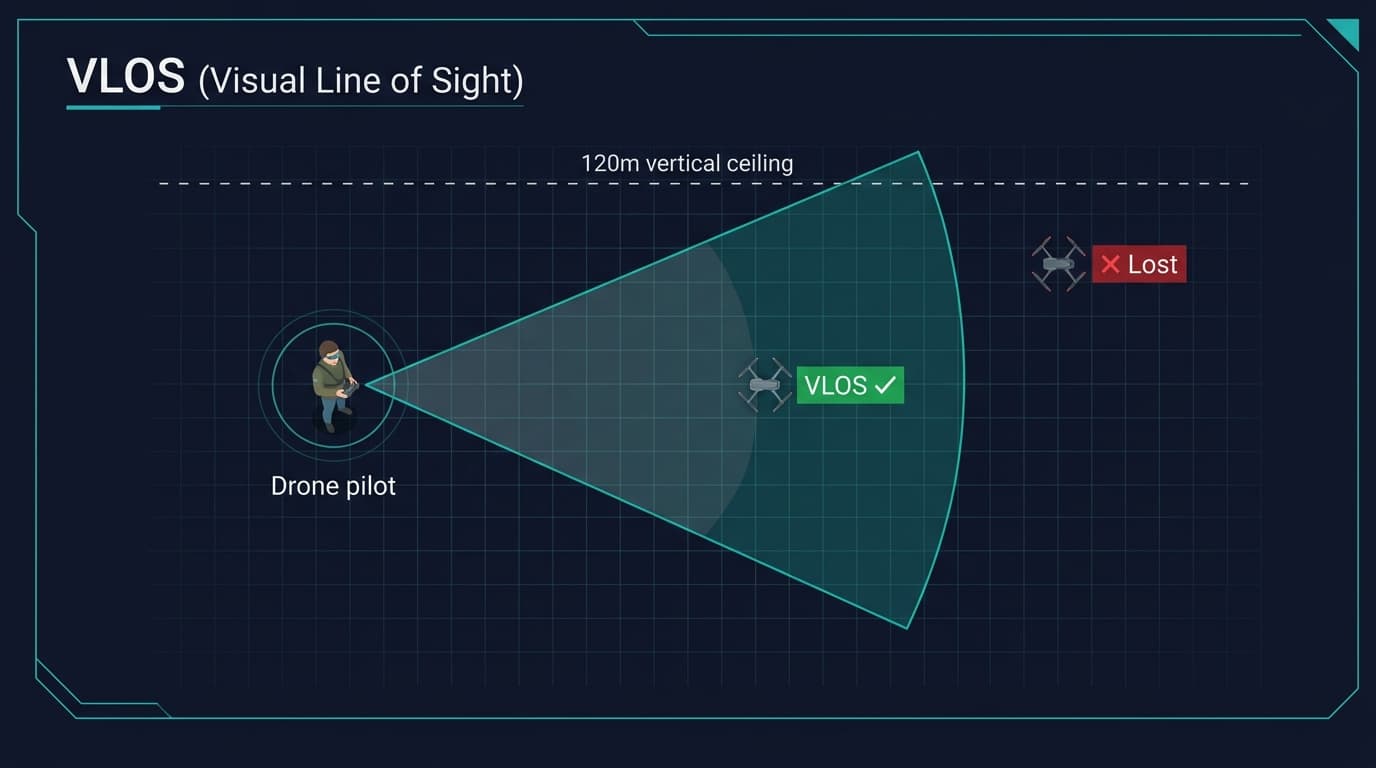
Diagram of a pilot at the origin with a cone of visual coverage extending forward. A drone inside the cone is labelled 'VLOS'. A second drone outside the cone is labelled 'lost — outside Open category'. A vertical 120 m ceiling is drawn across the cone.
First-person view (FPV) is not VLOS
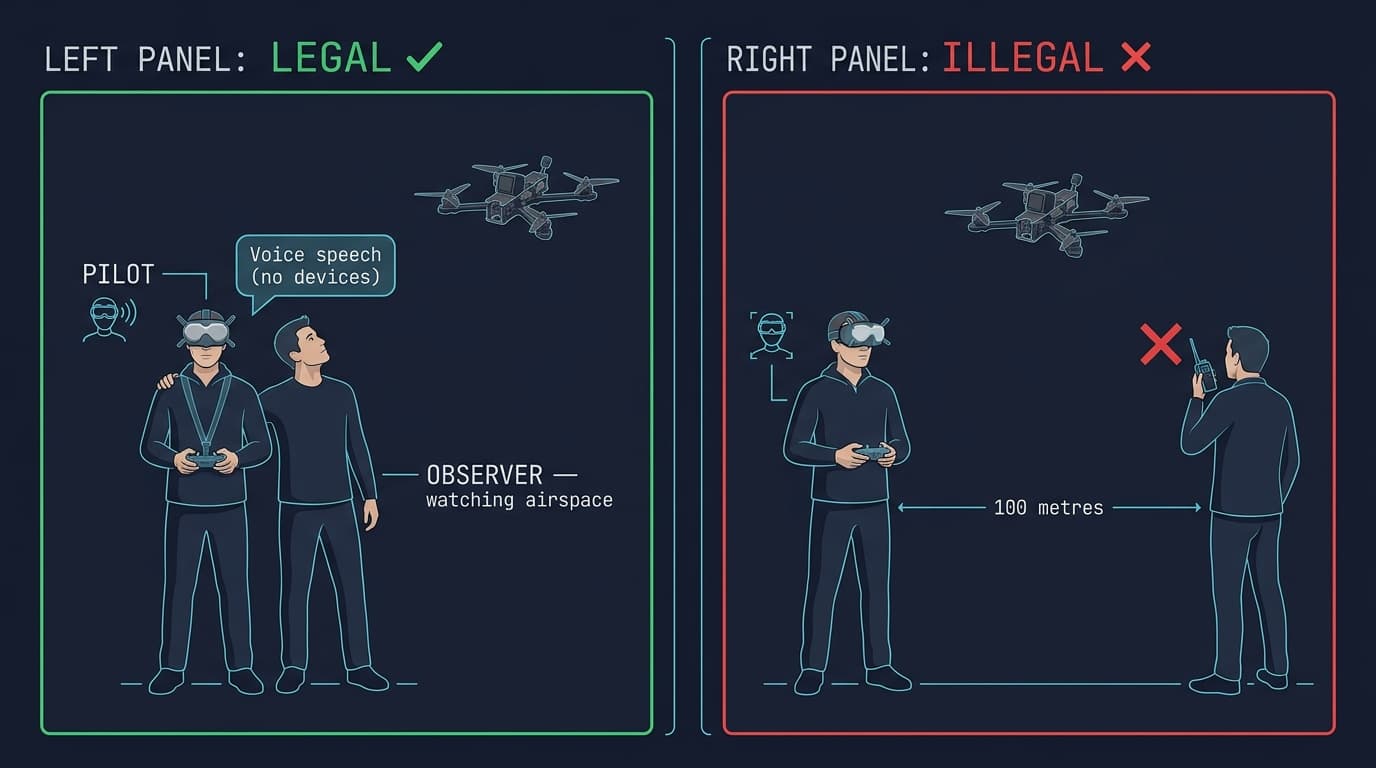
The moment the pilot looks at goggles or a phone screen instead of the aircraft, they're flying FPV, and that breaks VLOS. In the Open category FPV is permitted only if a separate UAS observer stands beside the pilot and keeps the airspace under direct watch.
The observer must be:
- physically next to the pilot (no radio, no phone link)
- watching the airspace, not the screen
Scenario
You're flying C1 with FPV goggles. Your friend wants to spot for you from 100 m away over a walkie-talkie.
That's not legal in the Open category. The observer-FPV rule needs direct, unmediated voice contact: the observer has to stand next to you. A radio link is not "next to." Either land, or have your friend walk over.
Common mistakes
- Treating "I can hear it" or "I can see it on the screen" as VLOS — neither counts.
- Using a radio between pilot and observer. Direct voice only.
- Trusting binoculars or zoom to recover VLOS on a drone that's too far. Once it's a dot, you're outside VLOS regardless of magnification.
Debrief