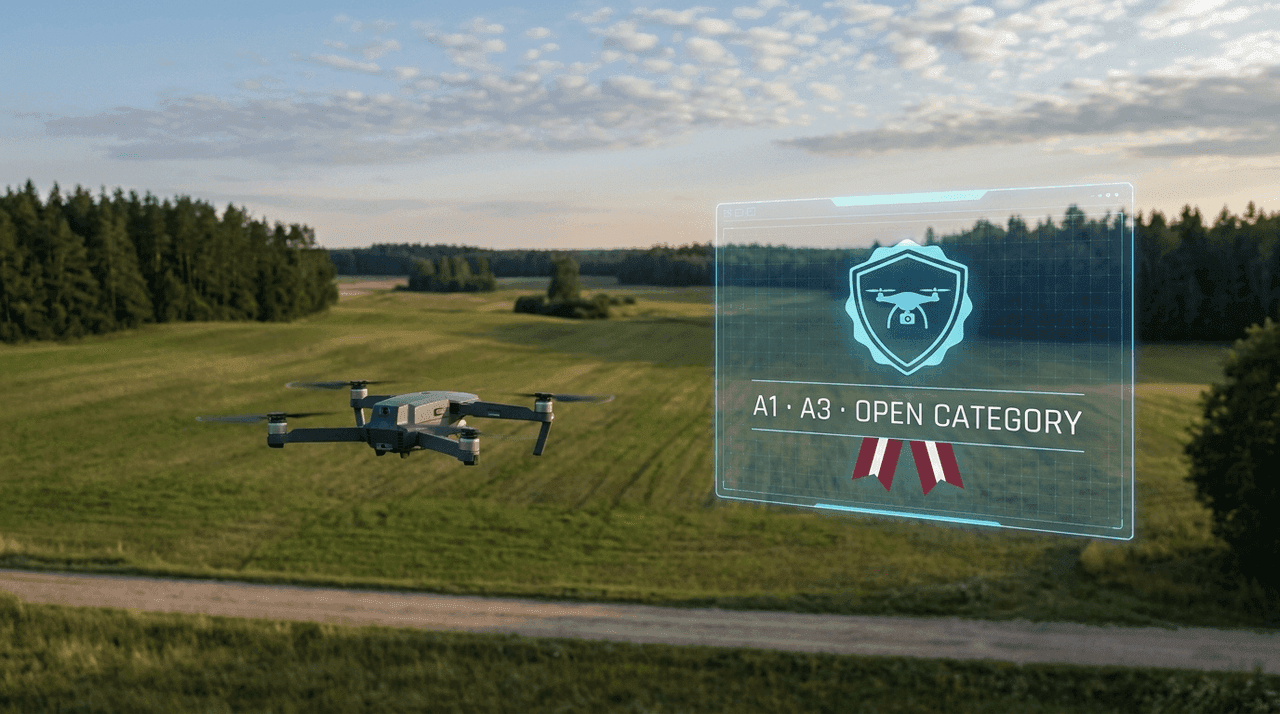
In Latvia, A1/A3 is not a catch-all “camera-drone licence”. It is the qualification the CAA wants you to have for certain Open-category flights.
When A1/A3 is actually required
The Latvian CAA page for the online course says you need A1/A3 training and the exam before you fly if the drone:
- has a C1, C2, C3 or C4 class mark, or
- weighs 250 g or more
That is the main legal line.
If you fly a drone under 250 g, the rule is narrower:
- a camera can still mean you must do operator registration
- but a camera alone does not make A1/A3 mandatory
So before you assume you need A1/A3, split it into three questions:
- Do I need operator registration?
- Do I need pilot qualification?
- Which subcategory will I fly in?
Registration is not the same thing as qualification
There is no single "drone licence" in Latvia, and that is why the same question gets ten different forum answers. Three separate things hide behind the word: operator registration, remote-pilot qualification, and — for the smallest drones — nothing at all.
You must register as an operator if the drone:
- weighs 250 g or more, or
- carries a camera or another sensor that can record people, or
- can transfer more than
80 Jin a collision, or - is flown in the Specific category
The exception is a genuine toy under the toy-safety directive. The trap most people miss runs the other way: a drone under 250 g with a camera still needs registration — the camera triggers it, not the weight — while that same camera does not make A1/A3 mandatory. Registration costs 5 EUR a year and is done once, whatever number of drones you own.
Three common cases
- No-camera drone under 250 g: nothing — no registration, no exam.
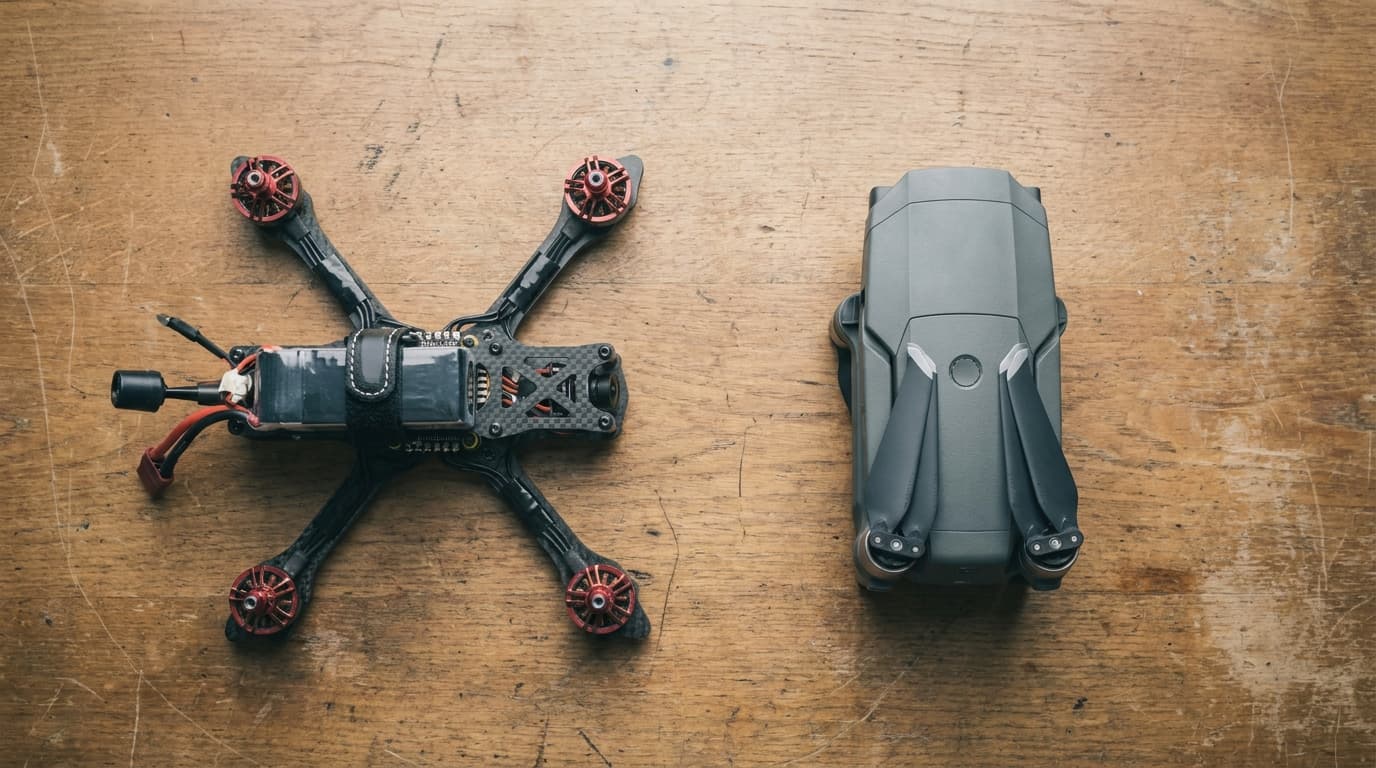
- Camera "mini" under 250 g, no class mark: register as an operator; no A1/A3 exam.
- 250 g or more, or a C1–C4 class mark: register and pass A1/A3.
Check your exact model. The class mark is applied by the manufacturer, and a CE mark is not the same as a C0–C4 mark.
Before you start
The CAA names one practical requirement for the Latvian A1/A3 course:
- a Latvian remote-pilot number in the portal
So the usual order is:
- register at
e.caa.gov.lv - get the operator and pilot registrations you need
- then start the A1/A3 course
What the course covers
The official online course is free and has no time limit. The published syllabus has nine topics:
- air safety
- airspace limitations
- aviation regulation
- human performance limitations
- operational procedures
- general UAS knowledge
- privacy and data protection
- insurance
- security
Exam format
The public CAA page says:
- 40 minutes
- 40 questions
- at least 75% correct to pass
Once you pass, the certificate shows up in the CAA UAS information system. It is valid for 5 years and recognised across the European Union.
What A1/A3 covers
A1/A3 covers the two Open-category subcategories named on the certificate:
- A1 — lighter aircraft and stricter rules around people who are not part of the flight
- A3 — flights far from bystanders and at least
150 mfrom residential, commercial, industrial, or recreational areas
If you plan to fly closer to people with a C2 drone, that is A2, not A1/A3 on its own.
A2 is a separate step
The Latvian CAA treats A2 as its own process:
- a valid A1/A3 certificate first
- then practical self-training
- then a separate A2 exam
So passing A1/A3 does not clear you to fly A2. If flying a C2 drone near people is your plan, read A1/A3 or A2: which certificate you need.
How to prepare without wasting time
Most people don't lose points on rare aviation details. They lose them on the Open-category basics they skim too fast.
Spend your time on:
- the difference between operator and remote pilot
- when registration is required
- VLOS and FPV limits
- the 120 m height limit
- the distance rules for A1, A2, A3
- Latvian geographical zones
If you can explain these rules in your own words, you're usually preparing the right way.
Your next step
A1/A3 is one stop on a longer path. If you're still deciding which certificate your drone actually needs, the category checker answers it in a few questions, and the full route from buying a drone to a prepared first flight is laid out in the step-by-step guide. When you're ready, the online course covers the full A1/A3 syllabus — then see exactly what the A1/A3 exam looks like.