Buying the drone is the easy part. In Latvia the legal path to flying it has a fixed order — and most beginners do the steps in the wrong one, then panic when they read a forum thread. Here is the whole route, from the box on your table to a first flight that won't earn you a fine.
Step 1 — Register as an operator
The Latvian CAA does not register the drone. It registers you. Operator registration is mandatory if your drone weighs 250 g or more, carries a camera or another sensor that records people, can transfer more than 80 J in a collision, or you fly in the Specific category.
- cost: 5 EUR, valid one year
- done once at
e.caa.gov.lv, whatever number of drones you own - you get a UAS operator number (
LVA…) that must be marked on every drone
There is a second, separate registration — the remote-pilot number (LVA-RP-…). It is free, and you need it before you can sit any exam.
Step 2 — Pass the free A1/A3 exam
If your drone has a C1–C4 class mark or weighs 250 g or more, you must pass the A1/A3 theory exam before you fly. The CAA's online course and the exam are free.
- 40 questions, 40 minutes, 75% to pass
- nine subjects, from air safety to privacy and insurance
- the certificate is valid 5 years and recognised across the EU
Step 3 — Learn where you can actually fly
A certificate is not permission to fly anywhere. In the Open category you stay within VLOS — the drone in your own line of sight — below 120 m, and inside the distance rules for your subcategory. On top of that sit geographical zones, around airports, over cities and near the border, that can restrict or forbid a flight entirely. Check them before you take off, not after.
Step 4 — Prepare your first flight
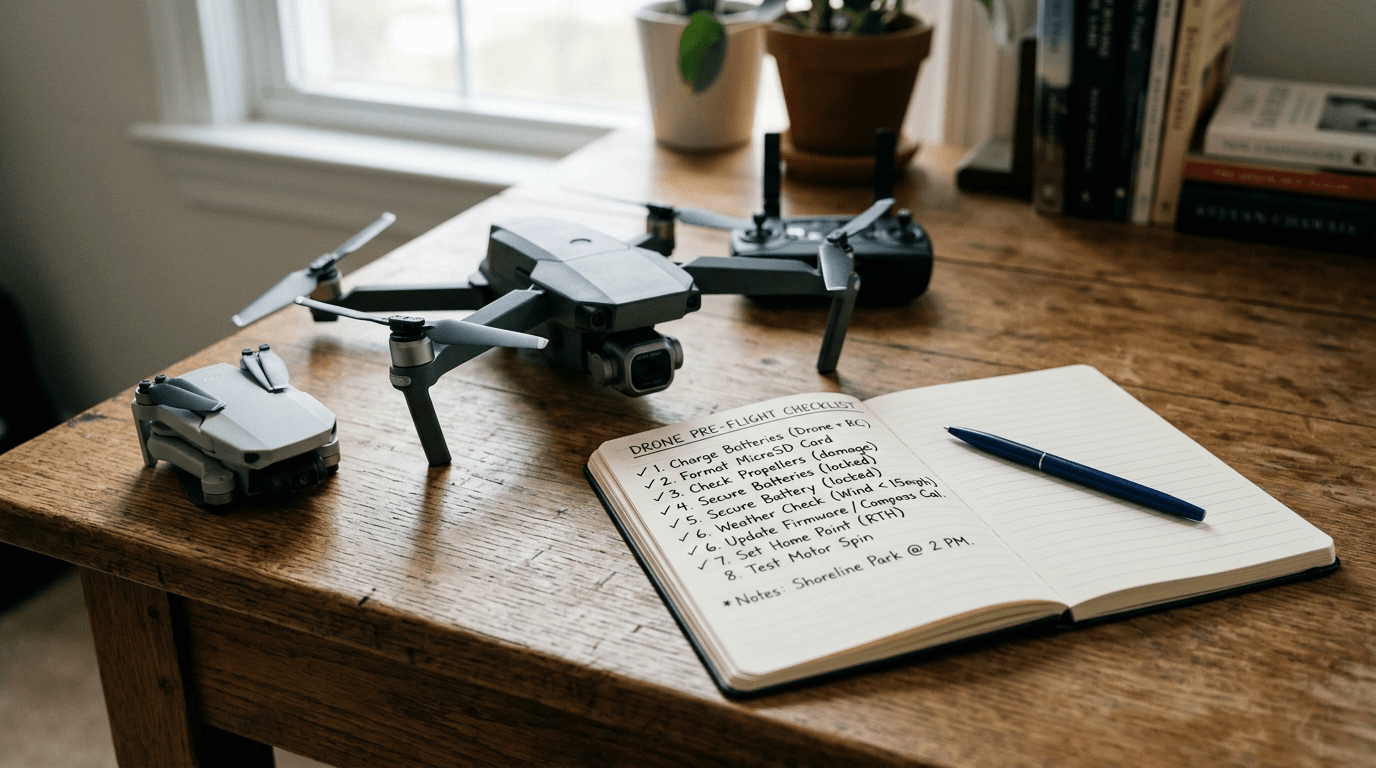
Do a short pre-flight: airspace checked, battery full, firmware current, home point set, weather within limits. Then fly the way the exam describes — not the way the marketing video does.
Do you even need all of this?
If your drone is under 250 g, has no camera or similar recording sensor, and you fly in the Open category, you can skip both registration and A1/A3. Add a camera and you are back to operator registration; cross 250 g and A1/A3 becomes mandatory too. Most popular "mini" drones carry a camera — so for most people the honest answer is: yes, do the steps.
Want the whole route on one page? The drone-to-first-flight guide sequences every step, and the category chooser tells you which qualification path is yours.
Want the theory without the guesswork? The dronelingo course walks all nine A1/A3 subjects and the exam format, and you can practise exam-style questions until 75% is boring.