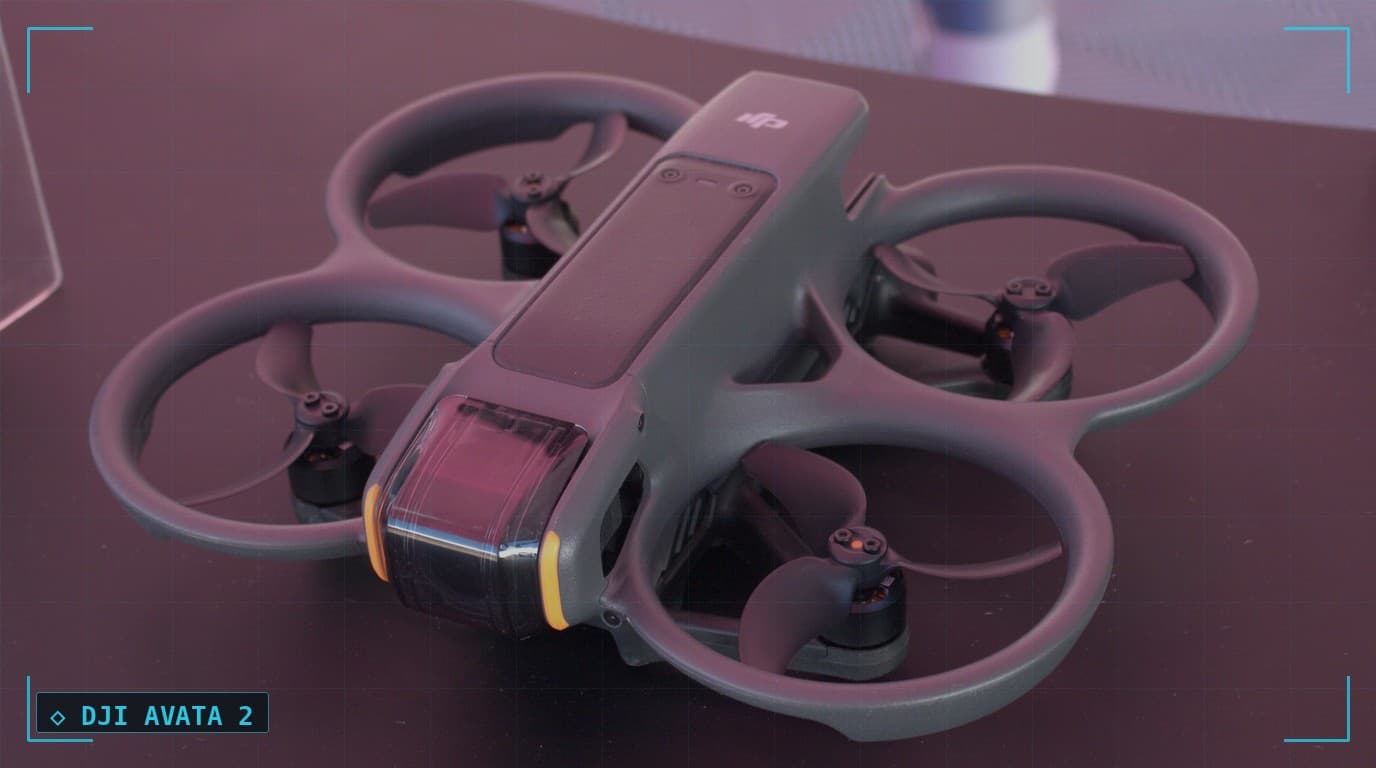
The Avata 2 answers a different question from the rest of DJI's line-up: not "how much camera under 250 grams?", but "how do you put someone inside the flight?" It is a cinewhoop — an FPV drone flown through goggles, with integrated propeller guards that let it skim close to walls, indoors and low to the ground, capturing footage no camera drone can frame.
The weight matters here for the opposite reason. At approximately 377 g the Avata 2 sits well above 250 g and carries a C1 (EU) class mark. That combination is decisive: a C1 drone requires the A1/A3 certificate before you fly, and the camera makes UAS operator registration mandatory in Latvia regardless. There is no sub-250 g shortcut with this one — the exam and registration are simply part of buying it.
Who is it for? FPV beginners who want the immersion without building or repairing a quad, and content creators after dynamic close-proximity shots. Flying needs the DJI Goggles 3, so the pilot sees a live feed rather than watching the drone from the ground — a genuinely different skill. Easy ACRO turns flips, rolls and drifts into one-button moves, and the electronic stabilisation produces smooth footage without a gimbal.
The honest caveats: the battery lasts only about 23 minutes, so most owners buy the three-battery combo; the goggles bundle is not cheap; and the fixed 155° ultra-wide lens gives a distinct look, not the flexibility of a normal camera drone. This is a separate FPV tool, not a Mavic replacement — and the licence reality is real: a 300 g-plus FPV drone means A1/A3 and registration, not a toy.
What owners report
Independent reviews and owners agree the appeal is the experience: the goggles, the immersive first-person view, and stabilisation that turns visibly rocking flight into silky footage. The integrated prop guards draw praise for safe indoor and close-proximity flying, and Easy ACRO makes tricks approachable for people who would never hand-fly manual acro. The larger 1/1.3-inch sensor and O4 transmission are noted as clear upgrades over the first Avata. The consistent gripes are just as honest — the ~23-minute battery pushes most buyers to the three-battery kit, the goggles bundle is expensive, and the ultra-wide fixed lens is an acquired taste rather than a do-everything camera. And more than one owner points out what the spec sheet does too: at 377 g this is not a sub-250 g drone, so registration and the certificate come with it.