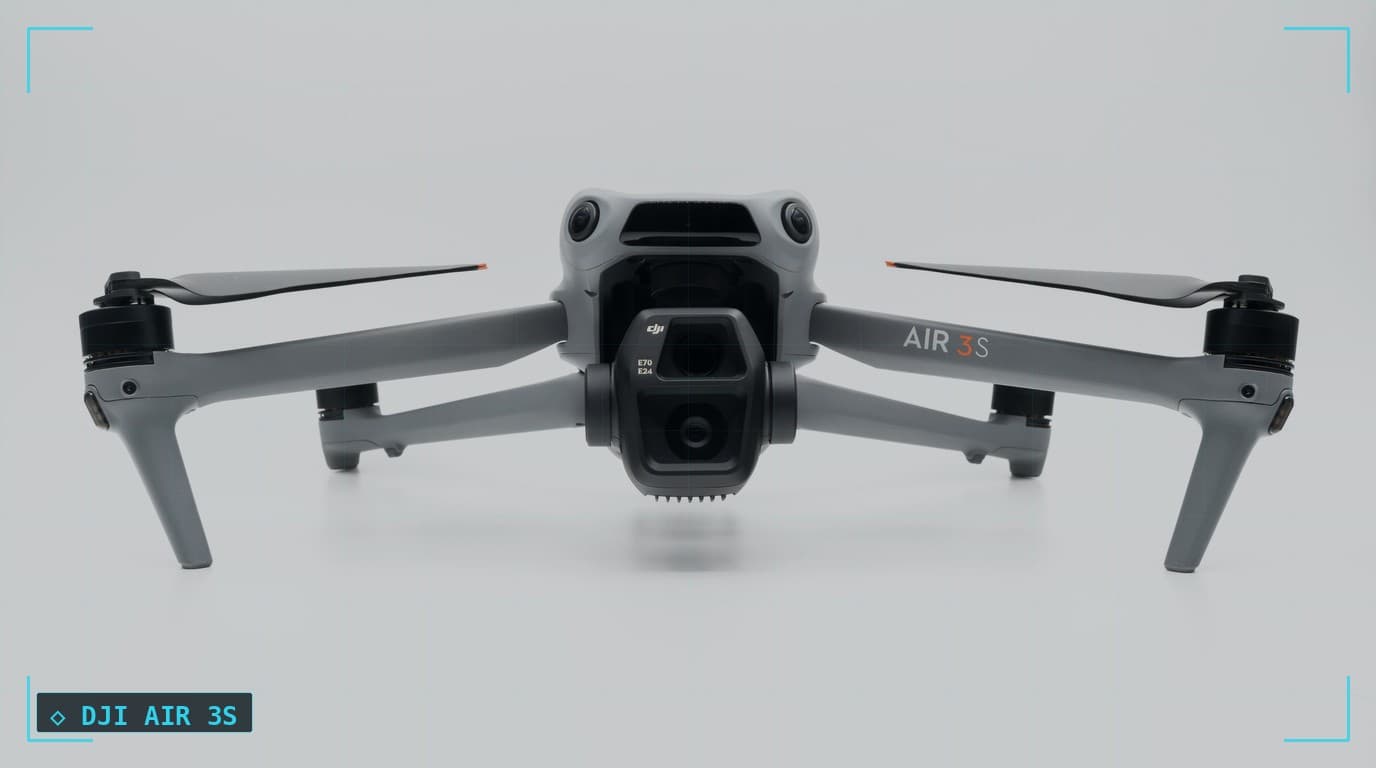
The DJI Air 3S weighs 724 g and carries a C1 class mark — you cannot fly it without the A1/A3 certificate, and operator registration is required. Specs and an honest verdict.
Photo & videoTravelCinematic
◇ Certificate and registration
Certificate: A1/A3 certificate required
A C1 drone (under 900 g) flies in A1 — plan your flight to avoid flying directly over uninvolved people.
Registration
Operator registration at e.caa.gov.lv is required — this drone carries a camera and is not a toy.
Subcategory A1 — you may fly over uninvolved people (but never over crowds or assemblies) and in built-up areas, keeping the drone in sight at all times.
+Dual camera: 1-inch wide sensor plus a 3x telephoto for real compositional range
+Clean low-light footage and strong dynamic range straight out of the drone
+O4 transmission holds a stable signal; fewer dropouts than older models
+LiDAR plus omnidirectional obstacle avoidance forgive pilot mistakes
+42 GB internal storage and long real-world flight time
◇ Limitations
−Fixed f/2.8 aperture — ND filters are mandatory in bright light
−Video caps at 4K; no 5.1K or 6K option
−No FPV goggle support
−Slow battery charging (about 80–90 minutes) and real flight time below the 45-min rating
−At 724 g it is firmly C1 — the A1/A3 exam and registration are unavoidable
◇ Best for
Enthusiasts who have outgrown a Mini and fly often
Travel and landscape creators who need telephoto reach and wind resistance
Pilots who want near-flagship image quality without Mavic size or price
◇ Skip it if
Beginners who just want holiday clips — a sub-250 g C0 drone skips the exam
FPV pilots who want goggle flying
Anyone needing 5.1K/6K video or an adjustable aperture
◇ Our verdict
Independent reviewers rate the Air 3S as one of DJI's most practical drones: a 1-inch main sensor plus a 3x telephoto give it real creative range, low-light footage is clean, and O4 transmission with LiDAR-assisted obstacle avoidance make it forgiving to fly. The trade-offs are honest — a fixed f/2.8 aperture (ND filters are mandatory), video capped at 4K, no FPV goggle support and slow battery charging. At 724 g it is a committed C1 purchase: the A1/A3 certificate and operator registration are prerequisites, not extras.
The Air 3S is the model DJI aims at people who have outgrown a Mini but do not need — or cannot justify — a Mavic. At 724 g it makes no attempt to duck under the 250 g line, and that is a deliberate trade: more weight buys a dual-camera setup (a 1-inch main sensor plus a 1/1.3-inch telephoto), better wind resistance and longer, steadier flights.
The regulatory consequence is simple and non-negotiable: this is a C1-class drone, so you must hold the A1/A3 certificate before the first flight, and the camera makes operator registration mandatory in Latvia. The upside of C1 is that you keep flying in subcategory A1 — the same near-people freedom a Mini enjoys, with the one difference that you must plan flights so you do not pass directly over uninvolved people.
Who is it for? Enthusiasts who fly often enough that the Mini's weight-driven compromises start to chafe: the Air 3S handles coastal wind and cold better, the telephoto adds real compositional range, and battery life is genuinely long. For occasional holiday clips it is overkill — a C0 drone does that job without the exam.
The honest caveats: it is heavy enough that a crash matters, it will not follow you into A2 territory (that door belongs to C2 drones with the A2 certificate), and the exam is a hard prerequisite, not a recommendation. Budget an evening or two of study before the drone leaves the box.
What owners report
Long-term owners consistently praise the low-light footage, the reach of the 3x telephoto and how stable the O4 signal stays in built-up areas; the LiDAR obstacle avoidance gets singled out as a genuine safety net. The recurring complaints are the fixed aperture that forces ND filters, real flight times closer to 30–35 minutes than the advertised 45, and slow battery charging. Some owners also note the propellers pick up nicks over time and wish for the goggle support the Air 3S does not offer.
Yes. The Air 3S is a C1-class drone (724 g), so you must pass the A1/A3 exam before flying it. Because it has a camera, UAS operator registration at e.caa.gov.lv (5 EUR per year) is also required.
+−Which subcategory does the DJI Air 3S fly in?
A C1 drone flies in subcategory A1 — plan your flight so you do not fly directly over uninvolved people.
+−How much does the DJI Air 3S weigh?
Takeoff weight is 724 g per DJI's official specs — well above 250 g, so flying without the certificate is not an option.
+−Can I take the A1/A3 exam online?
Yes, in Latvia the A1/A3 theory course and exam run online in the CAA system — 40 questions in 40 minutes, pass mark 75%.
Preparing for the A1/A3 exam?
dronelingo covers the full CAA Latvia syllabus: 10 topics, practice questions and unlimited mock exams in four languages.