Does EASA regulation cover FPV drones? Yes — completely, and without a single carve-out. Regulation (EU) 2019/947 does not know the word "FPV." It knows unmanned aircraft, subcategories, and pilot obligations, and an FPV quad is an unmanned aircraft like any other. Goggles change how you fly, not which rules apply to you.
That single fact is worth stating plainly, because the hobby's own marketing sometimes implies the opposite — that FPV is a loophole, a niche the regulators forgot about, a way to fly under the radar. It is not. Every open-category obligation that applies to a camera drone applies to an FPV quad: registration, the pilot exam, the weight and distance limits, and the visual-line-of-sight requirement that goggles seem to break on their face. If you want the fuller picture of what FPV actually is before getting into the legal detail, what is FPV? covers the disciplines and the hardware. This article works through what the rules mean in practice, and where they point you before your first flight.
Registration: triggered by weight or the camera, not by the discipline
FPV does not get its own registration track. The trigger is the same as for any drone: the UAS operator — the person responsible for the aircraft, usually the pilot — must register if the drone weighs 250 g or more, or if it carries a sensor capable of capturing personal data, which in plain terms means a camera, unless the aircraft is a toy.
An FPV quad has a camera by definition — that is the entire point of the aircraft. So in practice, almost every FPV pilot in Latvia needs to register as an operator, regardless of how light the build is. It costs 5 EUR a year, takes a few minutes at e.caa.gov.lv, and the resulting operator number goes on every aircraft you fly, including self-built ones with no serial plate.
The exam: same threshold as any other open-category drone
If the drone's mass is 250 g or more, or it carries a C1–C4 class mark, the pilot must complete the CAA online course and pass the A1/A3 exam before flying: 40 questions, 40 minutes, at least 75% to pass. The course and exam are free, and the resulting certificate is valid five years across the EU.
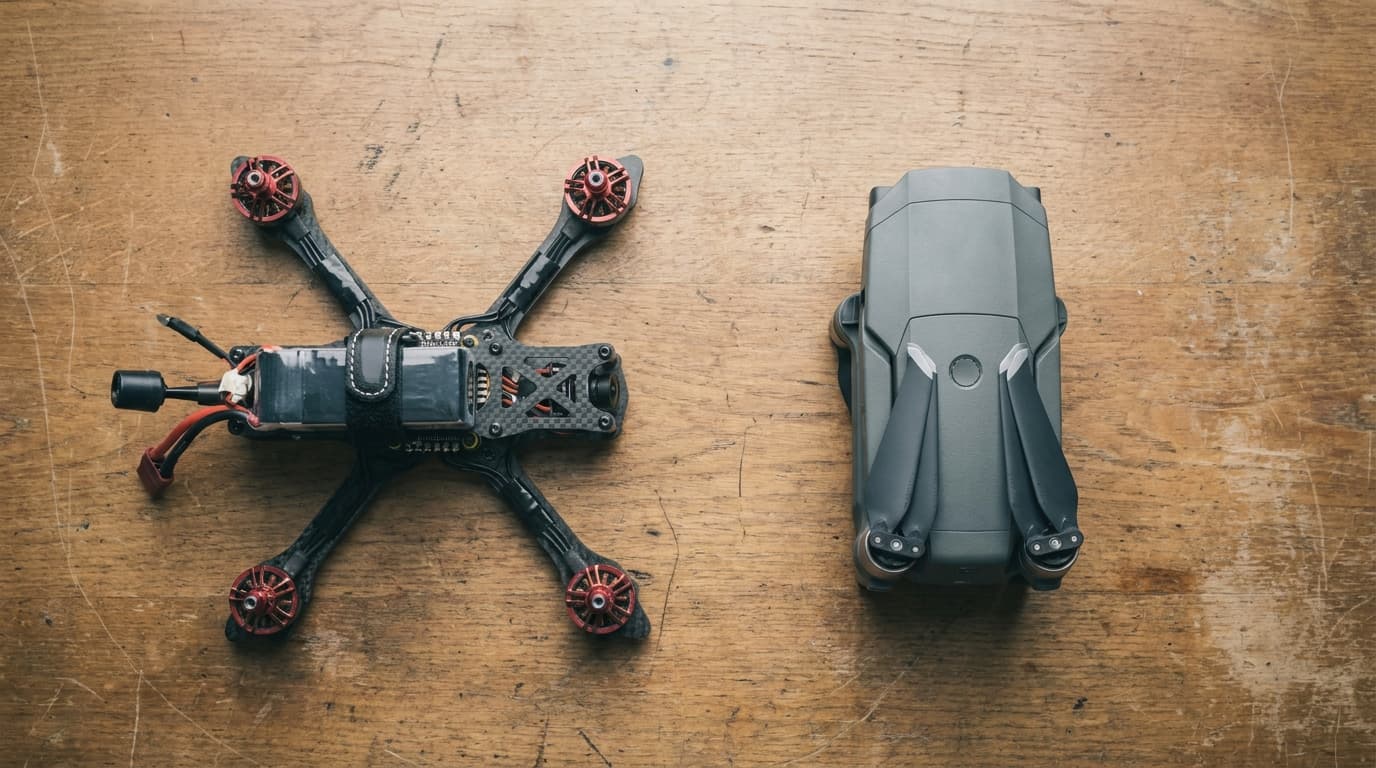
A typical 5-inch freestyle quad with a battery attached sits well above 250 g. That means the standard build most FPV pilots fly crosses the exam threshold automatically — there is no separate "FPV license," just the same A1/A3 certificate that covers a DJI Mini or a fixed-wing survey drone. Sub-250 g whoops and micro builds have more leeway, but the certificate requirement returns the moment class marking or mass pushes the aircraft over the line. The full category logic — what A1, A2, and A3 actually cover — is set out in the EU Open category, A1/A2/A3 explained.
VLOS and the observer: how FPV stays legal with the goggles on
Here is the part that looks like a contradiction until you read the regulation closely. The open category requires the pilot to keep the aircraft in visual line of sight — continuous, unaided eye contact with the drone and a scan of the surrounding airspace. Goggles, by construction, remove exactly that. So how is FPV legal at all?
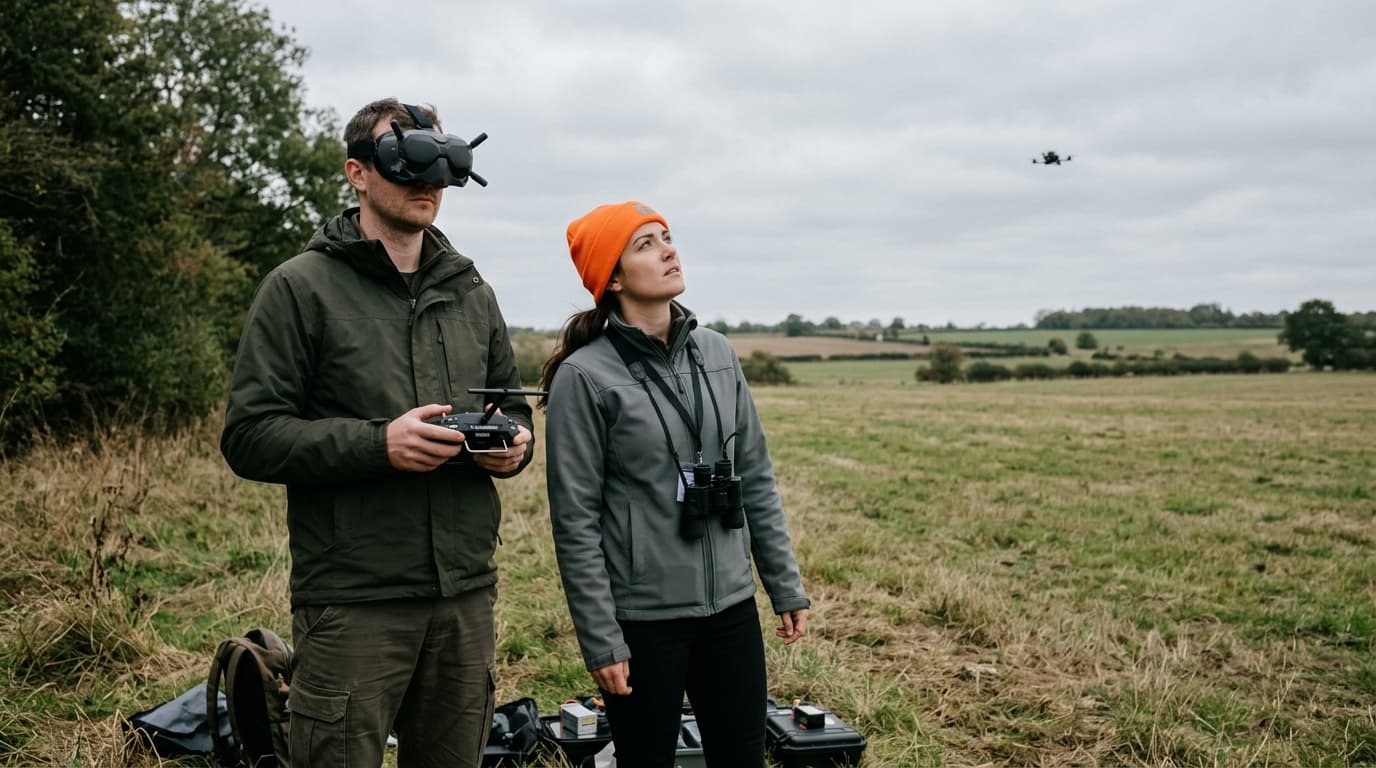
Regulation (EU) 2019/947 answers this with one narrow mechanism, not an exemption. Article 4(1)(d) together with point UAS.OPEN.060(4) allows the pilot to fly through goggles or a screen as long as they are "assisted by an unmanned aircraft observer, situated alongside them, who, by unaided visual observation of the unmanned aircraft, assists the remote pilot." The observer is doing your legally required job of watching the aircraft and the sky around it — you are simply borrowing their eyes for the duration of the flight.
CAA Latvia is specific about what "alongside" means: the observer stands next to the pilot, close enough to speak directly, with no technical means of communication in between — no phone, no radio relay. The reasoning is practical: an instruction that matters — traffic, land now — has to reach the pilot in the second it happens, not after a call connects. A friend watching from across the field, or a spotter texting warnings, does not satisfy the rule. Solo FPV with nobody standing beside you is not a grey area; it sits outside the regulation, full stop.
This is genuinely one of the more misunderstood corners of the open category, and it deserves its own read: VLOS and the FPV observer rule walks through the legal definition, the two narrow exceptions the regulation allows, and why examiners test this specific point more than candidates expect.
Practical limits that still bind with the goggles on
None of the standard open-category ceilings disappear because you are flying FPV. Maximum altitude of 120 m above ground, maximum 25 kg takeoff mass, the distance rules from uninvolved people, and geographical-zone restrictions all apply exactly as they would to a camera drone. A freestyle line flown under 120 m through an empty industrial yard is fine; the same line over a beach with people on it is not — an observer beside you does not change the no-overflight rule.
Weight also decides the subcategory for a self-built quad, which has no C-class mark because those marks are applied by manufacturers, not builders. A privately built aircraft under 250 g (with a maximum speed under 19 m/s) falls into subcategory A1, flown close to people but never over an assembly of them. A privately built or unmarked aircraft under 25 kg falls into A3 only — at least 150 m from residential, commercial, industrial, or recreational areas. A typical freestyle 5-inch build lands in A3 territory, which is why long-range and freestyle pilots end up flying industrial zones, quarries, and open countryside rather than parks.
Two situations sit at the edge of the standard rules. Organised racing inside a recognised model-aircraft club or association can operate under Article 16 of the regulation, with the club's own framework, instead of the open-category conditions above — but casual racing with friends in a field does not qualify for that; it is ordinary open-category flying, observer and all. Long-range flying beyond what an observer can track unaided is beyond visual line of sight by definition, and BVLOS operations do not belong in the open category at all — that is specific-category territory, requiring a separate authorisation. A flight over the horizon on open-category terms is not legal, regardless of how the footage looks.
What matters now
FPV is not a legal exception; it is a different way of flying an aircraft that the same rules already cover. Before the first outdoor flight: register as a UAS operator if you have not already, line up an observer who will stand beside you with no phone in hand, and check the subcategory your build actually falls into by weight and marking.
The exam is the one step pilots underestimate. It is free, it is online, and the material overlaps almost entirely with what an FPV pilot needs to know regardless of the certificate — airspace, distances, geographical zones, and the observer rule itself. Get the A1/A3 certificate done before the first flight, not after a warning from an inspector: the dronelingo course covers the full syllabus with practice questions built around exactly these scenarios, so the CAA exam is not the first time you see them.