"FPV or DJI?" is the question nearly every new pilot asks before buying anything, and it is the wrong question to ask first — because the two are built for different jobs, and picking one over the other changes how you learn to fly, what you spend after the purchase, and how the rules apply to you the moment you take off.
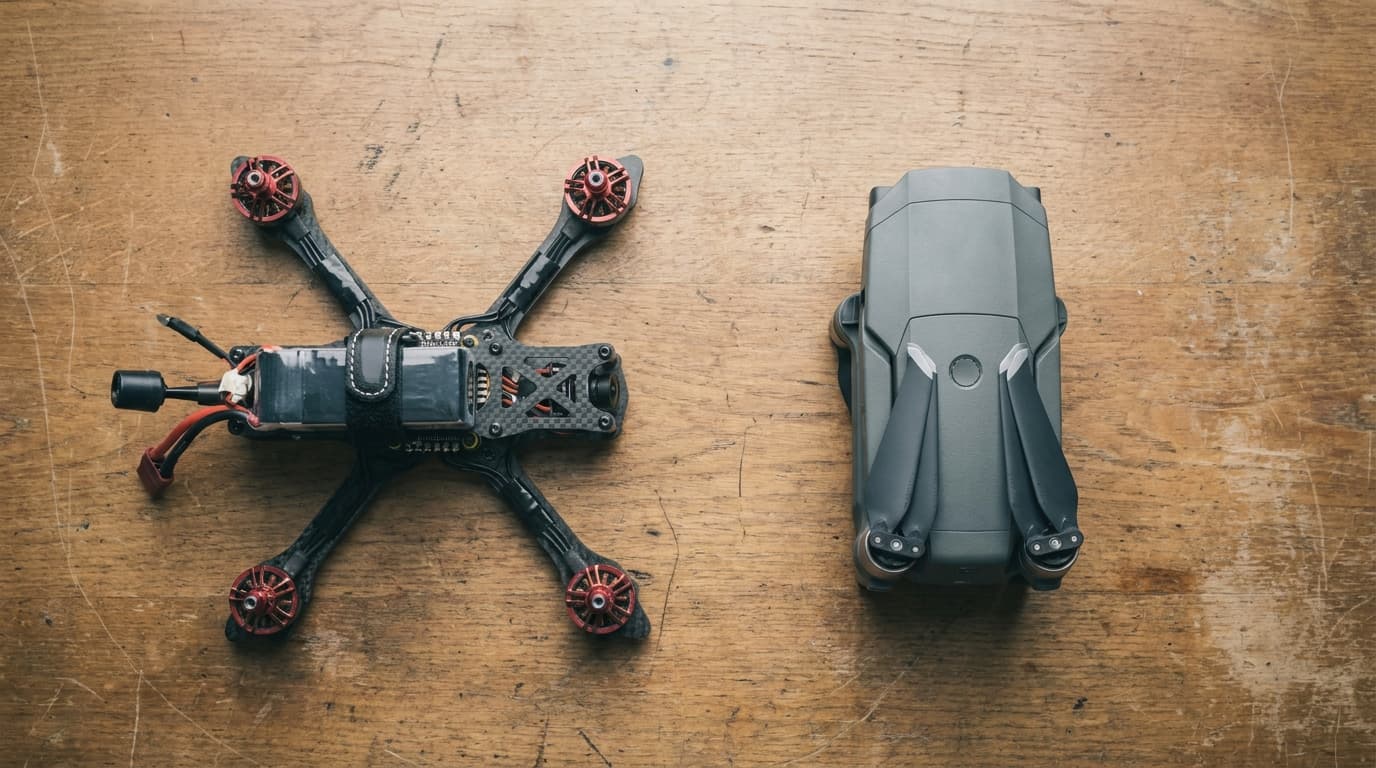
"DJI" here stands in for the whole family of GPS camera drones — stabilised, sensor-assisted, designed to be flown by anyone within a few minutes. FPV stands for the opposite philosophy: a manually flown quad, controlled through goggles, built around skill rather than automation. Neither is objectively better. They solve different problems.
What a GPS camera drone is for
A GPS camera drone holds position on its own. Release the sticks and it hovers — GPS lock, altitude hold, obstacle sensors, automatic return-to-home. The pilot mostly composes shots and manages a flight plan rather than fighting physics. That is exactly the point: the aircraft is designed so a beginner can produce a usable aerial photo or a smooth establishing shot on day one, with minimal training and minimal risk of a crash caused by pilot error.
This makes GPS drones the right tool for real estate photography, landscape and travel footage, site surveys, inspection work, and any job where the shot matters more than the flying. The camera, gimbal stabilisation and automated flight modes are the product; the piloting is almost incidental.
What an FPV drone is for
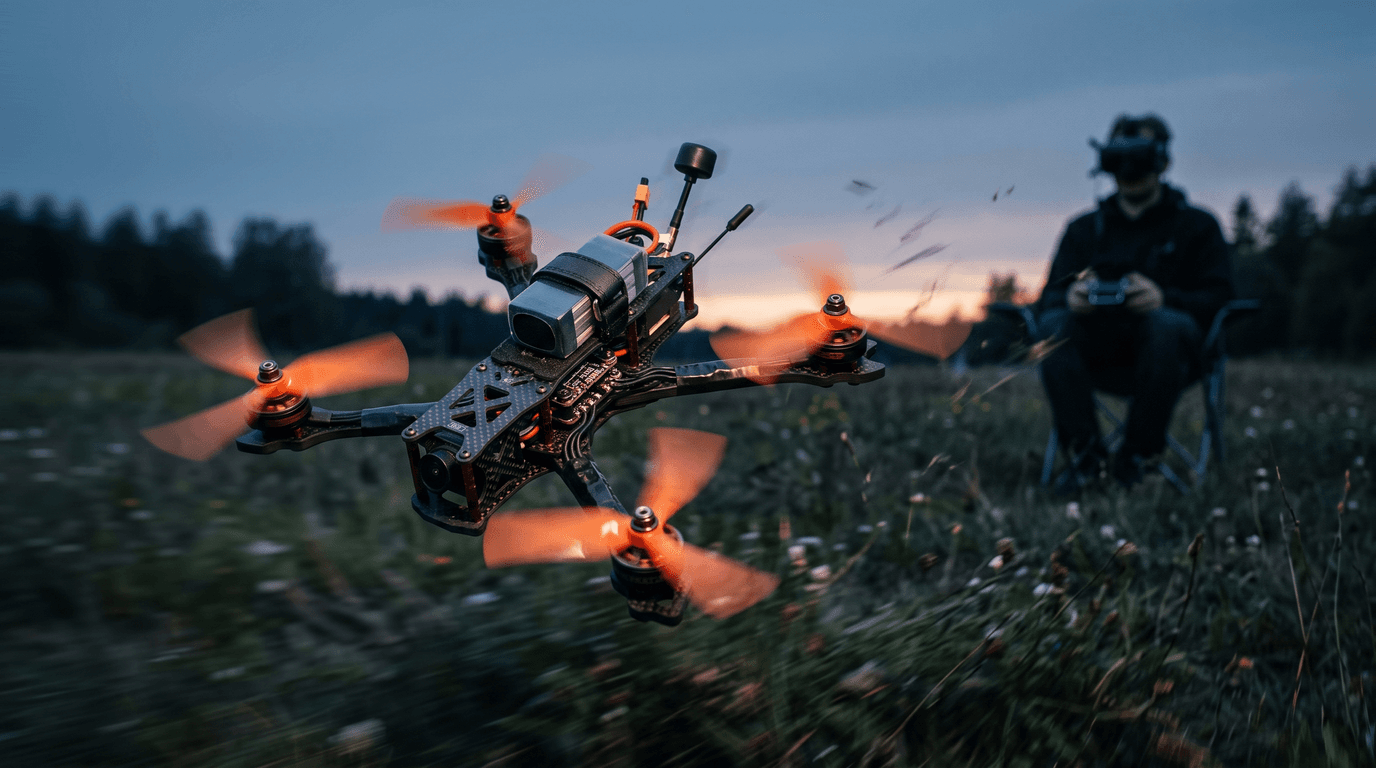
An FPV quad does the opposite on purpose. Most fly in acro (rate) mode: the sticks command rotation rates, nothing self-levels, and letting go of the sticks does not stop the drone — it keeps doing whatever it was doing, including falling. There is no obstacle avoidance, usually no GPS hold, and often no return-to-home. The pilot is the stabilisation system.
In exchange, FPV offers manoeuvres a GPS drone cannot do: tight gaps, low fast lines through trees or ruins, flips and dives flown at any angle, an immersive point of view instead of a third-person shot. It is the aircraft behind most viral freestyle and racing footage, and behind cinewhoop work that flies close to people and objects for film production. The full breakdown of disciplines and hardware — acro mode, analog vs digital video, bind-and-fly vs self-built — is in what FPV actually is.
Skill curve, cost, and maintenance — the honest comparison
| GPS camera drone | FPV drone | |
|---|---|---|
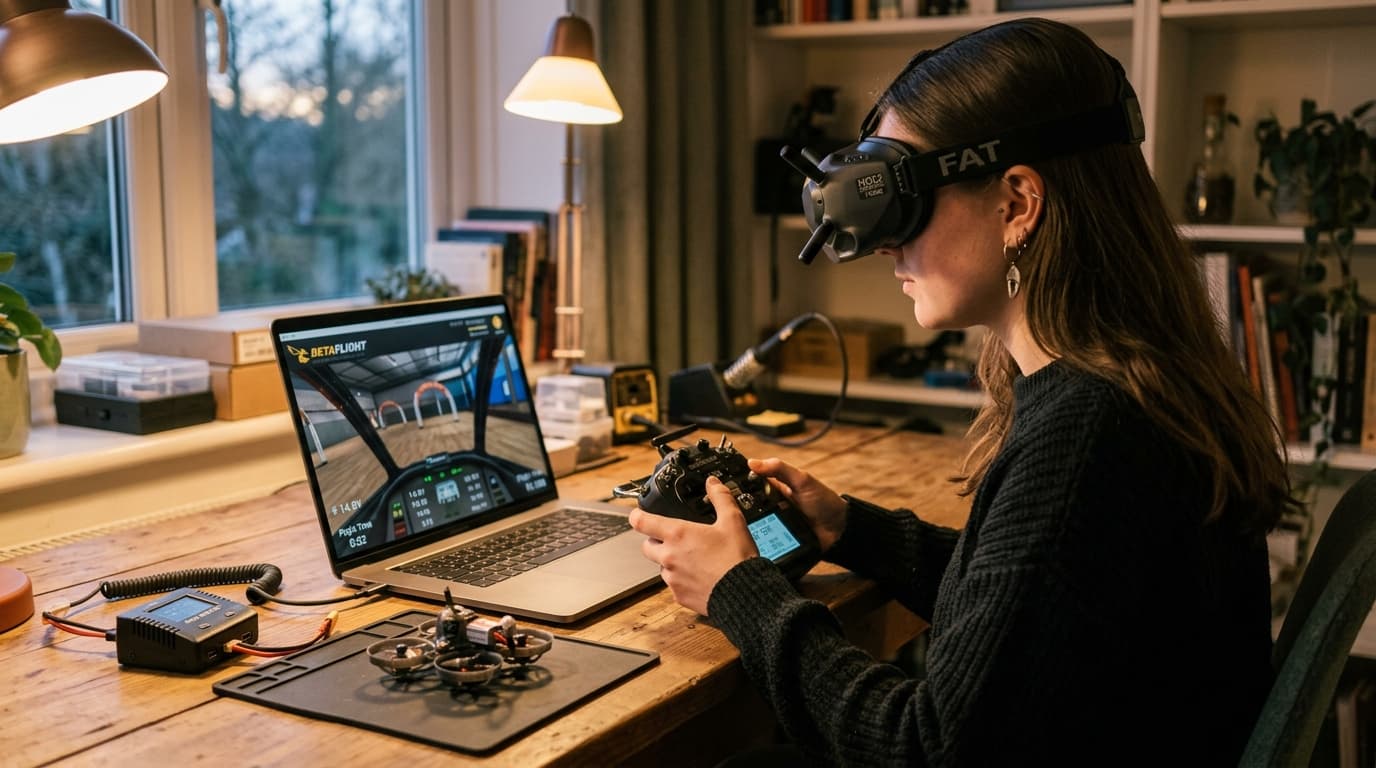
| Learning curve | Minutes to a usable flight; stabilised by default | Hours in a simulator before flying outdoors; genuinely manual |
| Typical use | Photography, video, survey, inspection | Freestyle, racing, cinewhoop, immersive footage |
| Crash risk while learning | Low — sensors and auto-hold correct most mistakes | High — no self-correction; crashes are part of learning |
| Repair after a crash | Often sealed units; a hard landing can total the aircraft | Modular by design — frame, motor, or flight controller swapped individually |
| Running cost | Mainly the upfront purchase | Ongoing — props, motors, frames wear out and get replaced |
| Build path | Bought ready to fly | Bind-and-fly kit, or fully self-built from parts |
The skill gap is the headline difference, but the maintenance model matters just as much day to day. A GPS drone is closer to a sealed consumer device: reliable while it works, expensive to fix when it does not, because a hard fall often damages the gimbal or airframe beyond a simple part swap. An FPV quad is built to be repaired — a snapped arm or a burnt-out motor is a cheap, ten-minute fix, which is exactly why the hobby tolerates the higher crash rate that comes with manual flying. Neither cost model is "cheaper" outright; it depends on how often you fly, how you fly, and how much you value having a working aircraft on day one versus building the skill and the toolkit over months.
The same rules apply to both
This is the part that surprises people: EASA does not care what the drone looks like or how it flies. Regulation (EU) 2019/947 defines rules by weight, class mark, and what the aircraft does — not by brand or flying style. A GPS camera drone and an FPV quad of the same weight sit in the same subcategory and answer to the same requirements.
Registration and the exam. Both need the UAS operator to register if the aircraft weighs 250 g or more, or carries a camera and is not a toy — which covers essentially every camera drone and every FPV quad. Both trigger the CAA online course and the A1/A3 exam once the aircraft crosses the same 250 g or C1–C4 threshold. The subcategory logic — A1, A2, A3, and what separates them — is covered in Open category A1/A2/A3 explained.
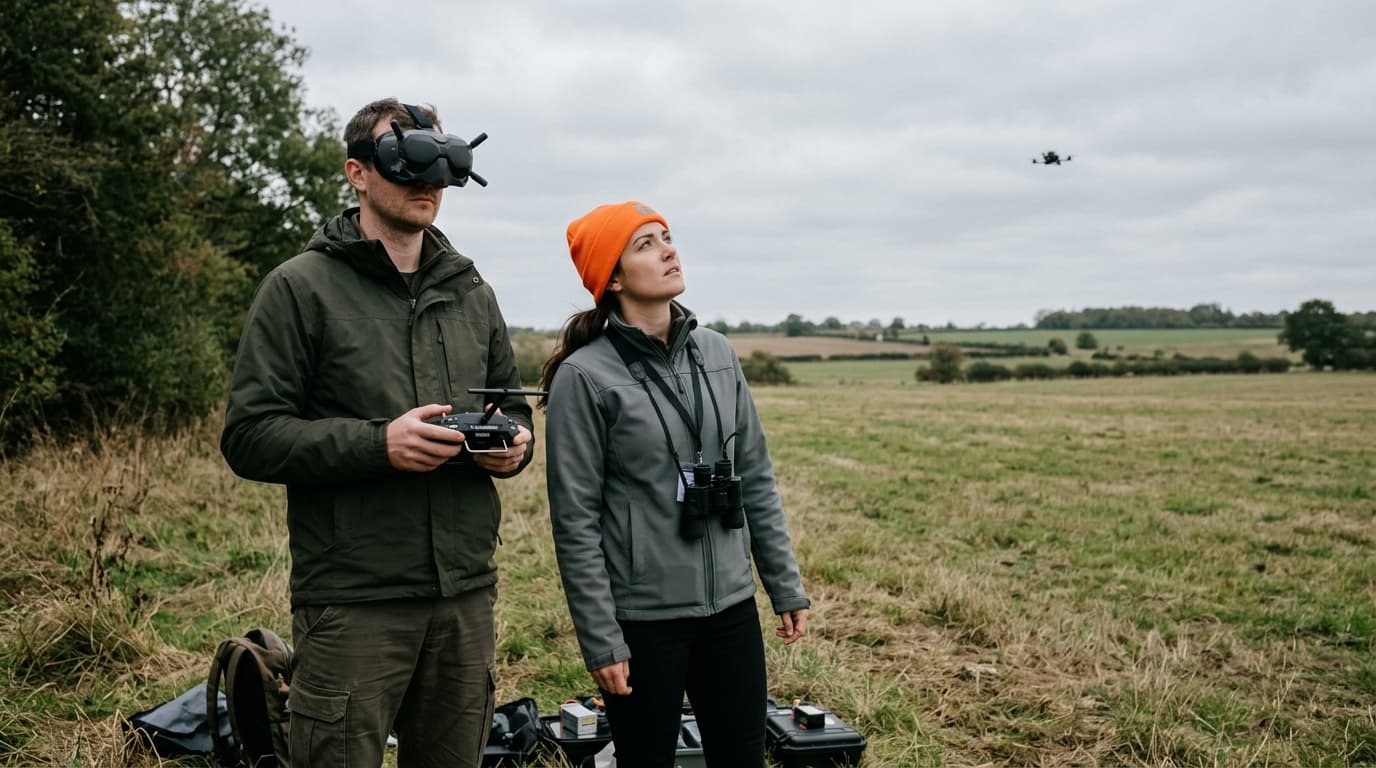
Where they part ways. A GPS drone flown line-of-sight from the ground meets the visual-line-of-sight requirement directly — the pilot simply looks at the aircraft. FPV cannot, because goggles remove that direct line of sight by design. The regulation's answer is a dedicated observer standing beside the pilot, keeping the aircraft in unaided sight and warning them directly. Skip the observer and solo FPV flying is not a grey area — it is outside the rule. The full mechanism, including the follow-me exception, is in VLOS and the FPV observer rule.
Everything else — the 120 m height ceiling, the 25 kg weight cap, distance from uninvolved people, geographical-zone restrictions — applies identically to both aircraft. Goggles do not exempt anyone from the open category; they add one extra requirement on top of it.
How to choose
Start from the job, not the hardware. If the goal is a usable aerial photo, a property walkthrough, or a survey with minimal training overhead, a GPS camera drone gets there faster and with less risk. If the goal is racing, freestyle, close-in cinematic work, or simply the experience of flying rather than filming, FPV is the only aircraft that delivers it — at the cost of a real learning curve and an observer on every flight.
Some pilots end up owning both, because they solve different jobs rather than competing for the same one. What neither aircraft changes is the legal floor under the hobby: registration, the exam, and — for FPV — the observer.
What matters now
The airframe decides how you fly. The regulation decides whether you are legal doing it, and it does not distinguish between a stabilised camera drone and a hand-flown FPV quad once weight or camera crosses the threshold. Whichever you choose, get the A1/A3 syllabus done before the first outdoor flight — the dronelingo course covers the full EASA material with practice questions, so the CAA exam is a formality rather than a surprise.