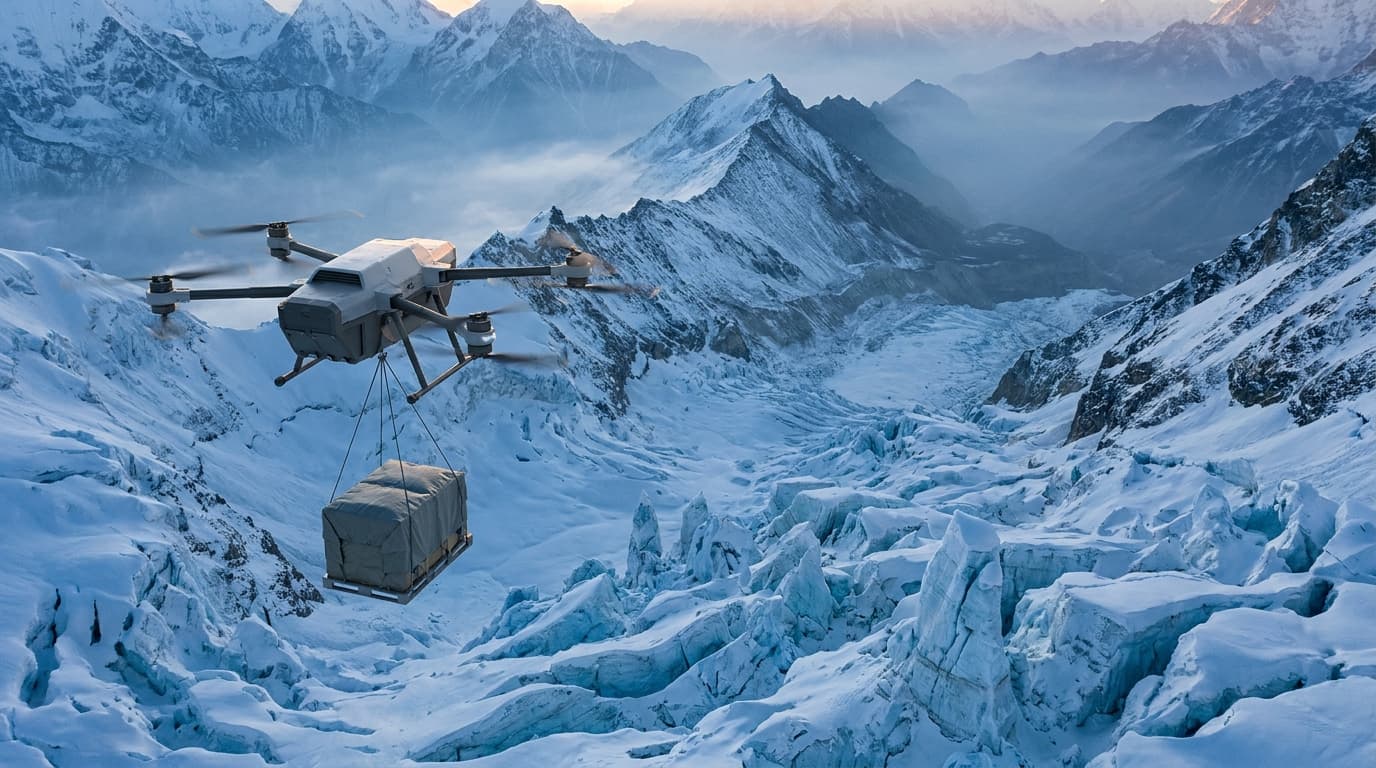
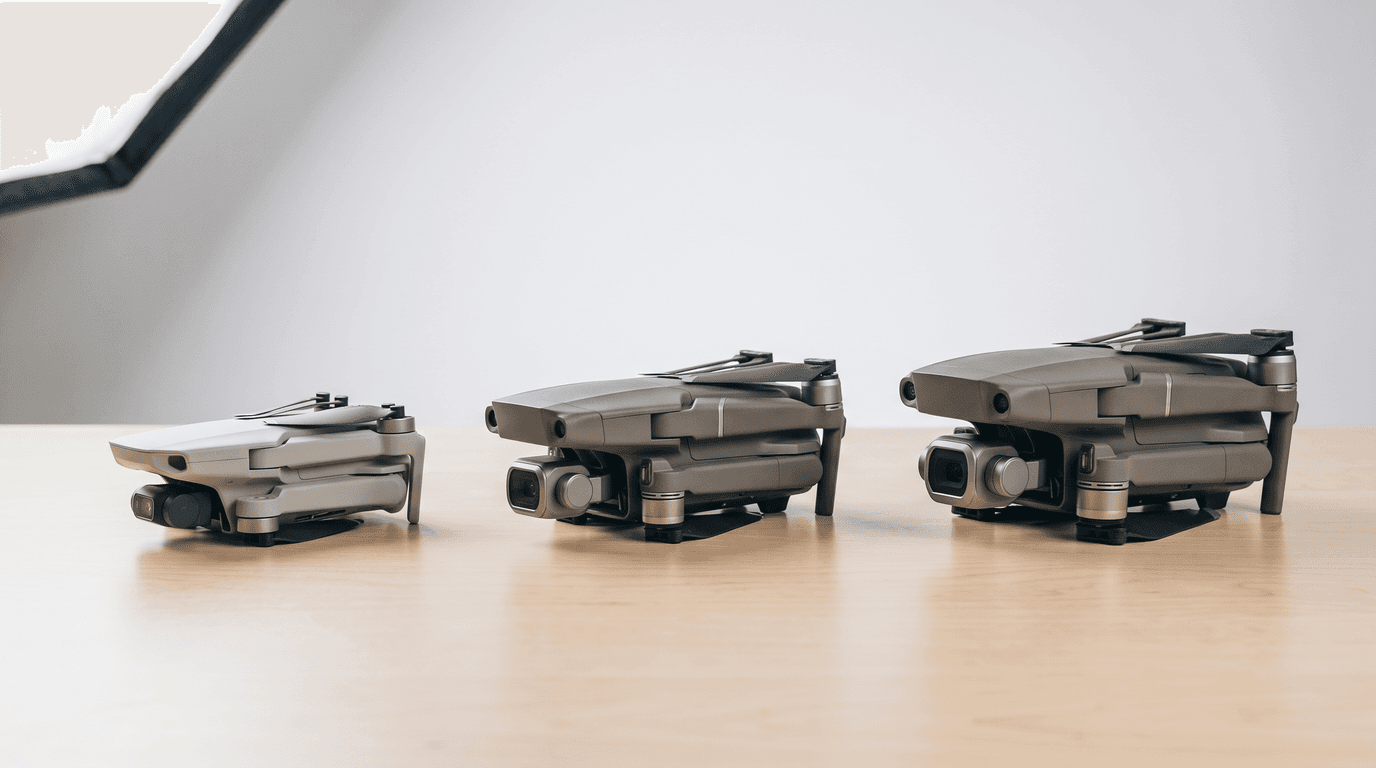
On 22 August 1849, the sky over the Venetian lagoon filled with roughly 200 paper balloons, each carrying a bomb on a timer. No engines, no radio link, no pilot — just wind, tasked with carrying an explosive charge over a besieged city. Some balloons reached Venice; others blew back over the Austrian lines that had launched them. It wasn't a precision strike; it was the first recorded time a weapon left the ground with nobody behind it. Most retellings of the history of drones start decades later, with something that actually flies. The real starting line sits here — and getting from a wind-blown balloon to a quadcopter that holds position over a rooftop on command took almost two centuries and only five real turning points, each one turning on the same question: who is responsible for what happens in the air.
1849: the strange start of drone history
By 1849, Venice had spent close to a year as the self-declared Republic of San Marco, in revolt against the Austrian Empire. The besieging army couldn't reach targets inside the lagoon — ordinary artillery simply didn't have the range across the water. The fix came from an Austrian artillery lieutenant, Franz von Uchatius: lift bombs into the air on balloons and drop them on a timer. Trial launches ran as early as July, and the main attack came on 22 August 1849 — roughly 200 paper and cloth balloons, each carrying a bomb fitted with a time fuse.
Nothing about these balloons could be steered; they were entirely at the mercy of the wind. Some of the payload reached the city, some drifted back over the Austrian lines. It still went down in the record books as the world's first aerial bombardment. Calling Uchatius's balloons a "drone" in any modern sense is a stretch — there was no engine, no control, no communications link, only the idea of delivering a weapon by air without a person on board. That makes them a distant ancestor of unmanned aviation rather than its actual beginning.
The story often gets tangled with a myth crediting the idea to Nikola Tesla. That's impossible on the timeline alone: Tesla was born in 1856, seven years after the siege. His real contribution came later, and in a different form. In 1898 he publicly demonstrated a radio-controlled boat — a "teleautomaton" — one of the first convincing examples of a machine steered from a distance rather than simply released to the wind. The gap between Uchatius's balloon and Tesla's boat is the entire gap between unmanned aviation as we know it and what came before it: an uncontrolled projectile can only go where the wind takes it, while a controlled craft goes where the operator decides.
1917: the first aircraft to fly under control
Almost seventy years separate a balloon left to the wind from genuine control from the ground. In March 1917, Britain's "Aerial Target" — a small aircraft built by the Royal Flying Corps' secret experimental workshop under Archibald Low — flew for the first time. The name was partly cover: the aircraft was really meant to become a radio-guided weapon.
The technology was rough: the radio link was unreliable, there was no automatic stabilisation, and the programme never turned into an operational weapon. But the principle it established outlived the hardware — the aircraft was flown by a person on the ground using radio, not carried by wind or a mechanical timer. The Imperial War Museum credits the Aerial Target as the first drone to fly under control, and that's the point where "unmanned aircraft" stops meaning a blind projectile and starts meaning a machine somebody is actually flying.
It's worth being honest that the Aerial Target itself won no battles and hit no targets. Its significance isn't in results — it's in the fact that, for the first time, an operator on the ground could change an aircraft's course in real time, instead of calculating a trajectory in advance and letting the machine carry it out.
The 1980s: the drone becomes a system
Radio control solved one problem — where to fly. The following sixty years went into solving the second one: what the aircraft could see, and how the operator would know. By the 1980s, radio links had grown reliable, electronics had shrunk, and video cameras plus navigation gear were being fitted to unmanned aircraft at scale for the first time. A drone stopped being just a remotely flown plane and became a system: airframe, ground control station, a communications link, navigation, and a payload — camera or sensor — all working as one.
The clearest example is the RQ-2 Pioneer, used by US forces from the late 1980s for reconnaissance, surveillance, and artillery spotting. Its best-known moment came on 27 February 1991, during the Gulf War: 40 Iraqi soldiers on Faylaka Island surrendered to a Pioneer launched from the battleship USS Wisconsin — often cited as the first surrender of humans to a robot. What matters isn't so much the episode itself as the fact that it was possible at all: an unmanned aircraft could hold station, stream imagery, and keep working to a plan long enough for someone on the other end of that feed to make decisions. That's the same architecture a consumer drone runs today — a battleship and a ground station have simply been replaced by a controller, an app, and satellites in your pocket.
For decades, the engine behind this leap was defence spending — that's where the money was to fund radio links, cameras, and navigation systems that didn't yet pay for themselves commercially. Only once that electronics got cheap and small did the same architecture fit into a box the size of a shoebox and reach people with no uniform at all.
2014: a drone above a cathedral tower, and a €350 fine
For half a century, this architecture stayed military and expensive. The footage that opens this article shows what happened once it got cheap and landed in an ordinary person's hands. In November 2014, Utrecht resident Jelte Keur, 32, flew his DJI Phantom 2 and filmed the Dom Tower — at 112 metres, the tallest church tower in the Netherlands — rising through thick morning fog. By his own account, he had waited around 10 months for exactly those conditions to line up.
The clip went up on YouTube on 18 November 2014, passed a million views, and was later named the best Dutch drone video of the year. The secret wasn't the hardware — the Phantom 2 was already a mass-market consumer machine by then — it was patience: catching that particular fog, lit by that particular sunrise, with the tower just breaking through the cloud layer, meant waiting for the right morning for months.
There's a second half to this story that headlines usually leave out. Flying over dense urban terrain, in fog, without a clear line of sight to the aircraft was illegal under the rules of the time — the operator couldn't see his drone or what was happening around it, and so couldn't reliably avoid other air or ground traffic. Press coverage first reported a threatened fine of €7,800–8,000. Keur actually received a fine of €350, noticeably less than experts had expected.
That gap is the real turning point of 2014. The technology already let an ordinary person with a few-hundred-euro quadcopter capture shots that used to require a helicopter and a film crew. The rules, the insurance, and the shared sense of what was acceptable hadn't caught up. That's the moment it became obvious that drones needed more than open sky — they needed a rulebook.
2021: one rulebook for Europe's sky
The answer to that gap took years to build and became applicable from 31 December 2020, which is why it's usually associated with the start of 2021. Regulation (EU) 2019/947 set unified rules for drone operations across the EU. The core idea is simple: flights are sorted not by whether they're hobby or commercial, but by risk.
The Open category covers most low-risk flights within fixed limits: aircraft up to 25 kg, flight within visual line of sight, altitude no higher than 120 m, restrictions near people and crowds, and no-go zones. Inside it sit the A1, A2, and A3 subcategories, set by drone type and proximity to people — the differences between them are worth knowing. Beyond that sits the Specific category, for flights that exceed Open limits and need a risk assessment and authorisation, and the Certified category, for the highest-risk operations, run on logic close to manned aviation.
The effect is exactly what was missing in 2014: a predictable, EU-wide framework where the boundaries are known in advance, instead of a fine that only gets worked out after the fact. The regulation also raised the bar on accountability — drone operators are now registered, and pilots are expected to show proven knowledge of flight categories and airspace restrictions rather than guessing as they go.
From a balloon on the wind to rules in an app
Line up these five moments and one thread runs through all of them. 1849: a balloon with no direction and no target, only wind. 1917: an aircraft flown by radio from the ground for the first time. The 1980s: a system that doesn't just fly but sees and reports. 2014: that same system, small enough for a backpack and available to anyone without a uniform. 2021: shared rules telling that person where, how high, and how close to others they're allowed to fly.
The motor and the camera settled whether a drone could get airborne and what it could show. What keeps it in the air, though, is not aerodynamics but a computer — why a modern drone is really a flying computer is the subject of the second part of this story. The rules — knowing your category and your airspace — settle whether it's allowed to fly there at all. It's worth understanding the line between the Open category and everything above it before your first flight, not after a call from an inspector.
The history of drones is, at its core, a story about a weapon with no pilot on board slowly becoming a tool an ordinary person operates under a clear set of rules. Responsibility for what happens after takeoff hasn't shifted once in almost two centuries — it has always sat with whoever is holding the controller. If you want to fly on the right side of those rules from day one, start here.