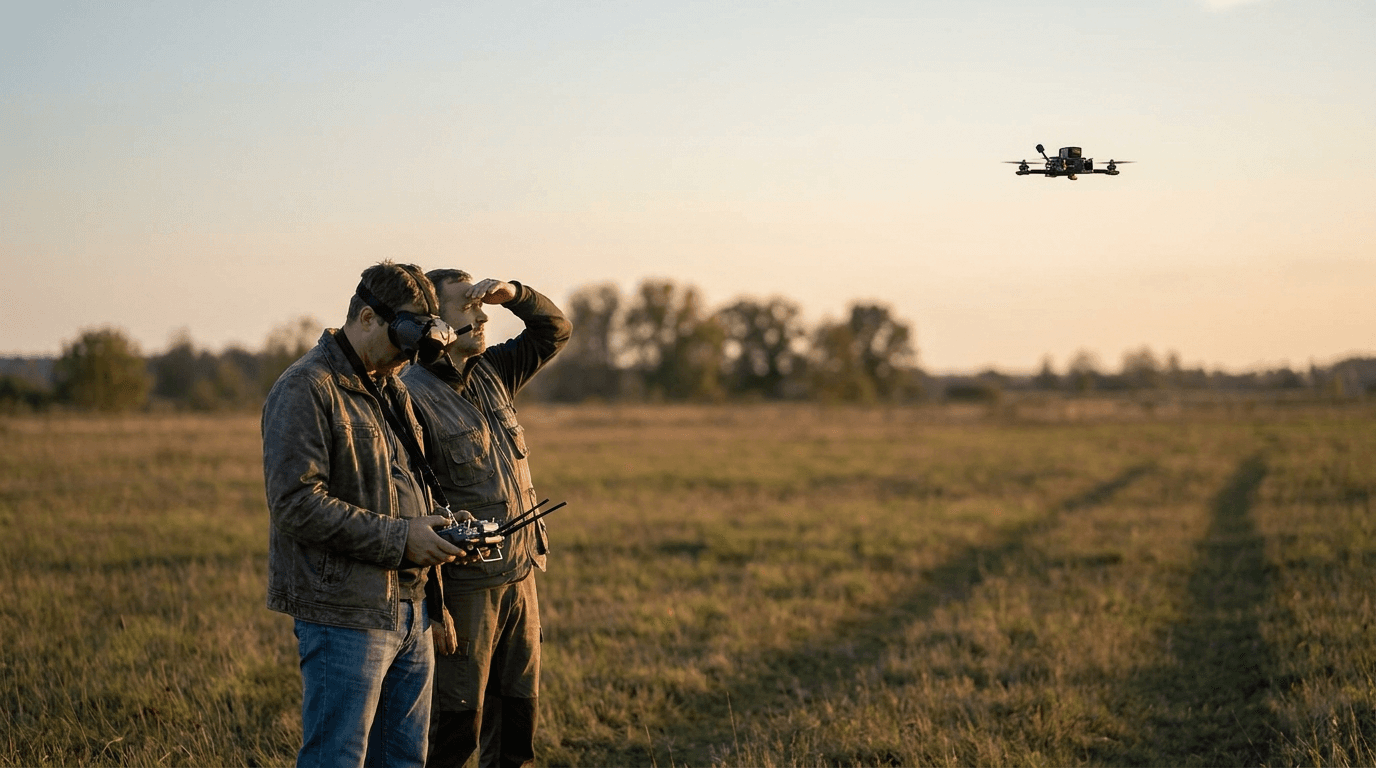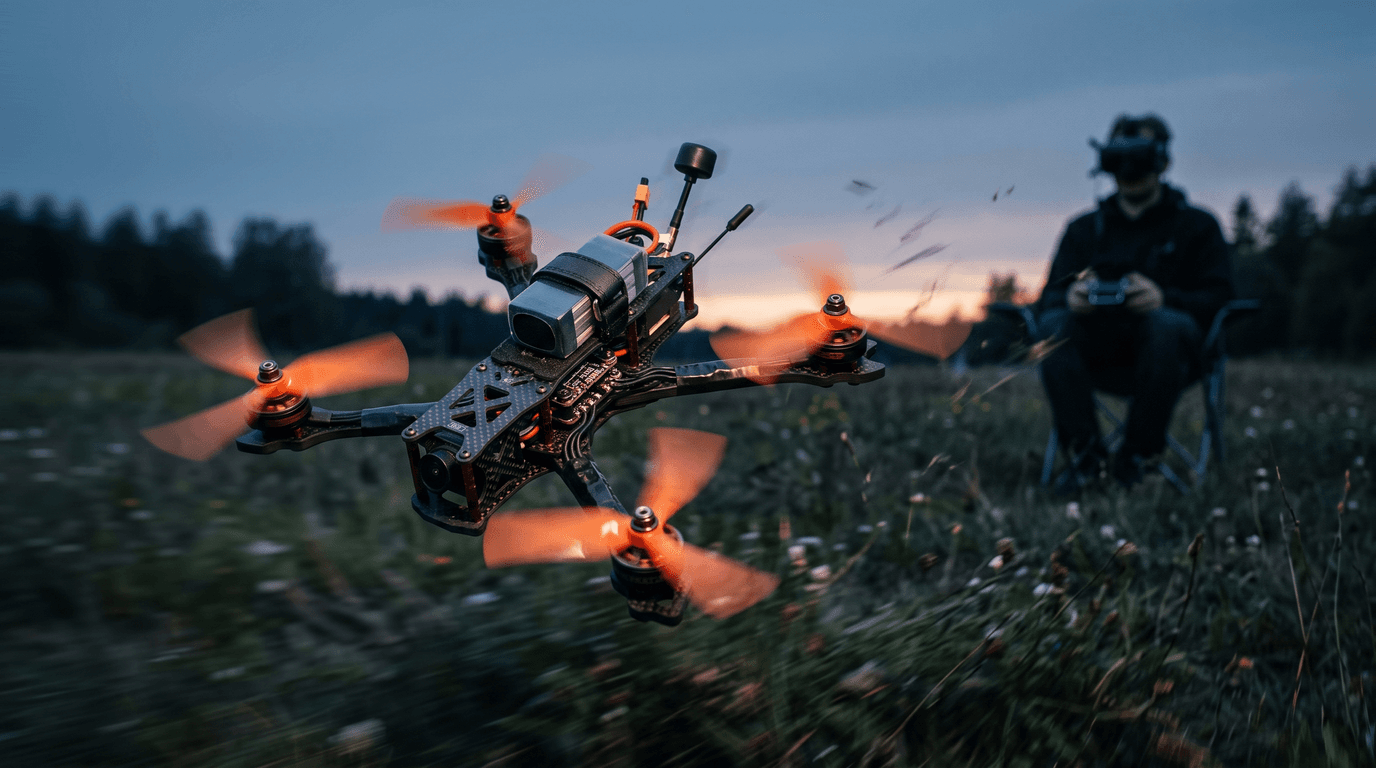
What is FPV? The short version: instead of standing on the ground watching your drone from below, you put on goggles and see what the drone sees — a live video feed from a camera on its nose, streamed to your eyes in real time. First-person view. It is the closest thing to flying that most people will ever experience, and it is the fastest-growing corner of the hobby.
The longer version matters, because FPV is not just a camera drone with goggles bolted on. It is a different aircraft, a different way of flying, and — this is the part drone shops rarely mention — the same set of EASA rules that governs every other drone in Europe.
How FPV actually works
An FPV quad carries a small forward-facing camera and a video transmitter. The feed goes to goggles on the pilot's head or, less commonly, a screen. Two link technologies coexist: analog, the older standard — noisy, low-resolution, but with graceful degradation as range grows — and digital, which delivers a far cleaner picture at the cost of more latency-sensitive hardware. Beginners today mostly start digital; racers still argue about it.
The bigger difference from a GPS camera drone is what happens when you move the sticks. A typical camera drone flies itself: GPS hold, altitude hold, obstacle sensors, return-to-home. Release the sticks and it parks in the air. Most FPV quads fly in acro (rate) mode: the sticks command rotation rates, nothing self-levels, and releasing the sticks means the drone keeps doing whatever it was doing — including falling. That is why FPV pilots put hours into a simulator before their first real flight, and why the learning curve is real. The reward is control a GPS drone cannot offer: flips, dives, gaps, and lines flown at whatever angle you choose.
Gear-wise, FPV lives in two worlds. You can solder a quad together from parts — frame, motors, flight controller, camera — or buy a bind-and-fly kit that only needs your radio and goggles. Self-building is half the culture. It also has a legal consequence we will get to.
The four disciplines
- Racing. Timed laps through gates on a closed course. Small, light, brutally fast quads; analog video still common for its latency.
- Freestyle. Acrobatics around structures and terrain — the discipline behind most of the FPV footage that goes viral. Usually 5-inch quads.
- Cinematic / cinewhoop. Slower, smoother flying for camera work, often on small ducted quads ("cinewhoops") that can pass close to people and objects while carrying an action camera. This is the branch feeding into professional video production.
- Long-range. Larger quads or fixed wings flown far out over landscapes. Spectacular — and, as we will see, the discipline that collides hardest with the rules.
The part the hobby skips: EASA rules apply to FPV, full stop
There is no FPV exemption in Regulation (EU) 2019/947. An FPV quad is an unmanned aircraft like any other, and everything that follows applies in Latvia and across the EU.
Goggles mean you need an observer
The open category requires the pilot to keep the drone in visual line of sight — continuous, unaided eye contact. Goggles, by definition, break that. The regulation solves this with one narrow mechanism: FPV is legal in the open category only when an unmanned aircraft observer stands beside the pilot, keeping the drone in unaided sight and warning the pilot directly — CAA Latvia specifies with no technical means of communication in between. Solo FPV in a field with nobody next to you is not a grey area; it is outside the rule. The full definition, the follow-me exception and what "alongside" means are covered in VLOS and the FPV observer rule.
Open-category limits still bind
Maximum 120 m above ground, maximum 25 kg, distance rules from uninvolved people and built-up areas, and geographical-zone restrictions — all of it applies with the goggles on. A freestyle line under 120 m through an empty quarry is fine; the same line over a beach with people on it is not.
Self-built quads and class marks
C-class marks (C0–C4) are applied by manufacturers, so a self-built FPV quad has none. The regulation accounts for this directly:
- privately built, under 250 g (max speed 19 m/s) → subcategory A1, close to people but never over assemblies;
- privately built or unmarked, under 25 kg → subcategory A3 only, at least 150 m from residential, commercial, industrial or recreational areas.
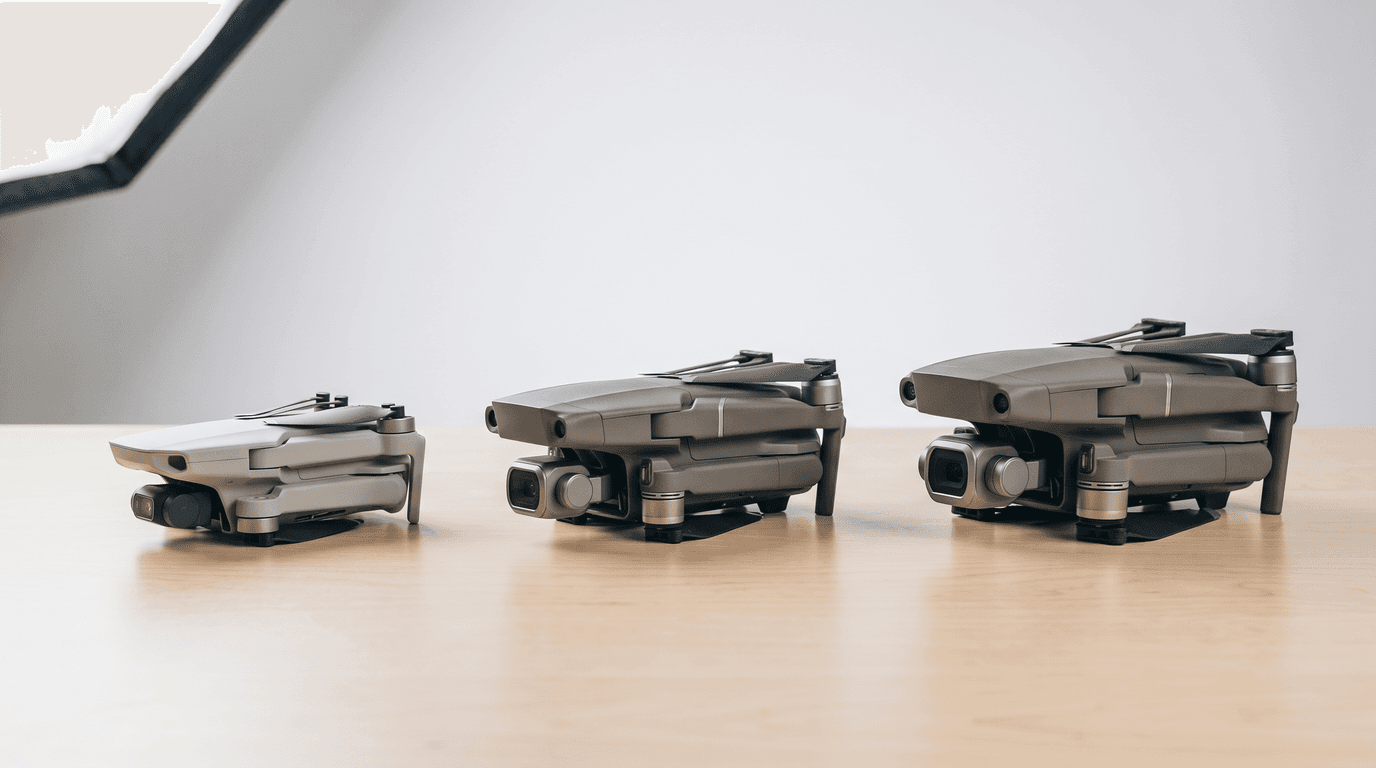
A typical 5-inch freestyle quad with a battery sits well over 250 g, which puts it in A3 — far from people, far from town. Sub-250 g builds and small whoops have far more freedom; the weight logic is the same as for camera drones, covered in drones under 250 g rules.
Registration is triggered by weight or the camera
The UAS operator (you) must register if the drone weighs 250 g or more — or if it carries a sensor able to capture personal data, i.e. a camera, and is not a toy. An FPV quad has a camera by definition, so in practice almost every FPV pilot in Latvia needs to register: 5 EUR, one year, done at e.caa.gov.lv, and the resulting LVA operator number goes on every aircraft you fly. The walkthrough is in drone registration.
The exam trigger
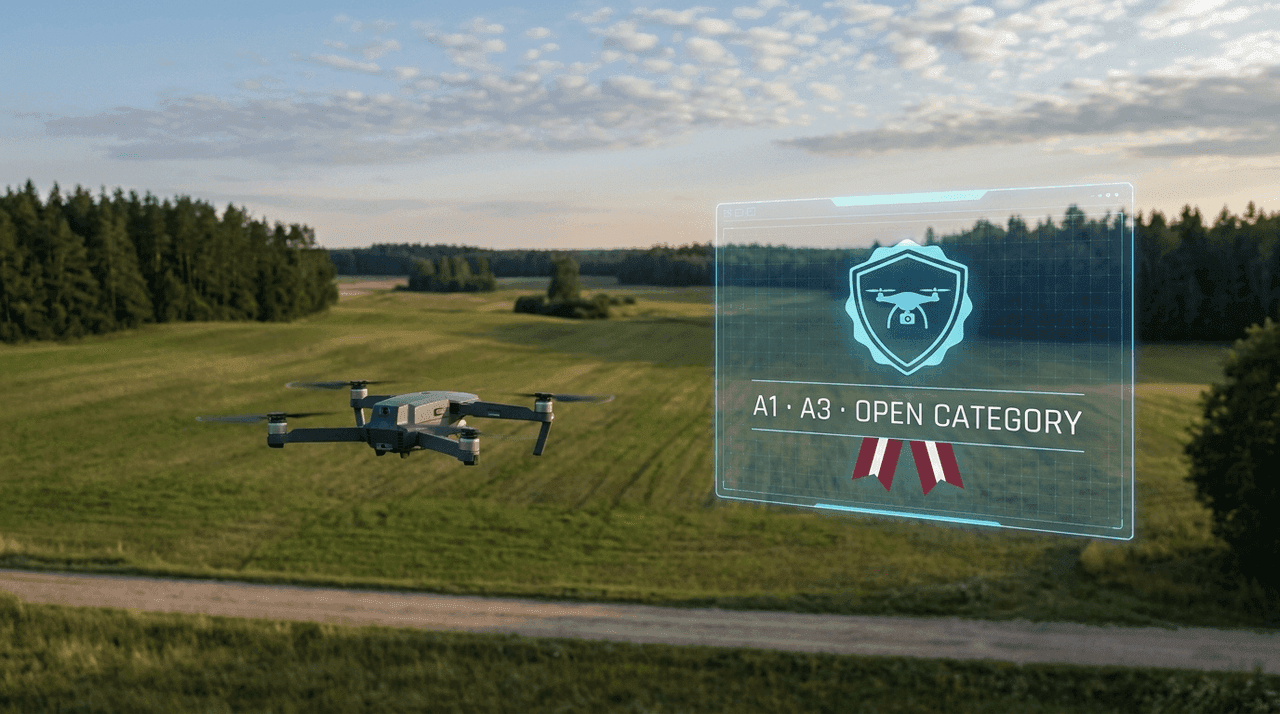
If the drone's mass is 250 g or more (or it carries a C1–C4 mark), the pilot must complete the CAA online course and pass the A1/A3 exam before flying: 40 questions, 40 minutes, 75% to pass, free of charge, valid five years across the EU. Again — a normal FPV freestyle quad crosses that threshold.
Two edge cases
Racing inside a recognised model-aircraft club or association can run under Article 16 of the regulation, with the club's own framework, rather than the standard open-category conditions. Casual racing with friends in a field does not qualify — that is ordinary open-category flying, observer and all. Long-range is the honest problem child: flying beyond what your observer can see unaided is beyond VLOS, and BVLOS operations do not fit the open category at all — they belong in the specific category with an authorisation. A long-range flight over the horizon on open-category terms is simply not legal, however common the footage.
Where this leaves a new FPV pilot
FPV changes how the drone flies, not what the law considers it to be. Before the first flight outdoors: check which subcategory your build falls into with the category tool, register as an operator, bring a friend as your observer — and if your quad is over 250 g, the A1/A3 certificate is not optional.
The good news: the exam is free, online, and the material is exactly what an FPV pilot needs to know anyway — airspace, distances, zones, and the observer rule itself. FPV is still EASA territory, so get the A1/A3 done first: the dronelingo course covers the full syllabus with practice questions, so you walk into the CAA exam already knowing the answers.