Ukraine has codified a system that lets a pilot in one country shoot down a drone over another. The headline number is 2,000 kilometres — the distance over which Wild Hornets demonstrated control of an interceptor drone, with the operator abroad and the aircraft in northern Ukraine. The number that decides whether it actually works is much smaller and rarely makes the headline: latency, or ping. For an interceptor, that is the whole problem.
This is an editorial read of what was actually achieved, and where the real limit sits.
What was codified
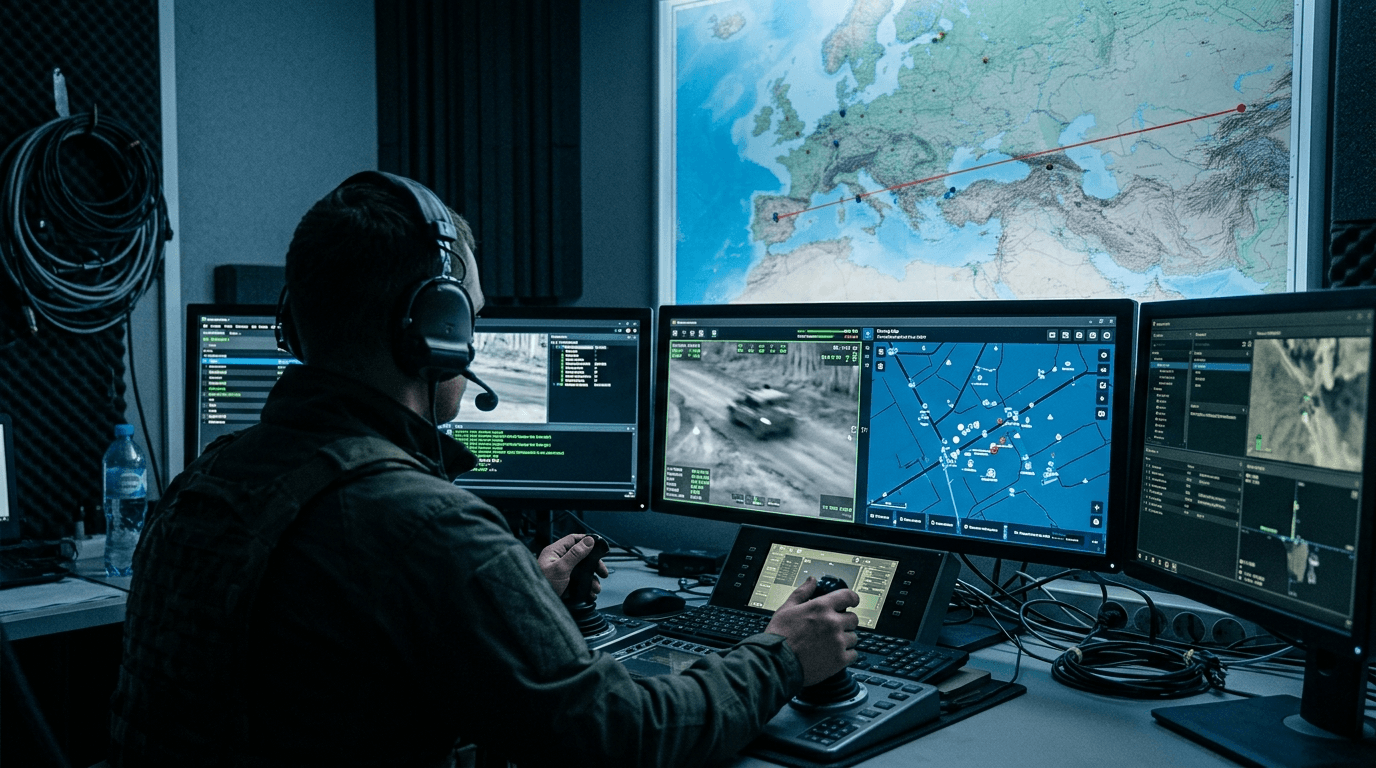
The Ukrainian Ministry of Defence has adopted Hornet Vision Ctrl, a remote-control system from Wild Hornets, as the first such system in Ukraine codified to NATO standards and formally admitted to service. The practical claim is blunt: the pilot no longer has to be on the front line. They can intercept incoming drones from somewhere safe — in principle, from another country entirely.
The progression is fast. In early 2026 Wild Hornets showed Hornet Vision, a ground station with a range over 30 km, able to detect targets out to 2 km, with independent comms channels it can switch between in flight and 360-degree coverage. By March came Hornet Vision Ctrl, a different level. In under three months the company says it helped destroy more than 600 air targets, including jet-powered Shahed variants. In April it demonstrated control of a Sting air-defence drone at 2,000 km.
Why latency is the binding constraint
A strike drone hitting a static position can tolerate a slow link; a few hundred milliseconds of lag does not change much when the target is not moving. An interceptor cannot. Its job is to meet a fast, manoeuvring object — increasingly a jet-powered one — in a closing engagement measured in seconds. Every millisecond between what the pilot sees and what the drone does is error in the intercept.
That is what makes the architecture, not the distance, the interesting part. Hornet Vision Ctrl is a relay system: signal goes from the drone to a ground station, then over the internet to the operator and back. That path is longer and more variable than a direct radio link, and the internet leg adds latency the operators do not fully control. This is a different bet from the satellite-controlled approach used on strike drones like Adis, which routes through orbit and suits latency-tolerant missions. Wild Hornets is pushing the harder case — remote control for the time-critical job of interception.
The record is the proof, not the demo
The 2,000 km figure is a demonstration. The more telling number is from a real engagement: in April a pilot with the call sign "Hulk", from the Bulava unit, shot down two Shaheds while sitting 500 km from the point of interception. Wild Hornets called it a world first — an operator remotely downing not one but two drones at that range. Two intercepts in one remote session is a latency claim you can believe, because reactive air defence does not forgive lag. Six hundred-plus targets over three months is the volume claim underneath it.
So read the two numbers correctly. 2,000 km is what the link can span. 500 km with two kills is what it can do in a fight. The second number is the one that matters.
Why NATO codification is the real news
It is easy to fixate on the distance and miss the procurement story. Codifying Hornet Vision Ctrl to NATO standards moves it from "combat-proven workaround" to officially recognised part of the Defence Forces' arsenal, cleared for large-scale supply. That is what turns a clever field system into something an alliance can buy, integrate and standardise around. The same shift toward affordable, scalable air defence is the thread running through the economics of cheap attack drones: the side that wins is the one that can mass-produce the answer, and codification is how the answer scales.
The remote-operator model also changes who is exposed. Pulling the interceptor pilot off the front line protects the scarcest asset — the trained operator — exactly as we have seen across the electronic-warfare and counter-drone contest. The drone is expendable; the skill flying it is not.
What matters now
Treat 2,000 km as a capability ceiling and 500 km with two confirmed intercepts as the real performance line. The open question is the same one that haunts every relayed control link: how the latency and reliability hold up over the public internet, under load, against an adversary trying to disrupt the path. The codification says the system is good enough to standardise on. Whether it stays good enough as the relay scales to many simultaneous operators is the thing to watch.
For civilian pilots, the lesson is the unglamorous constant underneath all of this: a flight is only as safe as its control link and the operator's awareness. The military version stretches that link across a continent; the civilian version keeps it short and within sight for exactly that reason. The discipline is the same, and it is what the certification guide and practice sets are built to drill.
FAQ
Did a pilot really control a drone from 2,000 km away? Wild Hornets demonstrated control of a Sting interceptor at 2,000 km, with the operator abroad and the drone in northern Ukraine. It was a demonstration of the link's reach. The strongest combat result is a separate, shorter engagement: a remote intercept of two Shaheds from 500 km.
Why is latency such a big deal for an interceptor? Interception is a time-critical, closing engagement against a fast target. Lag between what the operator sees and what the drone does becomes aiming error. Strike and logistics drones tolerate latency far better because their targets are static or slow.
How does the system actually carry the signal? It is a relay: drone to ground station, then over the internet to the operator and back. That gives unlimited operator standoff but adds latency and depends on network paths the operators do not fully control.
What does NATO codification change? It moves the system from a combat-tested field solution to an officially recognised part of the Defence Forces' arsenal, cleared for large-scale supply and easier for allies to integrate. It is a procurement and interoperability milestone, not a performance claim.