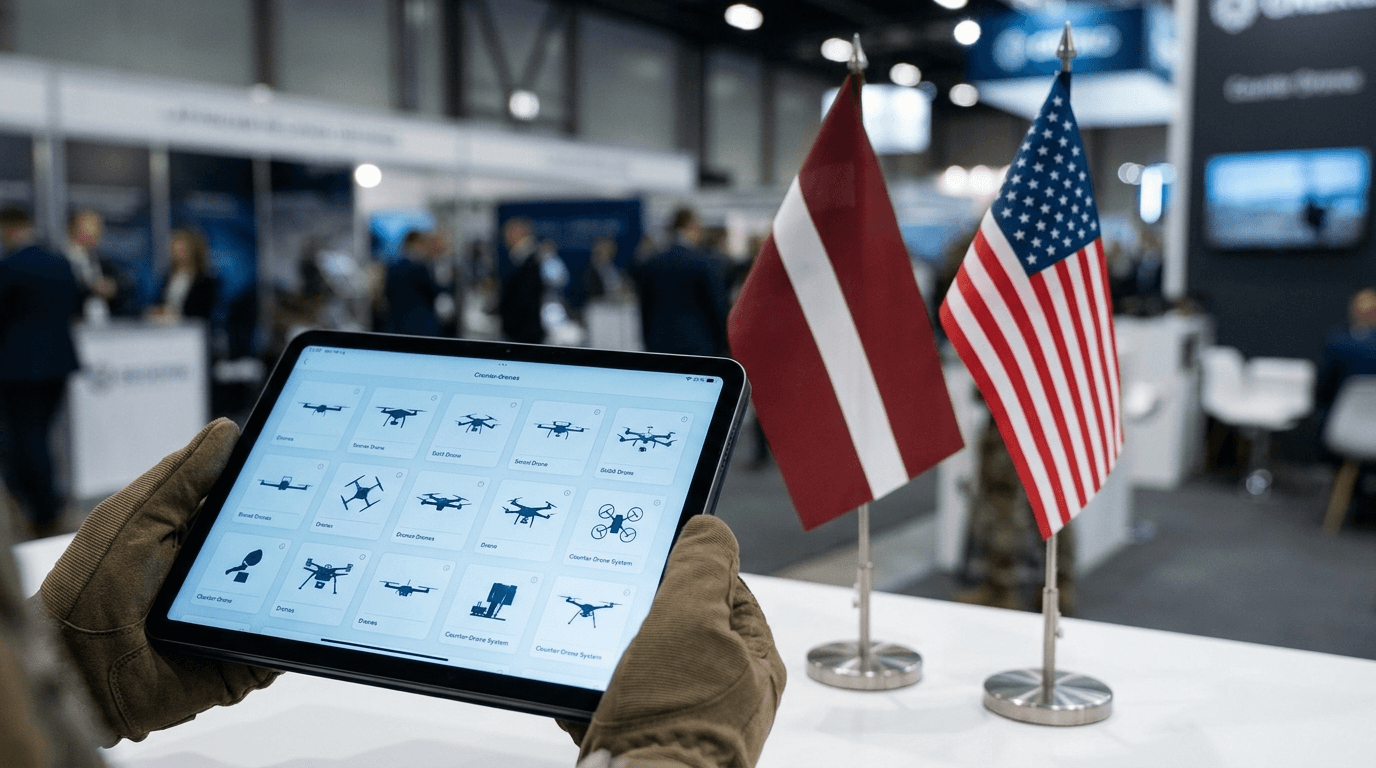
At Eurosatory 2026 in Paris, Latvia and the United States signed a letter of intent to build a joint digital platform for buying drones and counter-drone systems. It is easy to file this under routine defence diplomacy and move on. That would miss the actual idea, which is not about any one drone. It is about procurement speed — and about Latvia getting a seat inside an American digital marketplace as both a buyer and a seller.
This is an editorial read of what the document does, and what it could mean for Latvia's drone industry.
What was actually signed
On Monday, 15 June, Latvia's Ministry of Defence State Secretary Airis Rikveilis met US Deputy Under Secretary of the Army Patrick Mason at the Paris arms fair. The two sides signed a letter of intent to create a joint digital platform for the procurement of drones and counter-drone systems, with the stated aim of developing those capabilities in both countries' armed forces. A Latvian delegation led by Rikveilis and Deputy State Secretary Uģis Norītis represented the country at the exhibition.
A letter of intent is a direction of travel, not a contract. There are no quantities, no money and no delivery dates here. What it does contain is a commitment to a way of buying.
The real subject is procurement speed
Defence procurement is slow by design and slower in practice. The gap between a unit identifying an operational need and that capability actually arriving is measured in years, while drone technology turns over in months. That mismatch is the problem the platform is built to attack. Both sides say the focus is on aligning and streamlining procurement so the time from operational requirement to fielded technology shrinks dramatically.
That framing matters more than the word "drone" in the headline. The drone war's defining feature is the speed of the iteration loop — a design fielded this quarter is countered next quarter. We have written about the trends driving that cycle and the economics that reward whoever can produce and adapt fastest. A procurement system that still takes years cannot keep up with a threat that iterates in weeks. The platform is an attempt to fix the buying process, not to announce a specific piece of hardware.
Why "buyer and supplier" is the key phrase
The Latvian Ministry of Defence flagged one practical benefit above the others: Latvia's participation in the digital marketplaces for unmanned systems that the US armed forces have built. These marketplaces are designed to speed up turnover in American industry, replacing older, complex procedures. The part that matters for Latvia is that the platform could let the country act not only as a buyer but as a supplier — integrating into the same flow and strengthening the competitiveness of its own industry.
That is the line worth underlining. Latvia is not just buying access to American drones. It is positioning its own makers to sell into an American marketplace. Latvia has spent the last few years building a real counter-drone cluster — the companies and capabilities we traced in Latvia's counter-drone industry and its export turn at Eurosatory itself. A shared digital marketplace is exactly the kind of channel that turns a domestic cluster into an exporter, if the access is real and the standards line up.
The sober reading
Three caveats keep this honest.
- It is a letter of intent. The value is entirely in execution. Digital procurement marketplaces are a genuine reform when they work and shelfware when they do not. Nothing here is fielded.
- Access is not the same as sales. Being allowed onto a marketplace is a precondition for exporting, not a guarantee of it. Latvian suppliers still have to win on price, performance and certification against larger competitors.
- Standards and security cut both ways. Integrating into a US marketplace means meeting US requirements and accepting US dependencies — the same trade-off that runs through every deepening of the transatlantic defence relationship.
None of that makes the signing trivial. It makes it a first step whose worth will be decided by what gets built on top of it.
What matters now
For Latvia, the thing to watch is not the letter of intent itself but whether Latvian companies actually appear on the American marketplace as suppliers, and how fast the promised requirement-to-fielding compression shows up in real orders. The strategic logic is sound: a small country with a growing drone industry gains far more from a fast, shared buying channel than from another bilateral hardware deal. The execution is everything.
This is the defence-industrial backdrop to a country that is also, increasingly, a place where civilians fly drones under tightening rules. The same national focus on unmanned systems that drives deals like this one is what keeps Latvia's airspace, geographical zones and registration regime under active development — the environment every civilian pilot operates inside, and the one the certification guide is built to help you navigate.
FAQ
What did Latvia and the US actually sign? A letter of intent, signed at Eurosatory 2026 in Paris, to create a joint digital platform for procuring drones and counter-drone systems. It is a commitment to cooperate on a way of buying — not a contract with quantities, money or delivery dates.
What is the point of a "digital procurement platform"? To cut the time between identifying an operational need and fielding the technology. Traditional defence procurement takes years; drone technology changes in months. A digital marketplace is meant to speed up that turnover and replace slower, more complex procedures.
How does Latvia benefit beyond buying drones? The platform could let Latvia act as a supplier as well as a buyer — putting Latvian-made drones and counter-drone systems into a US-built marketplace. For Latvia's growing drone industry, that is a potential export channel, not just a purchasing one.
Is this deal operational? No. It is a letter of intent marking a new stage in the Latvia–US partnership. The practical value depends entirely on what is built and whether Latvian suppliers actually gain real access. Treat it as a first step, not a delivered capability.