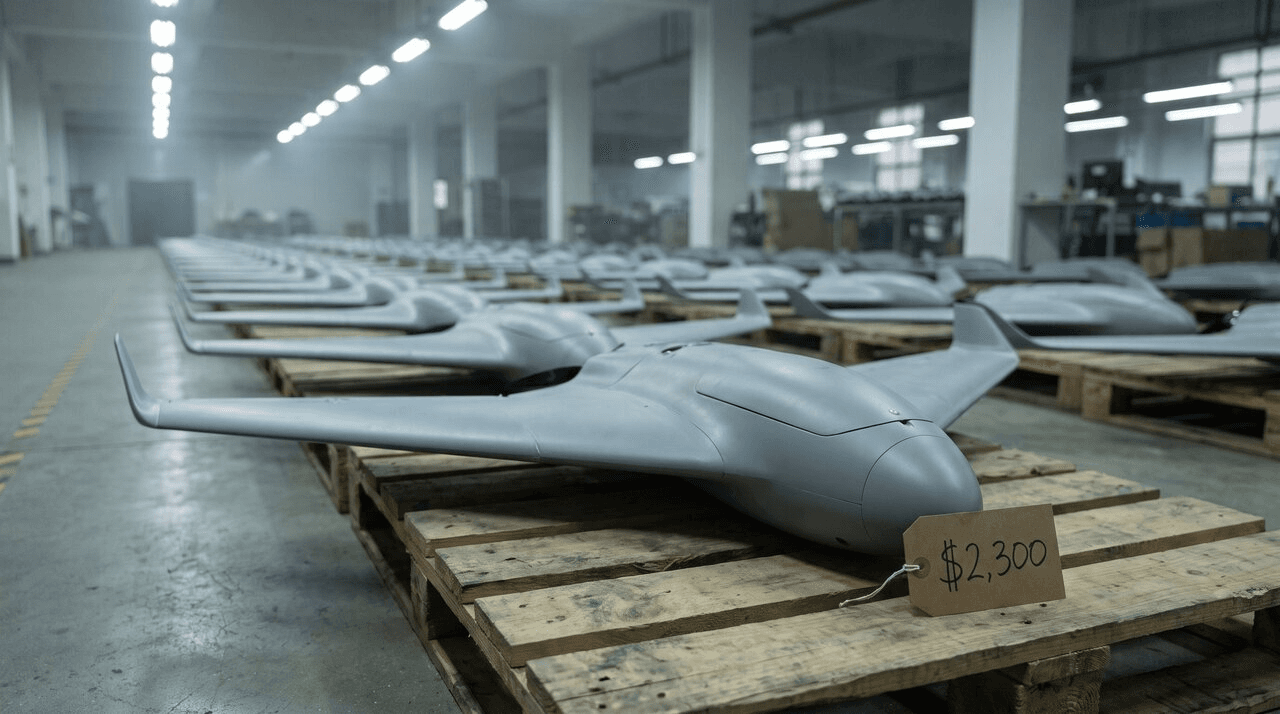
The number that matters in the US "Drone Dominance" plan is not 340,000 drones or a billion dollars. It is $2,300. That is the price the War Department wants to pay for a single one-way attack drone once production scales — down from about $5,000 at the start. When a usable strike drone costs roughly what a good laptop does, and a military plans to buy them by the hundred thousand, the interesting question stops being "how good is the drone?" It becomes "what does it cost to stop one?" That is the part of this story that reaches Europe.
This is an editorial read of the economics behind the headline, and of the one number nobody has answered yet.
What the $2,300 figure actually is
The price comes straight from the US War Department's own description of the program, not from a forecast. The plan runs through four phases it calls "gauntlets." Phase one, running February to July 2026, asks 12 vendors to build 30,000 one-way attack drones at $5,000 per unit — $150 million in total. Over the next three gauntlets the vendor field narrows from 12 to five, the order grows from 30,000 to 150,000, and the target price falls from $5,000 to $2,300. Across two years, roughly $1 billion from the 2025 budget bill is meant to fund about 340,000 small drones for combat units.
Two things are worth keeping straight.
- $2,300 is a target, not a fielded average. It is the price the department expects at the far end of a competitive procurement, after vendors have invested in capacity. Today's contracted price is $5,000. The whole point of the gauntlet structure is to force that number down by guaranteeing volume — what the department calls a "stable demand signal."
- These are one-way attack drones. Not reusable quadcopters, not sensors. The unit economics work precisely because the drone is meant to be expended. That is the design assumption, not a side effect.
So the right way to read $2,300 is as a procurement bet: that a guaranteed order book can pull the unit cost of expendable strike drones down to a point where a military can budget for them like ammunition rather than like aircraft.
Why the price is the weapon
The strategic argument here is not about any single airframe. It is about an exchange ratio.
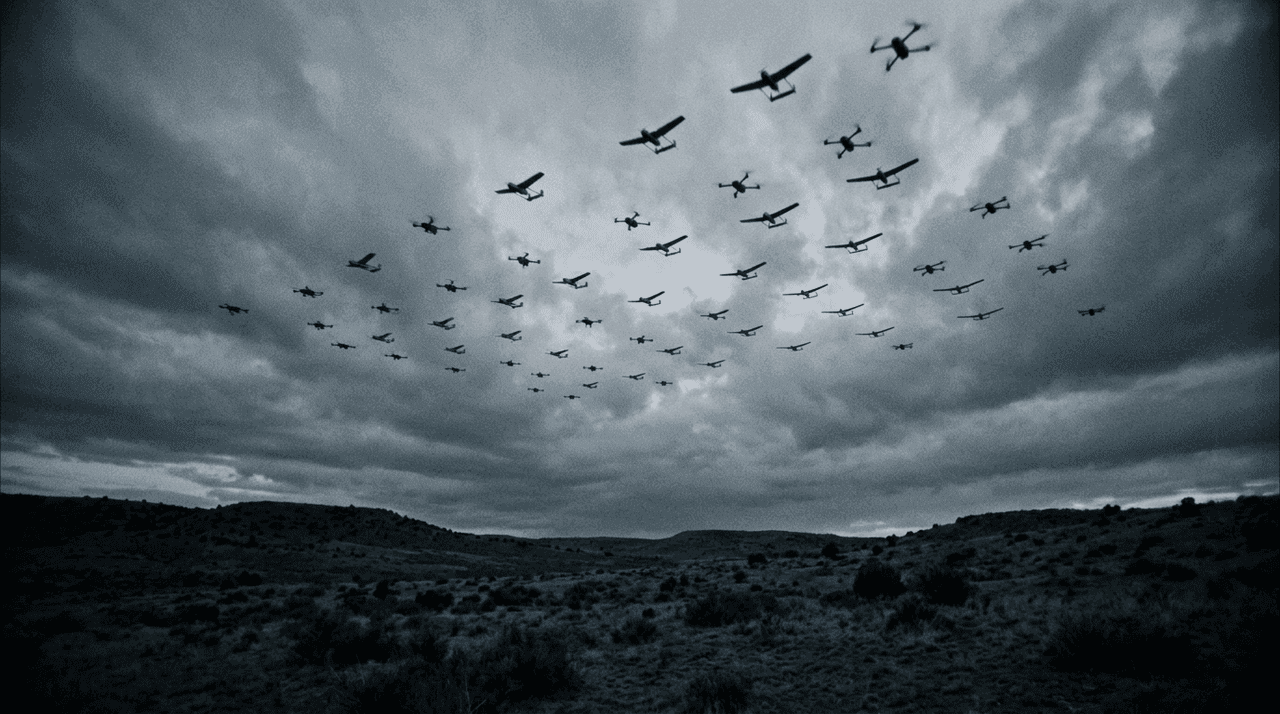
The Secretary of War put it plainly: "We cannot afford to shoot down cheap drones with $2 million missiles." That sentence is the entire economic thesis. A surface-to-air missile that costs seven figures will reliably destroy a drone that costs four. It will also lose money on every shot, and run out of inventory long before the attacker runs out of drones. Mass-produced cheap drones do not win because each one is excellent. They win because they invert the cost of the engagement.
That logic is what makes the $2,300 number a weapon in its own right. Drive the attacker's unit cost low enough, in high enough volume, and the burden shifts entirely onto the defender:
- the defender has to detect and classify every incoming object
- the defender has to commit an interceptor — kinetic or electronic — to each credible threat
- the defender's interceptor almost always costs more than the thing it stops
- the attacker only has to make the math unsustainable, not win every duel
This is why "attritable mass" has become the organizing idea of modern drone procurement. We covered the doctrine side of that shift in military drone trends for 2026. The cost curve is the engine underneath it.
The expensive end is a separate bet
It would be easy to read all of this as "drones are getting cheap." They are not, uniformly. The same week the War Department was driving expendable drones toward $2,300, the US Air Force ordered two far more expensive aircraft into production: General Atomics' FQ-42A and Anduril's FQ-44A, the first Collaborative Combat Aircraft meant to fly alongside crewed fighters as semi-autonomous wingmen.
These are the opposite economic bet. CCAs are not expendable; they carry sensors, electronic-warfare payloads and mission autonomy, and they are designed to be worth keeping. They answer a different problem — stretching a small fleet of costly crewed jets — which we looked at in the rise of autonomous combat UAVs.
The point is that there is no single "drone economics." There are at least two cost tiers pulling in opposite directions: disposable mass at the bottom, exquisite teamed autonomy at the top. A serious force needs both, for different jobs. Confusing the two is how procurement goes wrong.
What cheap mass does to Europe's air-defence math
For a reader in Latvia or the wider EU, the relevant part is not the US order book. It is the exchange ratio arriving on this side of the Atlantic.
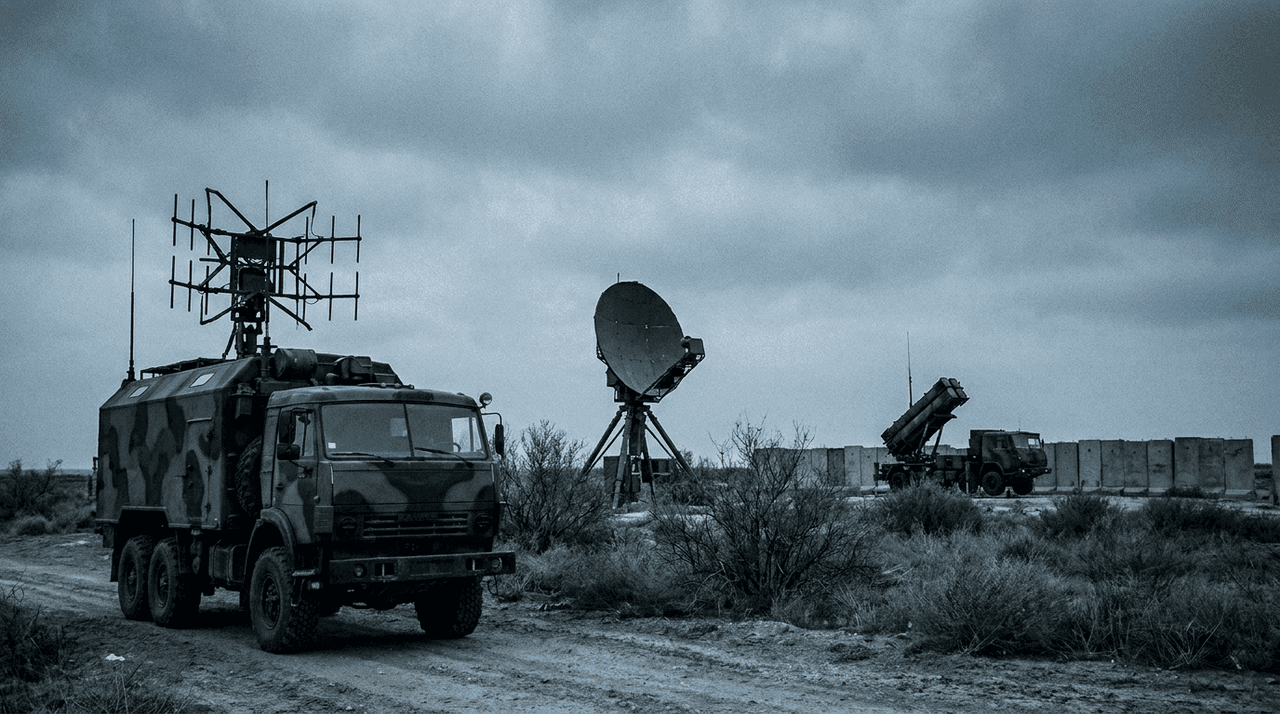
If expendable attack drones keep getting cheaper and more numerous, then the unsolved problem for European defence is the cost of stopping them. Shooting down a sub-$5,000 drone with a missile that costs orders of magnitude more is the losing trade the whole continent is now trying to escape. That is exactly the problem Latvia's counter-drone industry has built itself around — low-cost or reusable interceptors meant to fix the exchange ratio rather than win a single intercept at any price. We traced that domestic build-up in Latvia's counter-drone cluster and its export turn after Eurosatory 2026, and the airport and critical-infrastructure side in counter-drone systems for European airports.
Here is the honest gap, and it is the same one on both sides of the trade. Nobody has yet shown a counter-drone system that is cheap enough, at scale, to reliably beat mass-produced attack drones on cost. The US is betting it can drive attack-drone prices down to $2,300. European makers are betting they can drive interceptor prices down far enough to make defence affordable. Both are bets about manufacturing economics, and both are still being settled on real ranges and real frontlines, not on paper.
What matters now
The $2,300 attack drone is a claim about industrial capacity, not a delivered fleet. Treat the number as a target the program is steering toward, and watch whether the later gauntlets actually hit it. If they do, the centre of gravity in air defence moves decisively toward whoever can also mass-produce the answer cheaply.
For anyone preparing for civilian certification, none of this changes the rules you fly under. What it changes is the environment around them. A continent worried about cheap drones at scale is a continent that keeps tightening counter-UAS measures, geographical-zone restrictions and airspace controls — the rules civilian pilots actually live inside. Knowing those rules cold is the baseline; the certification guide and practice sets are built for exactly that.
FAQ
Is the $2,300 price real or a projection? It is a target price set by the US War Department for the later phases of its "Drone Dominance" procurement. The current contracted price in the first phase is $5,000 per one-way attack drone; the program aims to drive that down to $2,300 as order volumes rise and the vendor field narrows.
How many drones is the program planning to buy? Roughly 340,000 small uncrewed systems over about two years, funded by around $1 billion from the 2025 budget bill. Early phases deliver tens of thousands; the larger volumes are planned for later phases.
Are the FQ-42A and FQ-44A part of this cheap-drone program? No. The FQ-42A (General Atomics) and FQ-44A (Anduril) are Collaborative Combat Aircraft — far more expensive, reusable, semi-autonomous drones designed to operate with crewed fighters. They are a separate program and a different economic logic.
Why does a US procurement plan matter for drone pilots in Europe? It does not change civilian flight rules. It does shape the threat picture that drives European counter-drone investment and airspace restrictions. Cheaper, more numerous attack drones push defenders toward tighter controls — the regulatory environment civilian pilots operate within.