The interesting thing about Ukraine's new Adis drone is not how far it flies. Its range is limited: about a 20 km combat radius, roughly an hour in the air on one battery. The interesting thing is that the operator no longer has to be anywhere near it. Adis is flown over a satellite link, and that removes the single constraint that has shaped small-drone operations since the start of this war — the radio horizon. "Unlimited control range" is the vendor's phrase. It does not mean the drone flies forever. It means the person flying it can sit thousands of kilometres away.
This is an editorial read of what that actually changes, and what it costs.
What Adis is
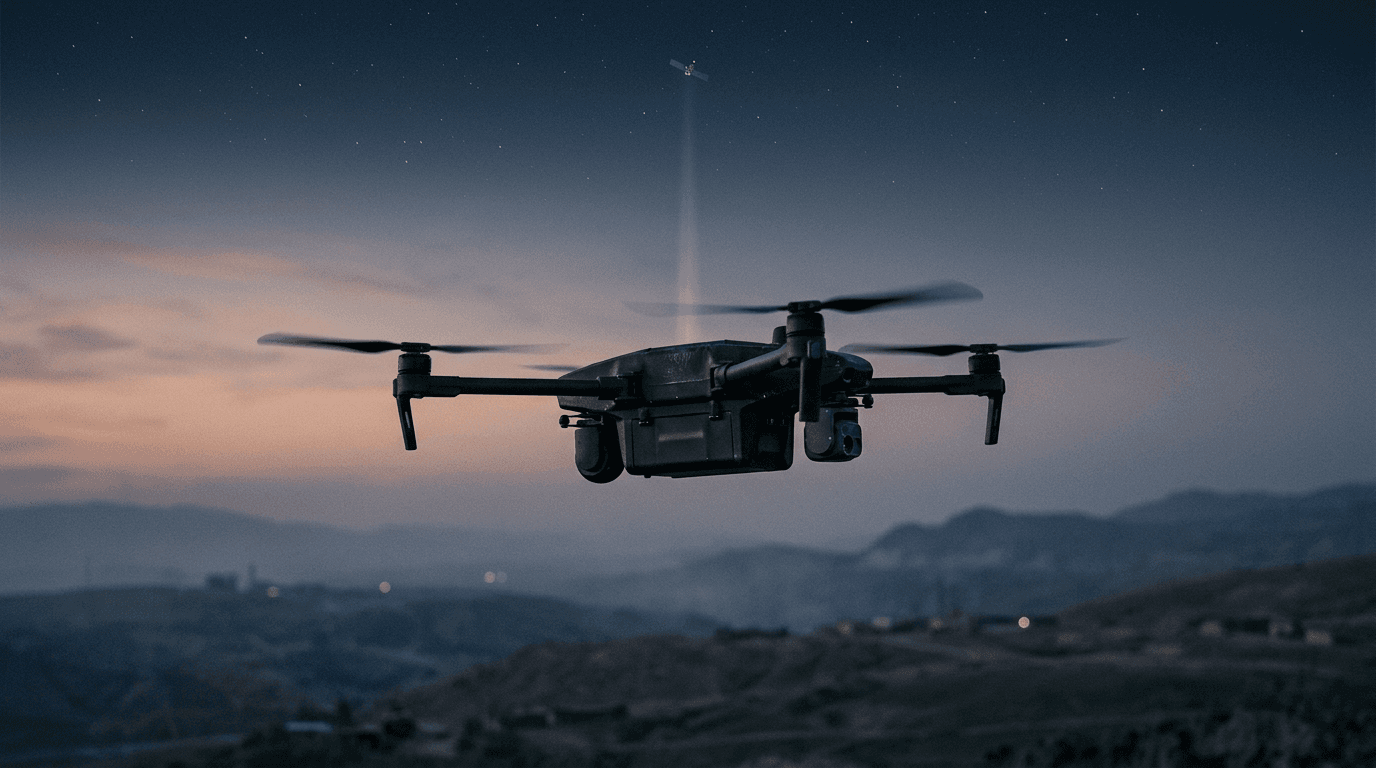
Adis is a heavy bomber quadcopter from the Ukrainian miltech brand Martyn Tech, built, the company says, on a direct request from the front. The airframe itself is unremarkable by 2026 standards. It carries about 10 kg over a 20 km radius; in testing it moved 12 kg across 20 km and flew 50 km with a 3 kg load. Cruise speed is 65 km/h, top speed 90 km/h, working altitude around 400 metres. A dual camera detects objects up to 600 m in daylight and 150 m in full darkness. The design is modular, aimed at three jobs: dropping munitions, remotely mining the enemy's logistics routes, and hauling critical cargo — water, medicine, ammunition — to positions that are hard to reach by ground.
None of that is the main change. The main change is the control link.
Why the radio horizon is the real constraint
A normal first-person-view or radio-controlled drone is limited by line of sight to its operator. Curvature of the earth, terrain and the power of the radio set put a hard ceiling on how far the operator can be from the aircraft — the radio horizon. In practice that ties the pilot to a position near the front, inside the same danger zone as the drone, often inside artillery and counter-FPV range.
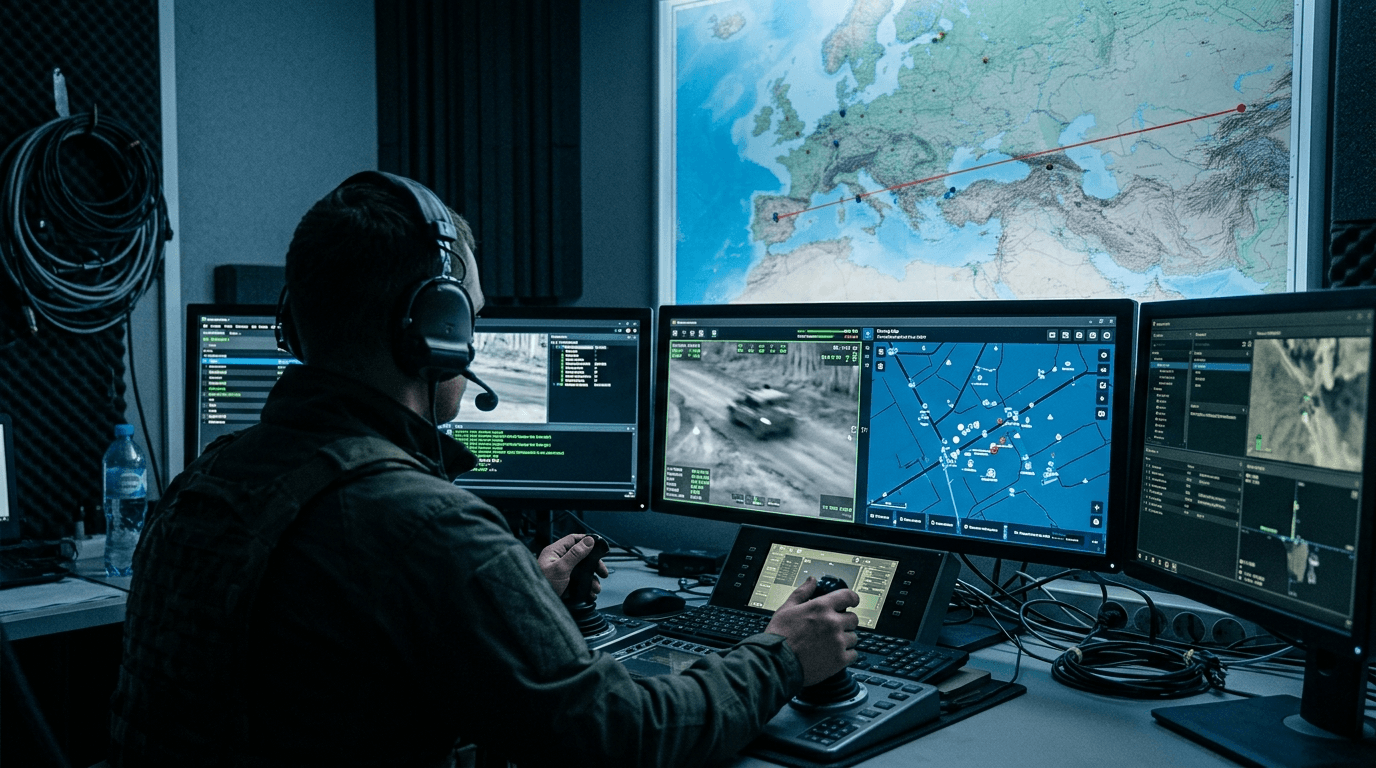
Satellite control breaks that link. Instead of a direct radio path from operator to drone, the command and video signal route up to a satellite constellation and back down, so the operator's physical location stops mattering. The drone still only flies its 20 km; the human flying it can be in another country. We have written about the alternative answer to the same problem — physically tethering the drone to its operator with a fibre-optic spool that cannot be jammed. Satellite control is the opposite bet: cut the wire entirely and accept a longer, less robust path in exchange for unlimited operator standoff.
The trade-offs nobody puts on the spec sheet
Decoupling the operator from the drone is genuinely useful — it takes the most valuable, hardest-to-replace asset, the trained pilot, out of the kill zone. But it is not free, and the marketing word "unlimited" hides three real costs.
- Latency. A signal that travels to orbit and back, then through ground networks to a distant operator, arrives later than a direct radio link. For dropping a bomb on a static position that may be tolerable; for a fast, reactive engagement it is not. The longer the path, the more the lag.
- Bandwidth and dependence. Satellite links carry less data than a strong local radio feed, and they depend on a constellation that is owned and operated by someone else. That is a supply-chain and a political dependency, not just a technical one.
- A different jamming problem. Satellite control sidesteps front-line radio jamming, which is its whole point. It does not make the drone immune to electronic attack — it moves the attack surface to the satellite and ground-network segments. The electronic-warfare contest follows the link wherever it goes.
So "unlimited control range" is best read as a capability with a bill attached, not a free upgrade.
The pattern underneath
Adis is one product, and like a lot of front-line announcements it is at the codified-and-orderable stage — available through Ukraine's Brave1 Market and DOT-Chain Defence — rather than proven at mass scale. Treat the specifics that way. But the direction it points is the durable part, and it is the same direction we flagged in the military drone trends shaping 2026: the operator is being pulled further and further from the aircraft. FPV gave one pilot a cheap precision weapon; fibre optics made that weapon jam-proof at the cost of a wire; satellite control now removes the wire and the distance limit together. Each step trades something — cost, robustness, latency — to move the human out of harm's way.
What matters now
The number to watch is not the 20 km radius or the "thousands of kilometres" of standoff. It is latency and reliability under real electronic attack, which no press release reports. Satellite-controlled strike and logistics drones are a real shift in how the operator relates to the machine, but the capability lives or dies on the quality of the link, and that is settled on the range, not on the spec sheet.
For civilian pilots none of this touches the rules you fly under — but it is the same physics. Your control link, your line of sight and your altitude are the things that keep a flight legal and safe, and they are exactly what the certification guide and practice sets drill. The military version just raises the stakes on the same three variables.
FAQ
Does "unlimited control range" mean the drone can fly unlimited distances? No. Adis has a combat radius of about 20 km and roughly an hour of endurance on one battery. "Unlimited" refers to the operator's distance from the drone, not the drone's range. Satellite control lets the pilot sit far away — potentially in another country — while the aircraft flies its normal short mission.
How is satellite control different from a normal FPV link? A normal FPV or radio link needs the operator within the radio horizon — roughly line of sight. Satellite control routes the signal through an orbital constellation, so the operator's location no longer limits the flight. The cost is higher latency, lower bandwidth and dependence on the satellite network.
Is this the same as a fibre-optic drone? No — it is the opposite approach to the same problem. Fibre-optic drones keep a physical, unjammable wire between drone and operator over a short distance. Satellite control removes the wire entirely and accepts a longer, less robust signal path in exchange for unlimited operator standoff.
Is Adis in mass use? It has been codified and listed for order through Ukrainian defence marketplaces (Brave1 Market and DOT-Chain Defence). That is a procurement milestone, not evidence of large-scale fielding. Treat the published specs as manufacturer figures until independently confirmed at scale.