Roofs, facades, chimneys, solar arrays and towers have always been inspected the hard way: scaffolding, rope access, a cherry picker, or someone with binoculars from the ground guessing at a crack line three storeys up. A drone survey replaces most of that first pass — faster per structure, and without putting anyone on a harness. The catch is the same one that shows up in every close-in commercial drone job: this work happens right next to structures and, more often than not, right above the people who live or work under them. That is the half of the story most equipment write-ups skip.
Why drones win for inspection work
- Access economics. No scaffold build and strike, no rope-access crew booked days in advance, no cherry picker rental and site prep. One pilot can cover in a morning what a rope team schedules over several days.
- Fall risk removed from the equation. Nobody stands on a wet roof pitch or leans off a chimney stack to get a photo. The inspection risk moves from a person at height to a remote pilot on the ground.
- No shutdown required. A building stays occupied, a warehouse roof stays weathertight, an industrial site keeps running through the survey — a short safety notice is usually enough, not a closure.
- Repeatable data. The same flight path and altitude can be flown again next season for a direct before/after comparison — something a one-off rope inspection with handheld photos rarely gives consistently.
None of this replaces a structural engineer's sign-off on a serious defect. It replaces the first, most expensive pass: finding out where to look closer.
What the client actually receives
An inspection is a data product, not a flyover. A useful deliverable set includes:
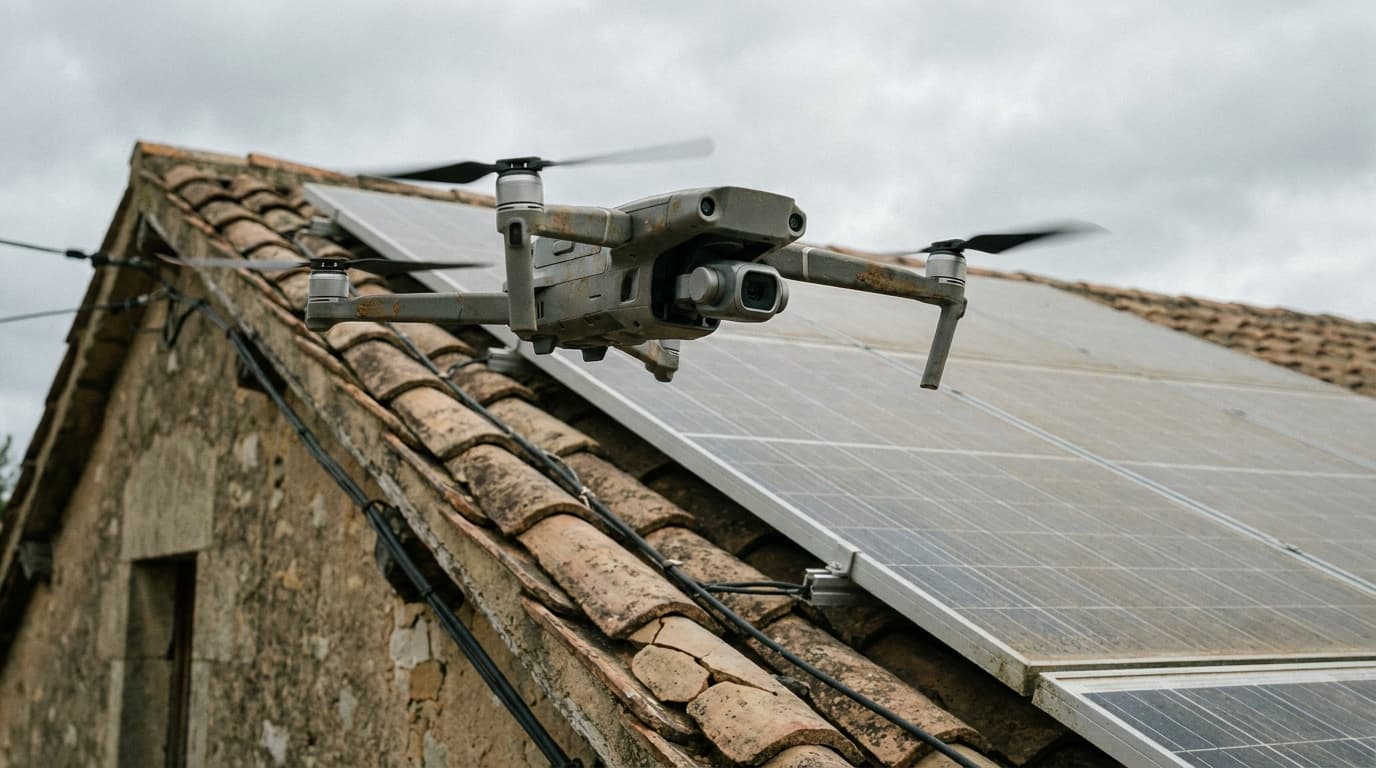
- Defect photos — geotagged, overlapping oblique frames covering tile or membrane cracking, flashing, moss growth, gutter blockage and visible corrosion.
- Thermal imagery, where the job calls for it — moisture ingress under a flat roof membrane, insulation gaps on a facade, underperforming cells on a solar array, heat loss patterns that are invisible in a normal photo.
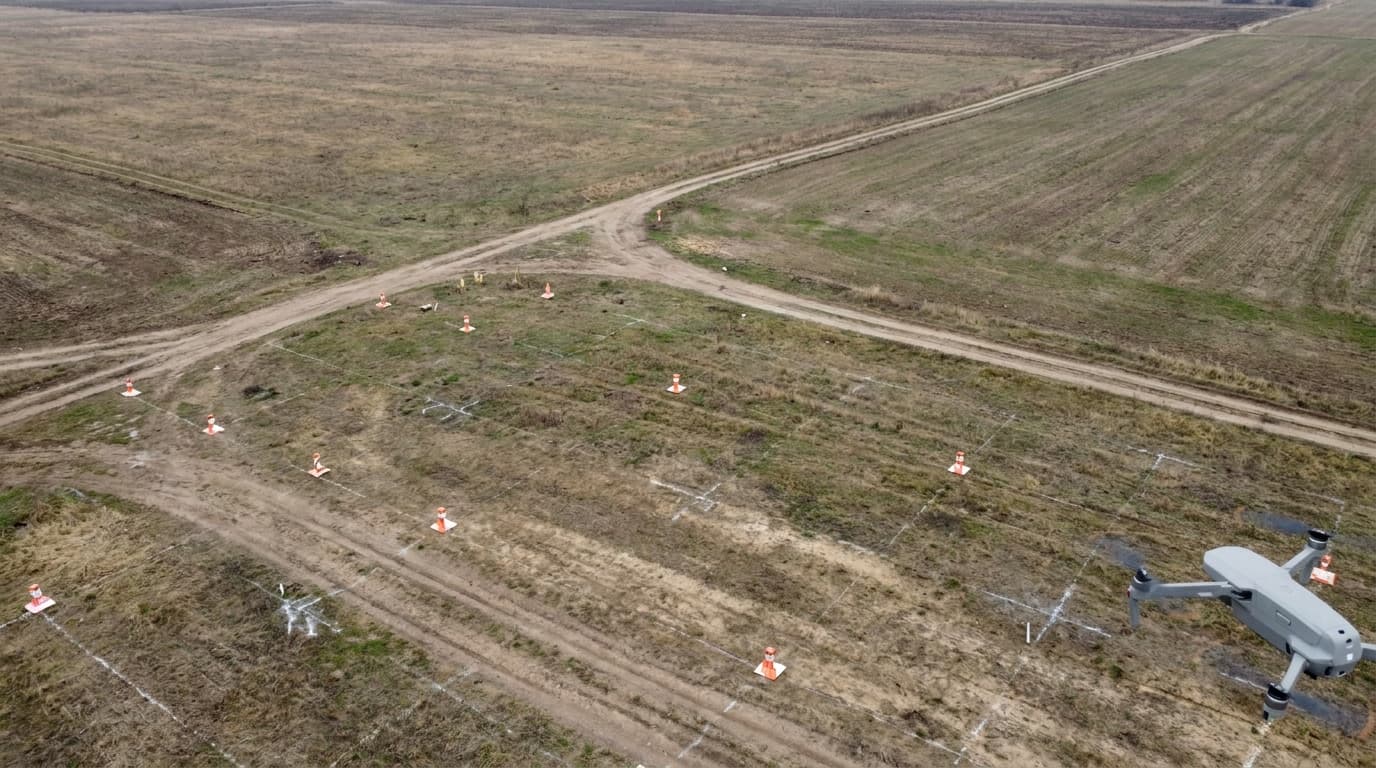
- An orthomosaic or simple photo map of the whole roof or facade for larger sites — a warehouse roof, a solar farm, an industrial yard — where a single oblique pass cannot cover the area.
- A short written report that ties every finding back to a photo and a location on the structure, not a raw folder the client has to sort through themselves.
Building the deliverable set around what the client will actually use — a maintenance decision, an insurance claim, a pre-purchase survey — matters more than flying more photogenic footage.
The legal reality: close to structures, close to people
Two distances matter here, and only one of them is regulated hard.
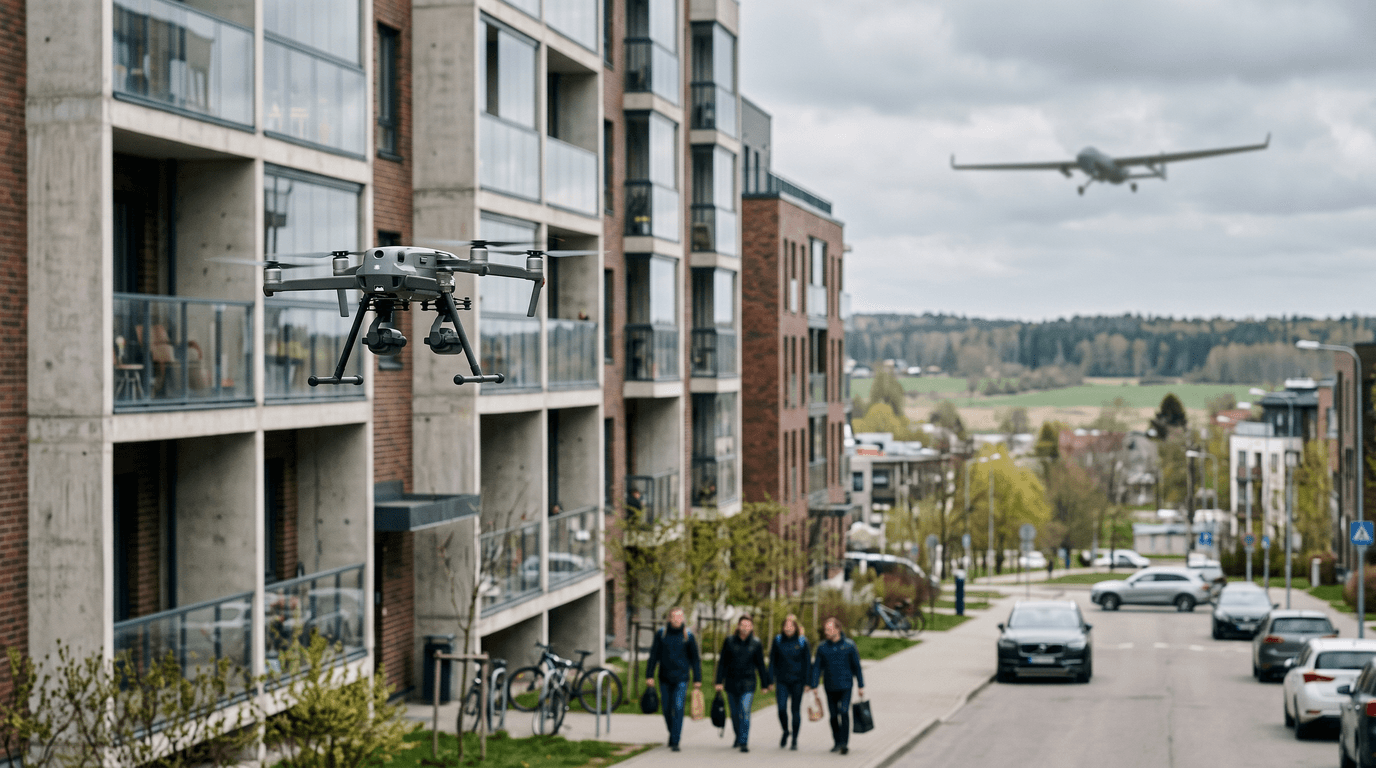
Distance from the structure itself is not restricted by category rules — the general duty to avoid a collision applies to any aircraft, and it is on the pilot to fly a margin they can actually hold. Distance from uninvolved people is where the Open category draws its lines, and roof and facade work almost always happens with people below: residents, staff, passers-by on a street-facing job.
- A drone under 250 g, or one carrying a C0 or C1 class mark, flies in subcategory A1 — close to people is fine, flying over an assembly of people never is. That covers most routine house or small-commercial roof jobs where the drone can stay off to the side of anyone standing below.
- The camera and sensor payloads that professional inspection work actually needs — longer zoom, radiometric thermal — usually push the airframe into C2 class, which defaults to subcategory A3: 150 m from residential, commercial, industrial and recreational areas. That rules out essentially every real inspection site. Closing that distance requires the A2 certificate — an in-person exam on top of the free A1/A3 — after which the minimum clears to 30 m horizontally from uninvolved people, reducible to no less than 5 m with the low-speed mode and the 1:1 principle.
- Height matters for tall structures. Chimneys, transmission towers, wind turbines and industrial stacks can approach the 120 m ceiling that Open-category operations must stay under, measured from the closest point of the surface below the aircraft. For structures taller than 105 m, the rules allow following the structure up to 15 m above it — worth checking against the actual asset height before a survey is scoped, not after the drone is in the air.
When the job pushes into Specific category
Some inspection jobs do not fit inside any Open-category subcategory at all:
- Flying over an assembly of people that cannot be diverted or paused — an active industrial site with staff working directly below, a city-centre facade job over a busy pavement.
- BVLOS work along a long linear asset — a transmission corridor or pipeline run beyond visual line of sight.
- Survey heights that genuinely exceed 120 m, including the terrain-following allowance for tall structures.
Those cases need an operational authorisation in the Specific category, not an Open-category subcategory — a separate declaration and paperwork step that belongs in the scoping conversation before a quote goes out, not something discovered mid-job.
Offering it as a service
- Scope the site before quoting. A zone check on airspace.lv/drones and, where the site falls inside a UAS geographical zone, a BGKIS application, decide which subcategory the job actually needs before promising a date.
- Match the airframe to the job. A sub-250 g drone covers routine house-roof and small-facade work in A1. Larger commercial and industrial sites, where a C2 airframe and its longer zoom or thermal payload earn their keep, need the A2 certificate and its 30 m/5 m clearance from uninvolved people.
- Agree the deliverable set with the client upfront — photo set, thermal, orthomosaic, written report — before flying, not after.
- Registration and insurance stay non-negotiable for anyone doing this commercially; a defect missed under a rushed inspection is a liability question, not just a reputational one.
Inspection sits close to real estate work as an entry point into commercial flying — the access economics and the subcategory logic overlap, and drones for real estate covers the residential end of the same trade-offs. If inspection is one line on a wider service menu, the operator-registration, insurance and pricing questions are covered in how to start a drone business.
What matters now
The economics are straightforward: a drone survey is faster and safer than putting a person on a roof or a rope, and it produces data that a one-off manual pass usually does not. What decides whether a job is legal is not the structure — it is who is underneath it, how close the airframe needs to get to do useful work, and whether the site height or crowd pushes the operation past what the Open category covers. Scope that before the quote, not during the flight.
Next step: roof and facade inspection work almost always means flying near people, which is exactly what the A1/A3 and A2 material covers in detail — prepare with the dronelingo course.