Within two days at Eurosatory 2026 in Paris, Latvia did two things that rarely happen to a country its size in the same week. On June 15 it signed a bilateral letter of intent with the United States to build a joint digital platform for buying drones and counter-drone systems. The next day, its own homegrown interceptor — Origin Robotics' BLAZE — was confirmed as the system France's armed forces had chosen after a months-long evaluation. One deal puts Latvia inside an American procurement marketplace as a potential supplier; the other is a sale of Latvian technology to one of Europe's largest militaries. Together they mark a shift that has been building for two years: Latvia is no longer only a place where counter-drone systems get tested. It is starting to export them.
This is an editorial read of what those two signatures mean — and what they do not yet tell us.
What Latvia signed with the United States
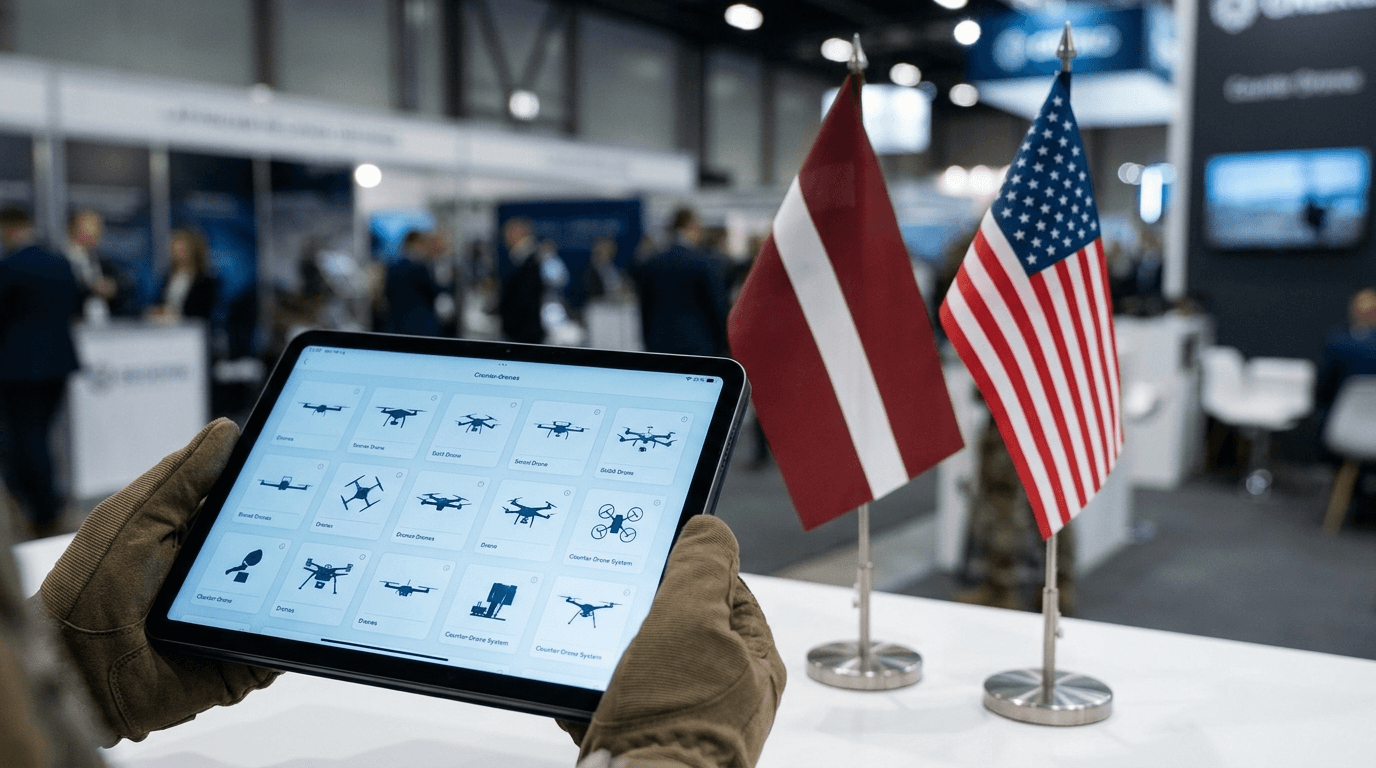
On the first day of the show, State Secretary of the Ministry of Defence Airis Rikveilis met Patrick Mason, the US Deputy Secretary of the Army, and the two sides signed a letter of intent to set up a joint digital drone and anti-drone acquisition platform, according to Latvia's public broadcaster LSM.
The stated aim is speed: cut the time between defining an operational requirement and getting hardware into service. The practical hook for Latvia is access to the US Armed Forces' digital marketplace for unmanned systems — and, in the ministry's own words, the chance to act "as both a buyer and supplier of technology." For a country with a small procurement budget but a fast-growing maker base, the supplier half is the part that matters.
It is worth being precise about what was and was not agreed. The ministry's release named no timelines, no costs, no responsibilities and no locations — LSM flagged that absence directly. A letter of intent is a statement of direction, not a contract. Read it as a door being opened, not a sale being made.
The bigger marketplace — and where Latvia's deal sits beside it
Latvia's bilateral signature sat next to a larger event. On day two, US Secretary of the Army Dan Driscoll led a separate ceremony for a multinational counter-UAS statement of intent, joined by nine NATO allies: Sweden, Denmark, Norway, France, Poland, the United Kingdom, the Netherlands, Italy and Lithuania, the US Army reported. Latvia was not one of the nine; its arrangement is the bilateral one signed the day before.
Driscoll's framing was blunt. The idea is to copy the "market portals that have made so many companies successful" and get "government and other governments' regulation out of the way" — let vendors from participating nations compete in one environment, collect feedback from the soldiers using the kit, and scale what works. The marketplace starts with counter-drone systems and is meant to widen later to drones, radars, sensors and heavier platforms.
For a Latvian maker, the signal across both deals is the same. The route to allied buyers is being redesigned around speed and direct feedback rather than slow national tenders. That favours small, fast companies that already field working hardware — which is exactly what Latvia now has.
France buys BLAZE — the export that matters
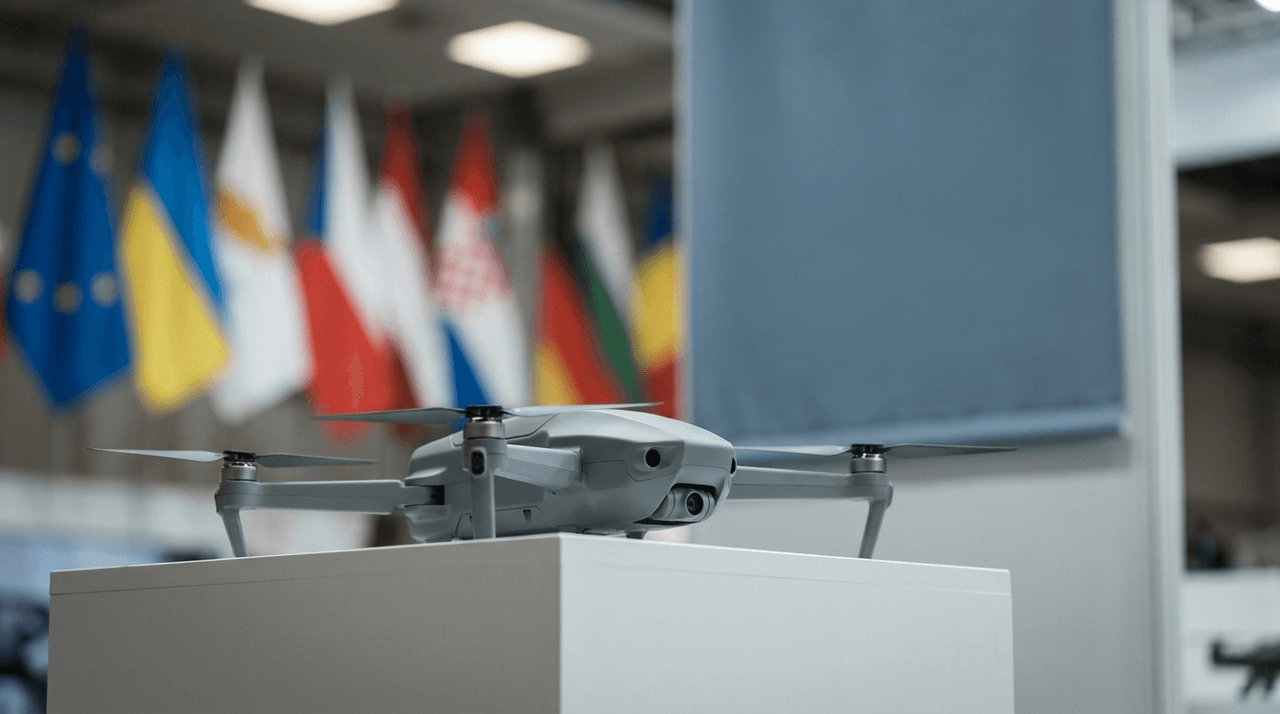
The concrete sale came from Origin Robotics. At Eurosatory the company, together with French defence integrator DSV, confirmed that the French Armed Forces had selected its BLAZE autonomous interceptor after a competitive, several-month evaluation run by France's defence procurement agency, the DGA.
The detail that matters is not the headline — it is the structure of the deal:
- France becomes the fourth European operator of BLAZE, after Latvia, Belgium and Estonia. A system in service with four NATO militaries is past the prototype stage.
- DSV will assemble and manufacture BLAZE in France, under a technology-transfer arrangement and a "Made in France" label. France is not only buying units; it is buying the right to build them.
- First systems are due within weeks, with personnel training starting immediately.
BLAZE is NATO-codified and built to interoperability requirements — the unglamorous paperwork that decides whether allied militaries can actually adopt a system. Origin Robotics' co-founder and CEO, Agris Ķipurs, framed the win as validation: France ran "a very rigorous evaluation process," and passing it confirms the trust the system has earned in the field. Origin's products are already in use in Ukraine as part of Latvia's military aid.
The technology-transfer point cuts both ways. It is how a small supplier reaches a large market — France gets sovereignty and local jobs, Origin gets scale and a reference customer. But it also means the long-term value is not only in units shipped from Latvia; some of it now lives on a French production line.
Why this is a shift, not a one-off
Two signatures in two days look like luck. The industrial base behind them is not.
Latvia spent the last two years turning a security problem on its eastern border into a development advantage. It hosts NATO's counter-UAS innovation range at Sēlija, where electronic-warfare and high-altitude tests run under government exemptions that are hard to get elsewhere in a dense, busy-airspace Europe. Its Autonomous Systems Competence Center can fast-track procurement, compressing cycles that normally take years into months. And through structured cooperation with Ukraine, Latvian developers get feedback from real intercepts rather than simulations. We covered that domestic side in Latvia's counter-drone cluster.
Put those together and the export story follows logically. A maker that can test against realistic threats, sell quickly to its own military, and iterate on operational feedback is in a strong position when allies come shopping. Eurosatory is where that position became visible.
The question the deals don't answer
The economics are the open question. Interceptor drones exist because bringing down a cheap attack drone with a missile that costs orders of magnitude more is a losing trade — a reusable or low-cost interceptor is meant to fix that exchange ratio. But none of the week's announcements put a number on it. France's contract value was not disclosed, and neither was the scale of the US platform. Whether BLAZE-class systems are cheap enough, at scale, to win the cost contest against mass-produced attack drones is still being settled in the field, not on a show floor.
That is the honest read: the deals prove demand and credibility, not yet durable economics. For a young exporter, demand and credibility are the harder things to win first.
What matters now
For anyone tracking Latvia's drone scene, the takeaway is narrow and real. In one week the country signed into a US procurement channel as a would-be supplier and sold a domestically built interceptor to France, with a French production line attached. That is a genuine move up the value chain, grounded in two signed documents — not a press-release ambition.
For readers preparing for civilian certification, none of this changes the rules you fly under. What it changes is the market around them. A country that exports drone technology builds a deeper professional ecosystem — more makers, more integrators, more roles where formal knowledge of the rules is a baseline, not a bonus. The certification guide and practice sets are built to grow exactly that kind of grounded competence.
FAQ
What did Latvia and the US sign at Eurosatory 2026? A bilateral letter of intent, on June 15, 2026, to build a joint digital platform for acquiring drones and counter-drone systems. It gives Latvia access to the US unmanned-systems marketplace as a potential buyer and supplier. No costs or timelines were disclosed.
Is Latvia part of the nine-nation US counter-drone marketplace deal? No. The multinational statement of intent signed on June 16 was joined by Sweden, Denmark, Norway, France, Poland, the UK, the Netherlands, Italy and Lithuania. Latvia's arrangement is the separate bilateral letter of intent from the day before.
What is BLAZE, and who makes it? BLAZE is an autonomous interceptor drone built by the Latvian company Origin Robotics to detect, track and neutralise hostile drones. It is NATO-codified and already operational in Latvia, Belgium and Estonia; France is the fourth European operator.
Why is France manufacturing BLAZE locally? Under a technology-transfer deal, French integrator DSV will assemble and build BLAZE in France under a "Made in France" label. That gives France industrial sovereignty over the system and a domestic supply chain — a common condition when a large buyer adopts a smaller supplier's technology.