Drones for events look like a natural fit: a wedding, a festival, a marathon start line, all shot from an angle no ground camera can reach. They also sit on the hardest legal ground in consumer droning, because the one thing every one of these events has in common — a crowd — is exactly what the Open category was built to keep drones away from. This article covers why the crowd problem is real, and how event operators actually work around it without breaking the rules.
The appeal is obvious
A rising drone shot at the start of a wedding video, a festival crowd from above showing the scale of the stage, a race captured as a single sweeping line through a city — these shots sell themselves, and clients ask for them by name. Compared to a helicopter or a crane, a drone is cheap, fast to deploy and flexible between locations in the same afternoon. For a videographer or a small production company, event work is one of the more visible ways a drone earns its keep.
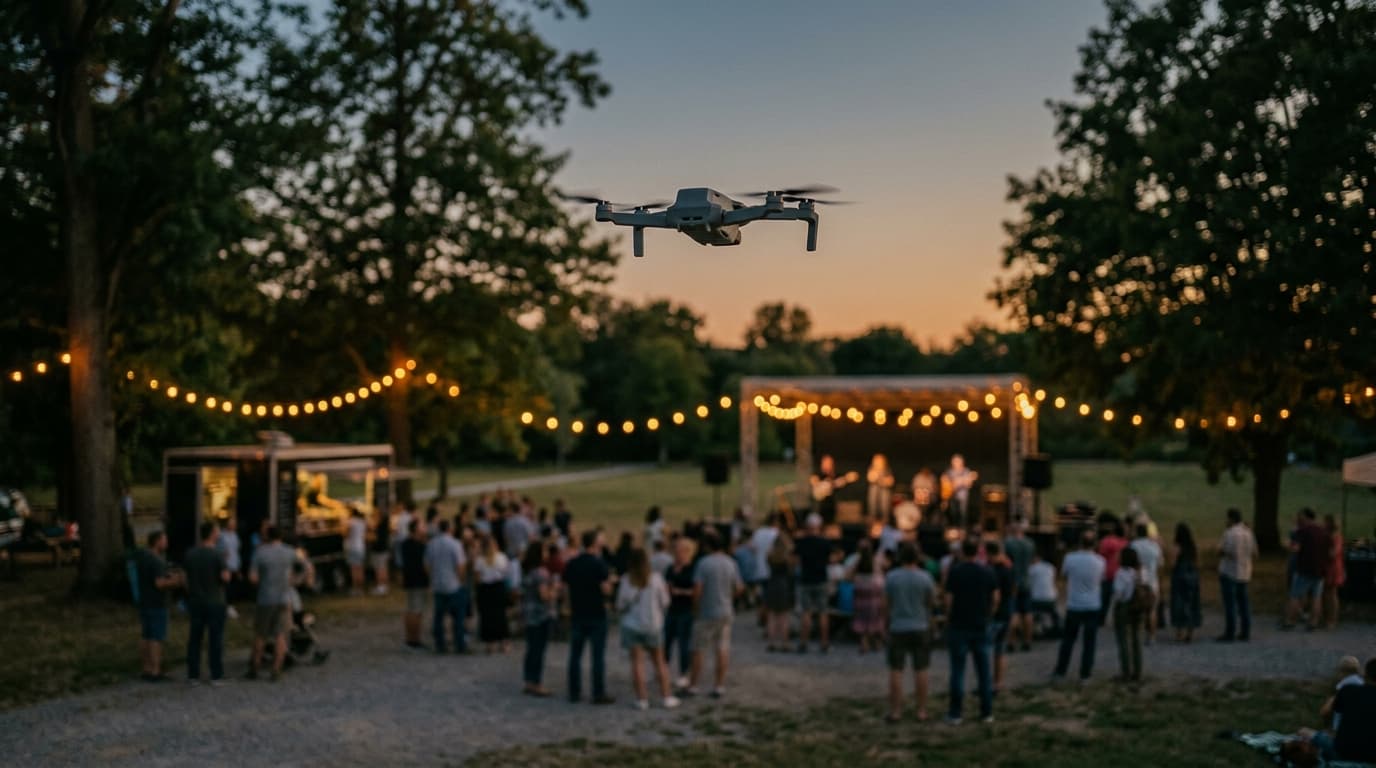
The catch is that none of these events happen in an empty field. A wedding has guests standing together for the ceremony. A festival has, by definition, a crowd. A marathon has spectators lining the route and a mass of runners at the start. All of that is exactly what drone regulation calls an assembly of people — and flying over one is where the Open category draws a hard line.
The crowd problem
Under the EU Open category, flying over an assembly of people is not allowed — full stop. This isn't a distance rule that a lighter drone can get around: it applies across subcategories A1, A2 and A3, and it applies regardless of the drone's class mark. A sub-250 g C0 drone that can legally fly close to individual bystanders in A1 still cannot fly over a group of people who cannot move away from each other, which is the practical definition of an assembly. Wedding guests seated for a ceremony, a crowd in front of a festival stage, spectators packed along a start line — all of these count.
This is the part most people booking a "drone for our wedding" don't expect: the classic shot of a drone rising directly above the ceremony, guests included in frame beneath it, is not something the Open category permits. It's not a paperwork inconvenience to route around with a bigger drone — the prohibition applies to every Open-category subcategory equally.
How pros actually shoot it
Professional event operators don't fly over the crowd; they work around it, using a mix of positioning, timing, category choice and permissions.
- Standoff and off-axis framing. The rising establishing shot at a wedding is usually flown from the side or from behind the seating, over ground with no guests on it, using a longer lens and perspective compression to read as "above the ceremony" without the aircraft ever passing over the assembled guests. The same trick works for festival stage shots: fly the orbit over the open area behind the crowd, not over the crowd itself.
- Timing around the gathering. An empty venue, an empty stadium, or an empty finish line before or after people fill it gives the same establishing shot without an assembly beneath the aircraft. Many of the wide "sense of scale" shots used in event edits are captured before doors open or after the crowd disperses, then cut in alongside ground footage of the actual event.
- The Specific category, when the shot genuinely requires it. If a production genuinely needs to fly over a crowd — a broadcast drone for a stadium event, a large festival's official aerial unit — that operation sits in the Specific category, not Open, and requires an operational authorisation from the competent authority based on a documented risk assessment. This is a materially higher bar than an A1/A3 or A2 certificate: it's built around the specific event, the specific aircraft, and mitigations agreed in advance, not a general licence to fly over people. Most wedding and small-event videographers never need to go there, because the standoff and timing approach covers the shots clients actually want.
- Coordination with the organiser. Even where a flight stays legal without an assembly beneath it, large public events often have their own airspace considerations — temporary restrictions, other aircraft (a helicopter or a display team), security perimeters. Event organisers and, where relevant, local authorities should know a drone will be flying before the day, not find out from a livestream.
Anyone building a business around this kind of shoot should treat the subcategory and permission question as part of the quote, not an afterthought — the same way it's covered for other commercial niches like property photography, where the built-up-area constraint plays a similar role.
Privacy and consent
Even a legally flown shot raises a separate question: who's identifiable in the footage, and did they agree to be filmed. A wedding couple hiring a drone operator has clearly consented; their guests, standing in frame, usually haven't been asked individually. For a public festival or a race, hundreds of attendees are recorded without any of them signing anything.
In practice, event operators handle this with a mix of measures: event organisers post visible signage or include drone-filming notice in the event's terms so attendees are informed before entering; wedding contracts typically cover use of the footage but rarely name every guest; and for close, identifiable shots of specific attendees rather than a wide crowd, some jurisdictions' data protection rules effectively require the same consent a ground photographer would need. None of this changes the flight rules above it — a legal flight can still create a footage-handling problem if identifiable people end up in a shot that gets published without a clear basis for using it.
What matters now
Event work is one of the more attractive commercial niches for a drone operator, but it's also the one where "can I fly this" and "can I fly it right there, over those people" are genuinely different questions. The Open category's ban on flying over assemblies of people applies regardless of drone weight or class, and it doesn't bend for a nice occasion. The shots clients actually want — a rising establishing frame, a sense of scale, a sweeping line through a route — are almost always achievable without ever putting the aircraft over the crowd, through standoff positioning, timing, and knowing when a shot genuinely needs Specific-category authorisation instead. Anyone weighing this as a business line, not just a one-off favour for a friend's wedding, should also read how to start a drone business before pricing the first job.
Next step: get the category and distance rules right before you ever point a drone at a crowd — start with the free A1/A3 and prepare with the dronelingo course.