Sample questions
Meteorology
A free preview of real exam-style questions for this topic — each with the correct answer, an explanation, and the official source it is based on.
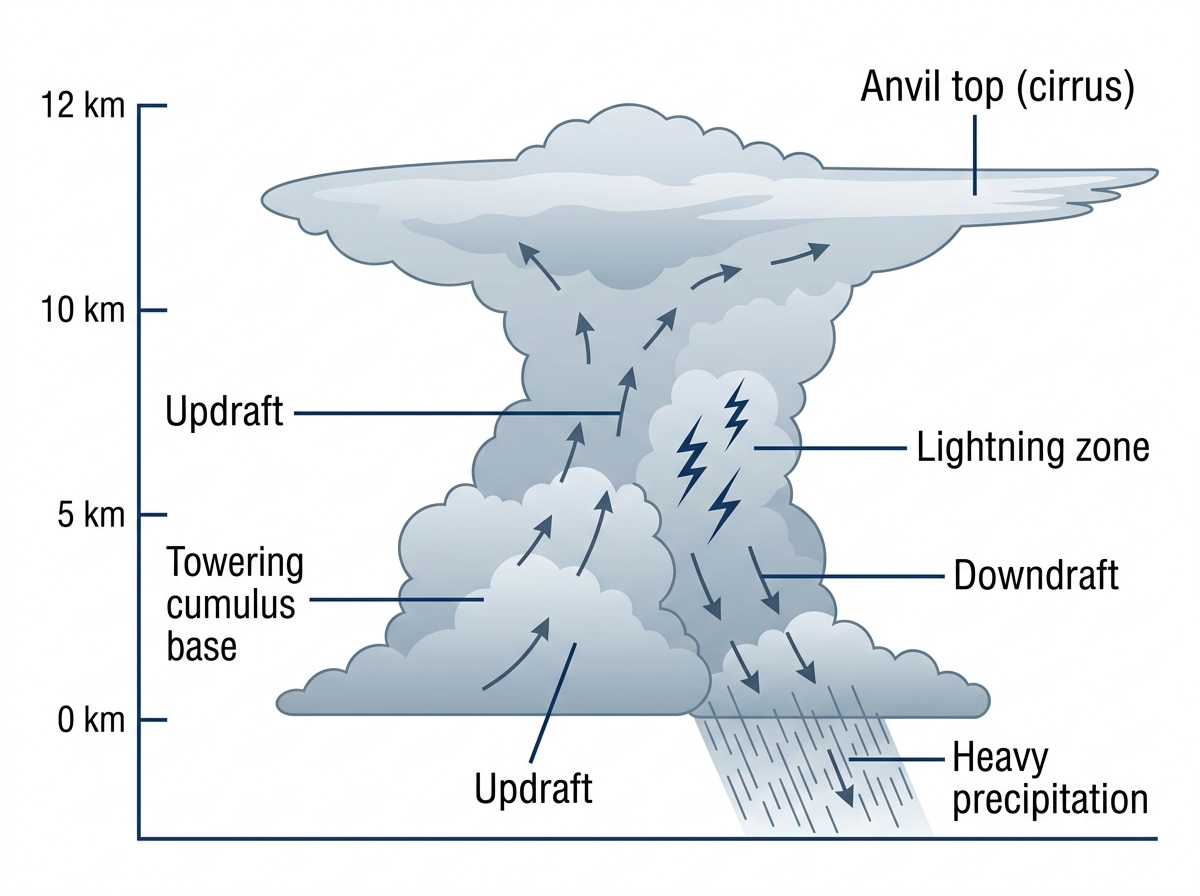
01The image shows a cloud type. What is the primary risk to drone operations even at a distance of 5 km from this cloud?
- No risk — 5 km is a safe distance.
- Severe turbulence, downdrafts and gust fronts that can extend far from the cloud. — Correct answer
- Only light drizzle if the wind blows from the cloud direction.
- Improved visibility due to moisture absorption inside the cloud.
A cumulonimbus is the most dangerous cloud type for a small UAS. Even if the heavy rain has not yet reached your position, it can still bring strong gusts, downdrafts and lightning risk at a distance. At 5 km the conservative answer is no-go.
AMC1 UAS.OPEN.030↗; meteorological hazards (cumulonimbus)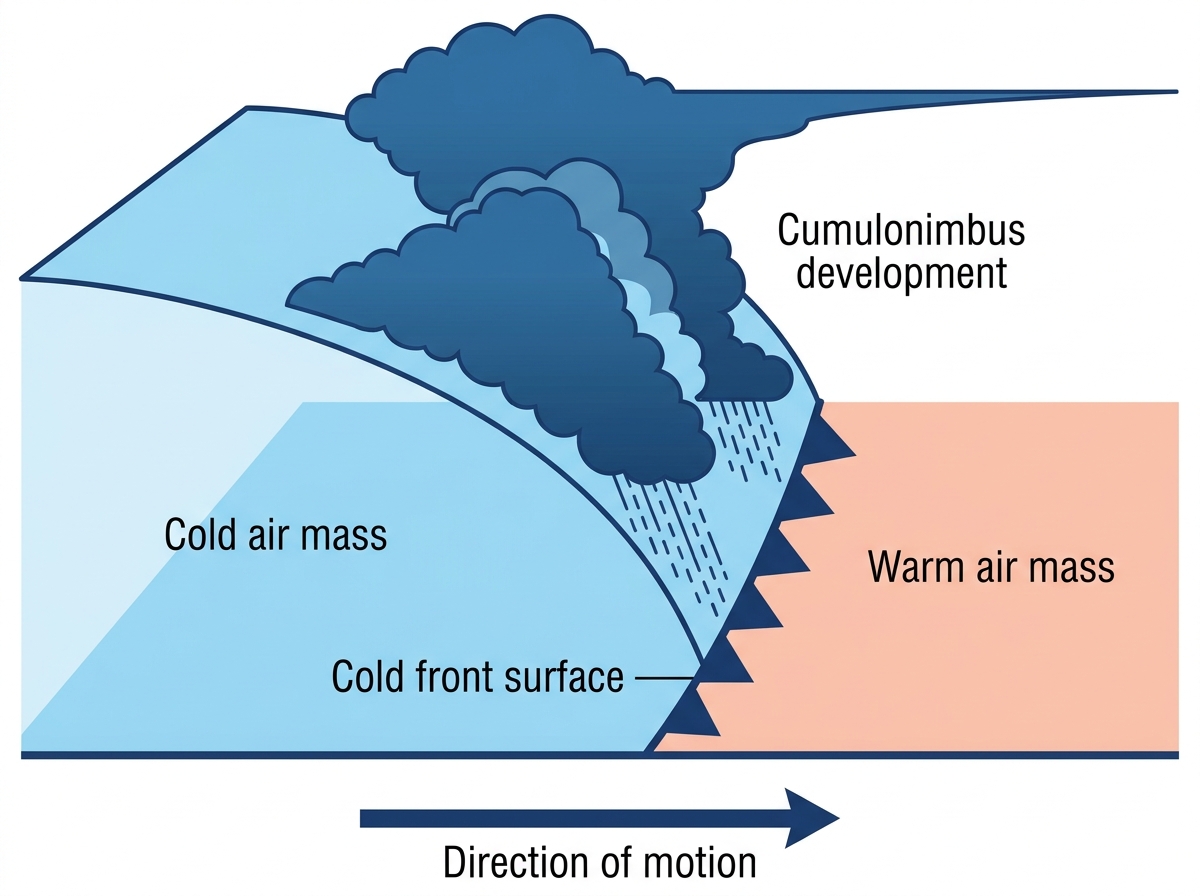
02The image shows a cold-front cross-section. Which weather conditions are most likely after it passes over your flight location?
- Sudden wind shift, gusts, brief heavy showers or hail, then improving visibility and lower temperature. — Correct answer
- Steady warm rain lasting 12–24 hours.
- Calm windless conditions and haze for several days.
- Temperature rises by 10°C and clouds dissipate.
A cold front often brings an abrupt wind shift, gusts, brief heavier showers or hail, followed by cooler and clearer air. For a drone pilot, the key point is not to launch through the frontal passage and to re-check gusts after it has moved through.
UAS meteorology↗; fronts and air masses03What does the METAR wind report "27012G22KT" mean?
- Wind from 270° at mean speed 12 knots, gusting to 22 knots. — Correct answer
- Wind from 270° at mean speed 22 knots, gusting to 12 knots.
- Wind from 120° at 27 knots.
- Wind distance 2712 m in direction with gusts of 22 KT.
METAR wind format: [direction 3 digits]°[mean speed 2-3 digits]G[gusts]KT. 27012G22KT: 270° (west), mean 12 knots, gusting to 22 knots.
Meteorological Service for International Air Navigation; METAR format04Your drone is rated at 10 m/s. METAR shows 09008G18KT. Is flight permitted?
- Yes — the mean wind (8 KT = 4.1 m/s) is well within limits.
- No — 18 KT ≈ 9.3 m/s exceeds the 10 m/s limit. — Correct answer
- Yes if the flight stays below 50 m altitude.
- No — the gusts (18 KT ≈ 9.3 m/s) approach the 10 m/s limit; safer to postpone.
18 KT × 0.514 ≈ 9.3 m/s. This does NOT technically exceed the 10 m/s limit, but at 9.3 m/s the drone is operating extremely close to its rated maximum. Any additional gust spike can exceed the limit. The safest answer is d — operating at 93% of the rated maximum in gusty conditions is not safe practice.
EASA Easy Access Rules — AMC1 UAS.OPEN.030↗; manufacturer wind rating standards05What is the minimum safe distance from a cumulonimbus (Cb) for UAS operations?
- 1 km.
- 5 km.
- 10 km. — Correct answer
- 20 km.
The minimum recommended distance from an active cumulonimbus is 10 km. Lightning discharge range, severe turbulence, and large hail risk extend significantly beyond the visible cloud boundary. 10 km is the minimum — further is always safer.
Manual of Aeronautical Meteorology; A2 syllabus meteorology↗06Under which combination of conditions does propeller icing form?
- Temperature +20°C, high humidity.
- Temperature -5°C, dry clear air.
- Temperature +10°C, light rain.
- Temperature +2°C, flying through cloud or freezing drizzle. — Correct answer
Icing requires two simultaneous conditions: temperature near or below 0°C AND visible moisture (cloud droplets, freezing drizzle). At +2°C in cloud, supercooled water droplets freeze on contact with the propeller surface.
aeronautical meteorology; A2 syllabus icing conditions↗
Want the full set?
This is a preview. One-time full access unlocks every question for this topic, all other topics, and unlimited mock exams.