
An approved request in BGKIS can feel like the finish line. It is not. The approval clears one specific thing — coordination for that zone — and it does not touch the rest of the rules. It is also not guaranteed to still hold when you arrive. In the minutes before takeoff, a careful pilot confirms that the approval is current, the conditions have not changed, and the baseline rules are still being met.
Treat the approval as one item on a pre-flight check, not as permission to stop checking.
The status can change
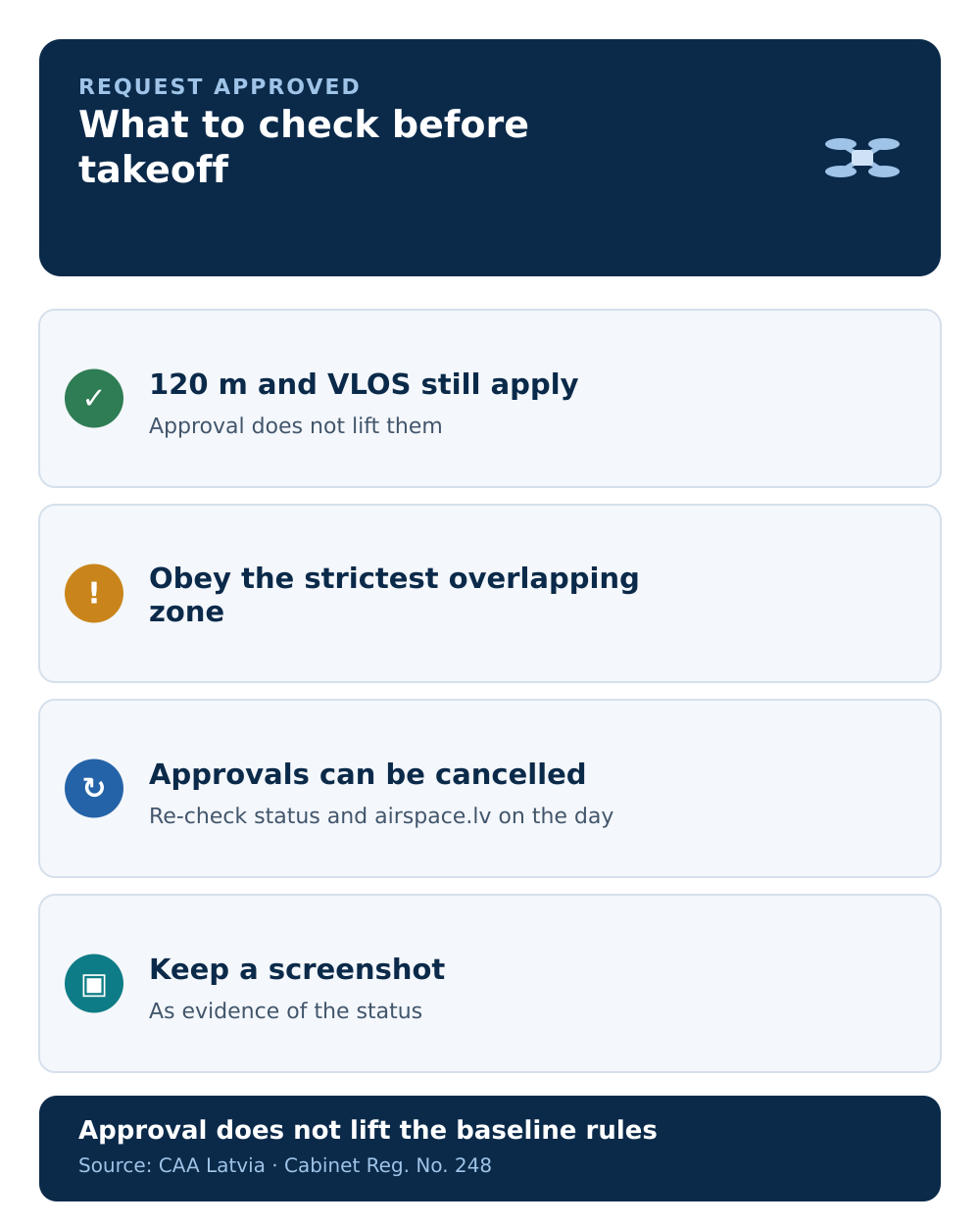
The most important point: a coordination approval can be cancelled. The CAA is explicit that approvals received from a zone manager may be withdrawn, so re-check the request status in BGKIS before you fly. An approval you saw yesterday is not proof of approval today.
Alongside the status, re-read any conditions the zone manager attached. A coordination decision can come with specific requirements, and those are part of the approval, not optional extras.
The airspace can change
Zone conditions and airspace restrictions are not static — they can change several times a day. The single official source is airspace.lv/drones, and you check it before every flight, including this one. The map inside BGKIS is only for coordination and does not show all current conditions, which is the split we cover in BGKIS or airspace.lv.
If a new restriction has appeared over your site since you filed, it applies regardless of your approval.
The baseline rules still apply
This is where approvals are most often misread. A decision in a zone does not let you depart from the baseline requirements:
- Maximum height. You still fly no higher than 120 m in the open category, even if the zone's upper limit is higher — and lower where an overlapping zone says so.
- Visual line of sight. An approval does not mean you are alone in the airspace; other users may be present, so you keep the drone in sight unless you hold the proper specific-category authorisation.
The zone approval narrows one risk in one place. It does not rewrite the rules you already fly under.
A pre-takeoff check
Run through this on site, before you launch:
- Request status in BGKIS is current and, for a coordination zone, approved.
- Attached conditions from the zone manager are read and met.
airspace.lv/dronesshows nothing new over your location today.- Height and distance plans stay within 120 m and the strictest overlapping limit.
- Visual line of sight is maintainable for the whole flight.
- Operator registration and pilot details are still valid.
For the general aircraft-and-environment checks that sit around this, see our pre-flight checklist.
If something doesn't line up
If the status is no longer approved, a new restriction has appeared, or a condition cannot be met, the flight does not go ahead as planned. Re-coordinate, adjust the plan, or stand down. An approval that no longer matches the current picture is not cover for flying anyway.
The takeaway
The approval answers "is this flight coordinated in this zone?" — and only that. Before takeoff, confirm it is still true, confirm the airspace has not changed, and confirm you are inside the baseline rules. Those three checks are quick, and they are what keep a coordinated flight a legal one.
Next step: see how the whole flow fits together in BGKIS from 2025.