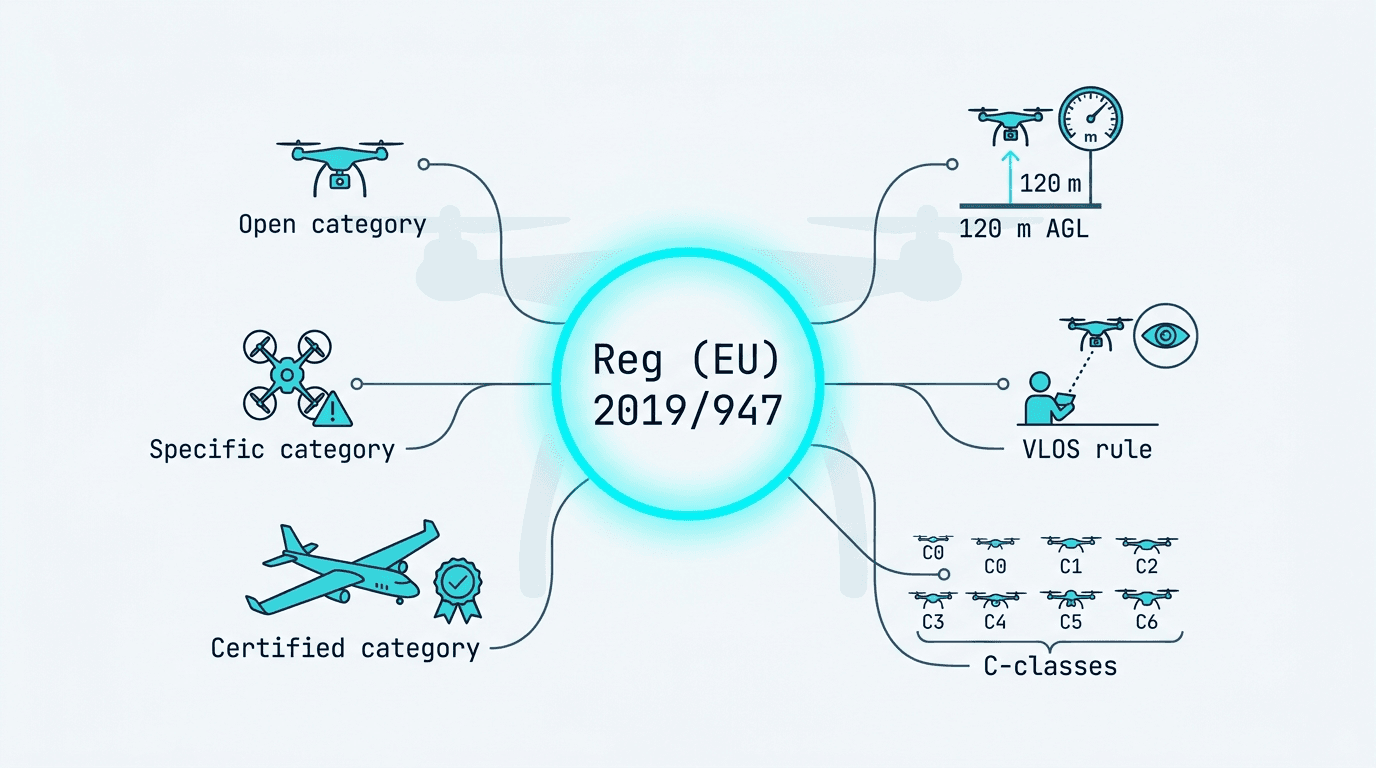
Reg. (EU) 2019/947 is the operational backbone of drone flying in Europe. You don't need to memorise the whole text, but you do need to understand the structure it sets up.
The three categories
The regulation splits drone operations into three categories:
| Category | Main idea |
|---|---|
| Open | lower-risk operations inside fixed limits |
| Specific | operations that go beyond those limits |
| Certified | the highest-risk operations, closer to manned-aviation logic |
For most private pilots and many simple commercial flights, the category that matters is Open.
What Open is built on
The Latvian CAA Open-category summary highlights the core limits that shape everyday flying:
- aircraft up to
25 kg - flight in VLOS
- maximum height of
120 m - clear limits around bystanders and crowds
- following the geographical-zone restrictions
The Open category then splits into A1, A2, and A3, depending on the aircraft and how close you are to bystanders.
Registration is part of the system
The regulation doesn't start with the aircraft alone. It also separates the operator and the remote pilot as two roles.
In Latvia, that distinction matters in practice because:
- the operator gets the number used to mark the drone
- the remote pilot is the person tied to the qualification path
If you fly as a private person in your own name, you usually hold both roles at once.
Qualification depends on the operation
One of the most common mistakes is talking about “a drone licence” as if there were only one.
In the Open-category logic:
- A1/A3 is the basic qualification path where it's required
- A2 is an extra step for the closer
C2case
So you should always read qualification together with:
- aircraft class or mass
- subcategory
- distance from bystanders
C-class labels matter
Reg. (EU) 2019/945 sits next to 2019/947 and defines the class-marking system used in practice:
C0C1C2C3C4
These labels are not just technical stickers. They affect which Open-category subcategory the aircraft can realistically fit into.
Geographical zones are national
The EU regulation lets member states define their own UAS geographical zones. So one of the most important local checks in Latvia sits outside the EU text itself: the national zone system and the official Latvian map.
So the practical reading order is:
- work out the EU category and subcategory
- confirm the aircraft class or mass
- then apply the Latvian geographical-zone restrictions
Older aircraft still need careful reading
Older aircraft without a C-class mark are not automatically unusable, but they don't fit the system as cleanly as newer class-marked aircraft. The Latvian CAA summary makes clear that, after the transition period, older aircraft often end up with narrower Open-category options.
So check older drones case by case against:
- aircraft mass
- the subcategory you have in mind
- the local operating environment
What this regulation is really doing
In practical terms, Reg. (EU) 2019/947 has one job: it turns risk into rules you can apply before take-off.
Instead of asking “Can this drone fly?”, the better question is:
- which category is the operation in?
- which subcategory does it fit?
- what registration, qualification, and local restrictions follow from that?
Once those answers are clear, the rest of the regulation is much easier to read.
Need the Open-category breakdown itself? Continue with our A1/A2/A3 comparison.