"My kid got a drone for their birthday — can they fly it?" It is one of the most common questions a new drone family asks, and the answer almost everyone gives is wrong. The popular version goes: anything under 250 grams has no rules, so any age is fine. The real rule is more precise, and the gap between the two is exactly where people get caught.
The minimum age for a remote pilot is set by EU law, the same Regulation (EU) 2019/947 that governs the whole open category. Here is what it actually says, the three exceptions where age stops mattering, and what Latvia chose to do with the one piece of national discretion it was given.
The default rule: 16 years
Article 9(1) is short and blunt: the minimum age for a remote pilot operating in the open and specific categories is 16 years. That is the baseline across the EU, and it is the number CAA Latvia publishes on its open-category page.
Note what "remote pilot" means here. It is the person at the controls — the one flying the aircraft. It is a separate role from the operator, the legal entity (a person or a company) registered with the authority and responsible for the drone. The operator must be at least 18 (or a registered organisation); the pilot is the one the 16-year rule is about. Confusing the two is a classic exam trap, and we cover it in UAS operator vs remote pilot.
When no minimum age applies — the three exceptions
Article 9(2) lists the situations where there is no minimum age at all. There are exactly three, and the wording matters:
- An A1 flight with a Class C0 drone that is a toy. Specifically, a UAS carrying the C0 class mark that qualifies as a toy under Directive 2009/48/EC — the EU Toy Safety Directive. These are products designed and CE-marked as toys for children, not camera drones that merely happen to be light.
- A privately-built drone under 250 g. If you built the aircraft yourself and its take-off mass is below 250 grams, no age floor applies.
- Flying under direct supervision. A younger pilot may fly with no age requirement when operating under the direct supervision of a remote pilot who meets the 16-year minimum and holds the required competency under Article 8. "Direct supervision" means the qualified pilot is right there, able to intervene — not reachable by phone.
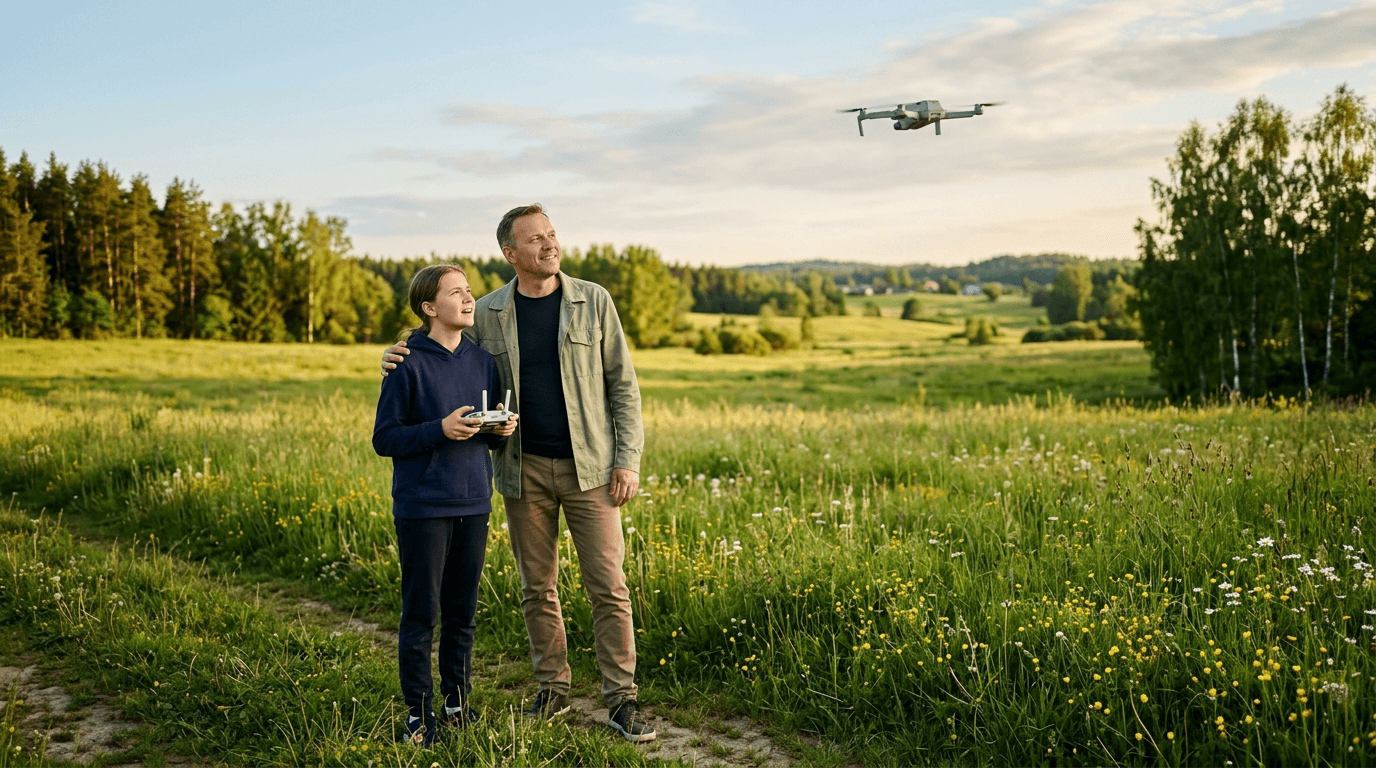
That third exception is the practical one for most families: an adult who is qualified and 16-plus can let a younger person fly, hands-on, with the adult ready to take over.
"Under 250 grams" is not the free pass everyone thinks
Here is the trap. The under-250 g class is famous for needing no pilot training and no online theory test, and people stretch that into "so a child can fly any sub-250 g drone." Read the exceptions again: the no-age rule applies to a sub-250 g drone only if it is a CE toy (exception one) or self-built (exception two).
A bought sub-250 g camera drone is neither. A DJI Mini, for example, carries a C0 class mark and weighs under 250 g, but it is not a toy under the Toy Safety Directive — manufacturers explicitly state these are not toys — and you did not build it. So a young person flying one is not covered by the no-age exceptions. They still need to be 16, or to fly under the direct supervision of a qualified adult.
The two requirements are separate, and that is the whole confusion:
- Competency (the online training and A1/A3 test) is waived for any sub-250 g or C0 drone, whatever its origin. CAA Latvia requires the training and test only for drones of 250 g and above.
- Age is only waived for the three specific cases above.
A sub-250 g camera drone removes the exam but keeps the age. Get that pair right and the rest of the topic falls into place. If you are still sorting out which class your drone belongs to, a drone with no C-class label and the weight classes that actually matter are the place to start.
Can a country lower the age? What Latvia did
The regulation gives Member States one lever. Article 9(3) lets a country lower the minimum age, following a risk-based assessment of operations on its territory — by up to 4 years in the open category and up to 2 years in the specific category. Taken to the limit, that means an open-category minimum as low as 12, and a specific-category minimum as low as 14.
Two conditions come attached. A pilot flying under a lowered national age (Article 9(4)) may operate only on the territory of the Member State that lowered it — the concession does not travel across the border. And a country can set a separate age for pilots flying within a recognised model-aircraft club or association, under the Article 16 authorisation that governs those clubs.
Latvia did not use this lever. CAA Latvia's open-category guidance states the minimum age plainly as 16, with no national reduction. So in Latvia the answer is the EU default: 16, unless one of the three exceptions applies. If you are planning to fly abroad, do not assume the country you visit made the same choice — and remember a lowered age elsewhere would not carry into Latvia anyway. The cross-border picture is in flying your drone in another EU country.
Why this is on the A1/A3 exam
Minimum age is a named item in the A1/A3 theory syllabus, and it is a favourite because it has a clean wrong answer waiting. A candidate who remembers "16" but not the exceptions loses the question about the supervised under-16; a candidate who over-learned "under 250 g has no rules" answers a flat "no age limit" and gets it wrong for a bought Mini. The exam rewards the precise version: 16 by default, three exceptions, and the difference between waiving the test and waiving the age.
Quick reference before you hand over the controller
- Default: 16. The remote pilot — the person flying — must be 16 in the open and specific categories.
- Operator ≠ pilot. The registered operator must be 18+; the 16 rule is for the pilot.
- No age only for: an A1 Class C0 CE toy, a self-built sub-250 g drone, or flying under the direct supervision of a qualified 16+ pilot.
- A bought sub-250 g camera drone keeps the age rule — it is neither a toy nor self-built.
- Competency and age are separate: sub-250 g/C0 waives the online test; it does not waive the age.
- Latvia keeps 16 — no national lowering. A lower age set in another country applies only there.
Age is one of the small rules that decides whether a flight is legal before the drone even leaves the ground. Once you have it straight, line it up with the open category A1, A2 and A3 and what the A1/A3 exam in Latvia expects, then drill the regulation questions in the practice sets — "how old do you have to be" is exactly the kind of question that looks easy until the answer has three exceptions.