Sooner or later, a working drone pilot hits the ceiling of the Open category: a client wants a flight beyond visual line of sight, a survey needs more than 120 m of altitude, or the aircraft itself is heavier than 25 kg. At that point three acronyms appear at once — STS, SORA, PDRA — and it is rarely obvious what each one is, or which one actually applies. This article sorts out the vocabulary: what the Specific category is, and what the three routes into it mean in practice, including how the process runs in Latvia.
If you first want to check whether your operation has actually left the Open category, start with when do you need the Specific category. Here we assume the answer is yes.
The Specific category runs on risk, not on fixed limits
The Open category works on fixed limits: keep the drone in sight, stay under 120 m, stay away from people according to your subcategory. Cross any of those lines and the flight is no longer Open. Under Regulation (EU) 2019/947, the Specific category covers operations such as:
- flights beyond visual line of sight (BVLOS);
- flights above 120 m over ground or water;
- aircraft with a take-off mass above 25 kg;
- flying closer than 150 m to residential, commercial, industrial or recreational areas with a drone over 250 g that carries no C0, C1 or C2 class mark;
- dropping material or spraying;
- operating several drones at once.
The logic changes with the category. Open asks: does your flight fit inside the published limits? Specific asks: have you shown that the risk of this particular operation is acceptable? Everything therefore revolves around one of two documents from the UAS operator — the party responsible for the operation, not necessarily the one holding the sticks:
- an operational declaration, when the flight matches a published standard scenario (STS-01 or STS-02); or
- an operational authorisation issued by the aviation authority, when a risk assessment demonstrates the operation is acceptably safe.
One detail worth underlining: the category is decided by the flight, not the purpose. A purely recreational flight that departs from Open-category conditions puts a private individual in front of the same choice — declaration or authorisation.
One method, three levels of pre-packaging
STS, PDRA and SORA are not three unrelated systems. They are the same risk logic at three levels of standardisation.
| Route | Paperwork | When it applies |
|---|---|---|
| SORA | Operational authorisation | Any operation that fits no pre-defined template |
| PDRA | Operational authorisation | Operation matches a pre-defined risk-assessment profile |
| STS | Declaration | Operation matches STS-01 or STS-02 exactly, with a C5/C6 drone |
SORA — the Specific Operations Risk Assessment — is the general method underneath everything. PDRA — pre-defined risk assessments — are SORA exercises the regulators have already worked through for common operation types and published as templates. STS — standard scenarios — are the most standardised subset of all: specified so tightly in the regulation itself that a declaration replaces the case-by-case authorisation. Read the table bottom-up: the more standard the operation, the less assessment work lands on you.
STS: a declaration instead of an authorisation
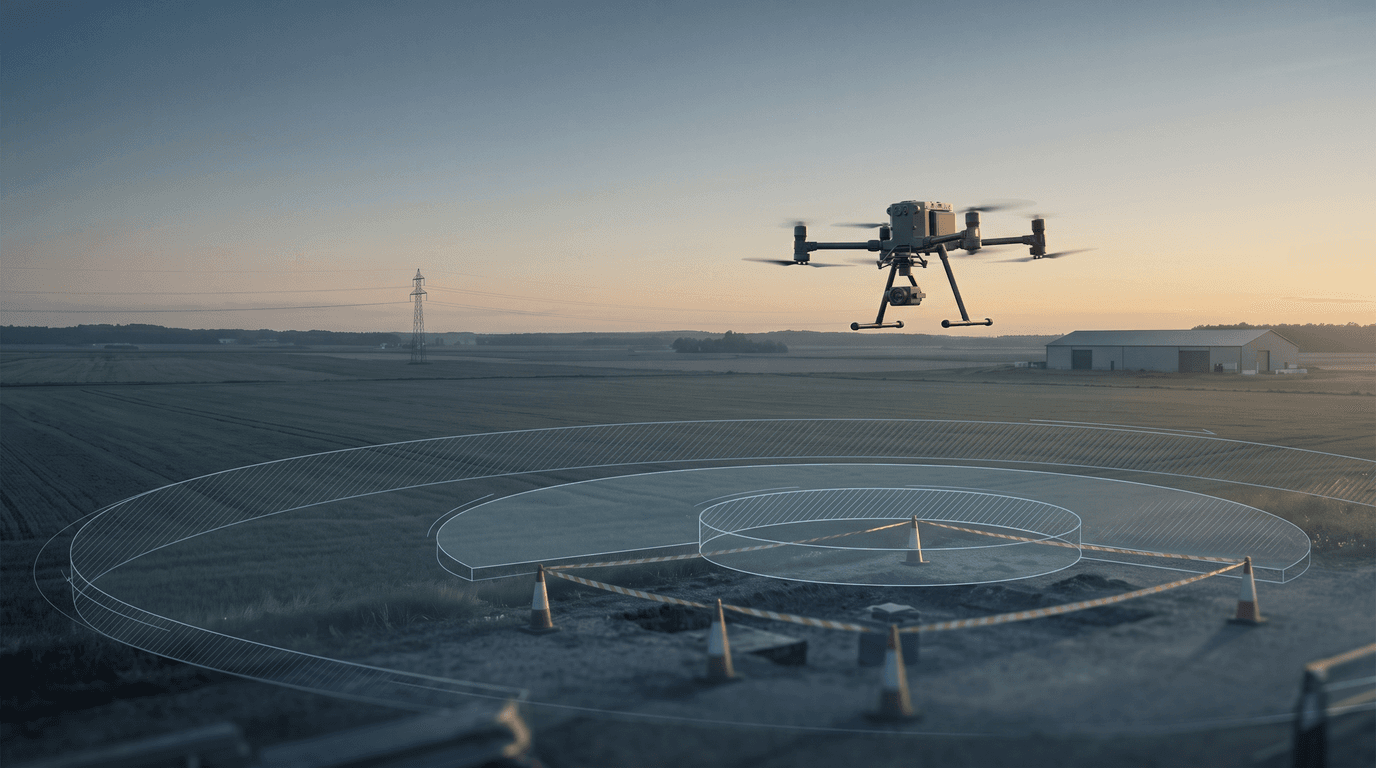
There are two standard scenarios in the EU regulation. STS-01 covers flights within visual line of sight over a controlled ground area in a populated environment, and requires a C5-class drone. STS-02 covers BVLOS flights with airspace observers over a controlled ground area in a sparsely populated environment, and requires a C6-class drone. The full comparison is in STS-01 vs STS-02.
If the operation matches one of these scenarios exactly, the operator submits a declaration and does not wait for an individual authorisation. The requirements split across two roles:
- the operator submits the operational declaration;
- the remote pilot needs an STS theoretical-knowledge certificate plus an accreditation confirming completed practical training for the specific scenario.
The pilot side is a real step up from the Open category: the STS theory exam goes beyond A2 level, covering — alongside regulation, human performance and operational procedures — technical and operational mitigations for air and ground risk, meteorology and UAS flight performance.
PDRA: the assessment is done, the authorisation is not
Pre-defined risk assessments sit one step below STS in standardisation. The authority has already run the SORA for a typical operation profile and published the outcome; the operator applies for an operational authorisation referencing that PDRA instead of building an assessment from scratch.
Two families matter in practice. PDRA-S01 and PDRA-S02 mirror STS-01 and STS-02 but drop the requirement for a C5 or C6 class mark — which makes them the working route for drones without class labels flying an STS-shaped mission. PDRA-G01 to G03 cover more general profiles: BVLOS outside populated areas in uncontrolled airspace up to 150 m, BVLOS in reserved airspace, and BVLOS in so-called atypical airspace close to obstacles or below 30 m. Pilot qualification for the PDRA routes builds on the same STS theory certificate and practical accreditation.
The trade-off against STS is simple: no class-marked drone required, but a declaration no longer suffices — you need the authorisation.
SORA: the full assessment, when nothing pre-baked fits
When the operation matches neither a standard scenario nor a PDRA, the operator runs a full SORA. The method walks through ground risk and air risk, the mitigations that reduce them, and lands on a SAIL level (Specific Assurance and Integrity Level) that scales how much evidence the operator must present. The output goes to the authority as an application for an operational authorisation.
It is the most flexible route and the most demanding — the point where a drone operation starts looking like a small aviation business: the application includes the risk assessment, the list of mitigation measures, an operations manual covering procedures, personnel responsibilities and training, plus proof of insurance.
How the process runs in Latvia
In Latvia the counterpart for everything above is the Civil Aviation Agency (CAA), and the paperwork goes through the e.caa.gov.lv portal.
For the pilot, the sequence is concrete. The prerequisites for the STS theory exam are an LVA-RP pilot number and a valid A1/A3 certificate. The exam itself is taken in person at the CAA, in Latvian: 40 multiple-choice questions in 40 minutes, pass mark 75%, 20 EUR for the first attempt and 15 EUR for a retake. Pilots who already hold the A2 certificate sit a shortened 30-question version. The resulting certificate is valid for 5 years and recognised across the EU.
For the operator, authorisation applications are filed through the portal's Specific-category section with the risk assessment (a SORA or a PDRA reference), the mitigation list, the operations manual, insurance confirmation and proof of payment. The CAA's evaluation fee depends on the SAIL level — 175 EUR for SAIL I/II, 325 EUR for SAIL III and above — and an issued authorisation is valid for up to 2 years. In some locations or conditions, individual flights still need coordination with other authorities.
What matters now
The vocabulary reduces to one question: how standard is your operation? Fully standard — STS, a declaration, a C5/C6 drone. Standard in shape but not in hardware — PDRA, an authorisation on a pre-baked assessment. Neither — a full SORA. All three routes assume the same base underneath: an A1/A3 certificate and a pilot who is fluent in the Open-category rules before adding a layer on top.
Planning an operation beyond the Open category? Send the specifics through the support form — advanced-operation questions are exactly what it is for. And since every Specific-category qualification is built on the Open-category foundation, that comes first: prepare for A1/A3 with the course.