Choosing between a DJI Mini, Air and Mavic looks like a camera decision. In the EU it is first a rules decision: each line sits in a different weight band, carries a different C-class mark, and therefore opens a different Open-category path — with a different certificate attached. Get that mapping right and the shortlist mostly writes itself.
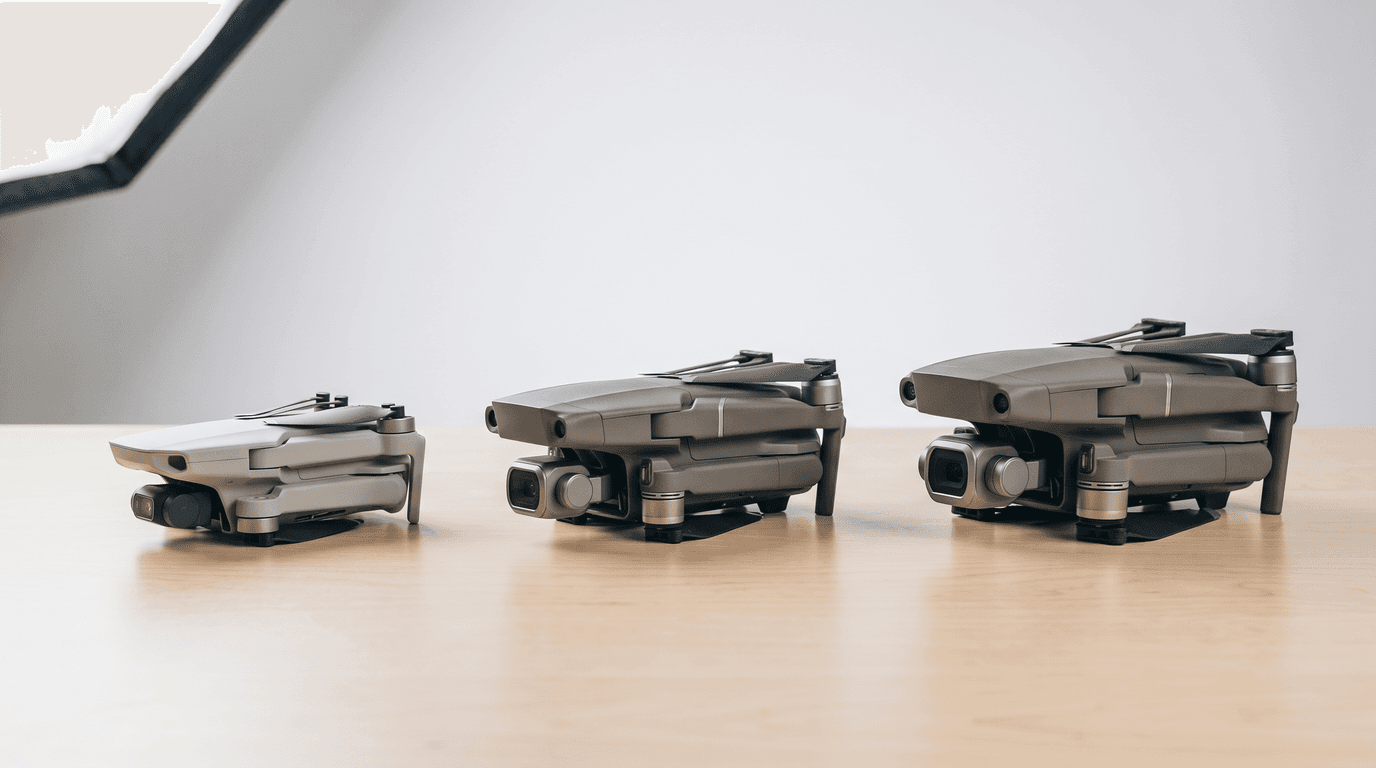
The current flagships of each line, from DJI's own spec pages:
| Line | Current model | Takeoff weight | EU class | Main sensor | Open subcategory |
|---|---|---|---|---|---|
| Mini | Mini 5 Pro | 249.9 g | C0 | 1-inch CMOS | A1 |
| Air | Air 3S | 724 g | C1 | 1-inch CMOS (wide) | A1 |
| Mavic | Mavic 4 Pro | approx. 1063 g | C2 | 4/3 CMOS (Hasselblad) | A2 or A3 |
Three lines, three different regulatory positions. Here is what each one actually buys you — and costs you.
Mini: sub-250 g, C0, the lightest paperwork
The Mini 5 Pro's 249.9 g takeoff weight is not an accident. Under 250 g with a C0 mark means A1: you may fly near people, and overflying an individual uninvolved person is tolerated — assemblies of people never. No A1/A3 exam is strictly required for a C0 aircraft, though operator registration still applies because it carries a camera.
Two honest caveats. First, DJI itself notes on the spec page that weight can vary by production batch, and a unit that crosses the C0 threshold can no longer be operated as a C0 aircraft. Second, accessories count: propeller guards or a strobe can push the aircraft over 250 g, and with them the whole legal advantage of the class goes. The sub-250 g rules are simpler, not absent.
What you trade for the light airframe: less mass to hold position in wind, a smaller battery, and a sensor that — while the current 1-inch chip is remarkable for the class — still works with less light-gathering hardware than the bigger lines. For travel, hiking and general hobby flying, that trade is usually worth taking.
Air: C1, the same A1 freedom — with an exam
The Air 3S weighs 724 g and carries a C1 mark. C1 still flies in A1, so on paper it enjoys almost the same proximity to people as a Mini. The differences are real, though:
- intentional overflight of uninvolved people is not allowed for C1 — a line the sub-250 g class does not have
- the pilot needs the A1/A3 certificate — in Latvia that is the CAA's free online course and exam
So the Air's regulatory price is one free online exam and slightly tighter behaviour around bystanders. In exchange you get a dual-camera setup around a 1-inch main sensor, more battery and an airframe that holds its line in coastal wind far better than any sub-250 g aircraft can. For an enthusiast who mostly shoots landscapes, real estate exteriors or travel work where people are nearby but not the subject, the Air line is the balanced middle.
Mavic: C2, where the certificate question gets serious
The Mavic 4 Pro is a different regulatory animal: approx. 1063 g, C2 mark, 4/3 Hasselblad main camera. A C2 aircraft has two legal homes:
- A3 — at least 150 m from residential, commercial, industrial or recreational areas, with just the A1/A3 certificate
- A2 — closer to people (30 m horizontally, reducible to 5 m in low-speed mode under the 1:1 rule), but only with the separate, in-person A2 certificate on top of A1/A3
In practice: buy a Mavic for urban photo or inspection work and you have also bought an exam plan. Flying it "far from everything" on A1/A3 alone is legal but wastes the reason most people pay for the 4/3 sensor. The A1/A3 versus A2 decision is covered separately — the short version is that A2 is a modest, cheap add-on, but it is in-person and it is real study.
The Mavic's non-regulatory trade-offs are the familiar ones: the largest and heaviest airframe of the three, the best wind behaviour, the biggest sensor, and a price band well above the other lines. It earns its keep when the images are the product.
Who each line actually fits
- Travel and hobby pilots — Mini. The A1 position of a sub-250 g C0 aircraft is the most permissive in the Open category, the airframe fits in a jacket pocket, and the paperwork stays minimal. Accept the wind and battery limits.
- Enthusiast photographers — Air. One free online exam buys a 1-inch dual-camera platform that still flies in A1. The most sensible middle for most people who have outgrown a Mini.
- Paid or near-professional work — Mavic. The 4/3 sensor and wind margin justify the weight, but plan the A2 certificate from day one if the work happens near people or buildings. Without A2, a Mavic in a city is mostly a very expensive A3 aircraft.
One buying rule falls out of all this: do not buy more class than your flying needs, because in the Open category extra mass buys restrictions, not freedom. If you are still weighing the bands themselves rather than these specific lines, start with choosing your first drone by weight class.
What does not change between the lines
Some limits follow the pilot, not the aircraft, and no line buys you out of them: the 120 m maximum height, keeping the drone in visual line of sight, and Latvia's geographical zones with their own local restrictions. A Mini near an airfield is just as grounded as a Mavic. Whichever line you pick, checking the airspace before the flight stays part of the job.
The takeaway
The line you pick sets the certificate you need: Mini → effectively none (registration aside), Air → the free A1/A3, Mavic → A1/A3 plus A2 for any serious use near people. Check specs against the current DJI pages before buying — weights and class marks belong to specific models, not to line names.
Not sure which subcategory your flying lands in? Run it through the category chooser. Then, whichever line you buy, the A1/A3 exam is the common first step — prepare for it with the dronelingo course.