
BGKIS is now part of flying a drone in a UAS geographical zone in Latvia — but most of the trouble pilots run into has nothing to do with the system being complicated. It comes from a handful of recurring misunderstandings about what BGKIS is, who it is for, and what an approval actually means. Here are the common ones, and how to stay on the right side of each.
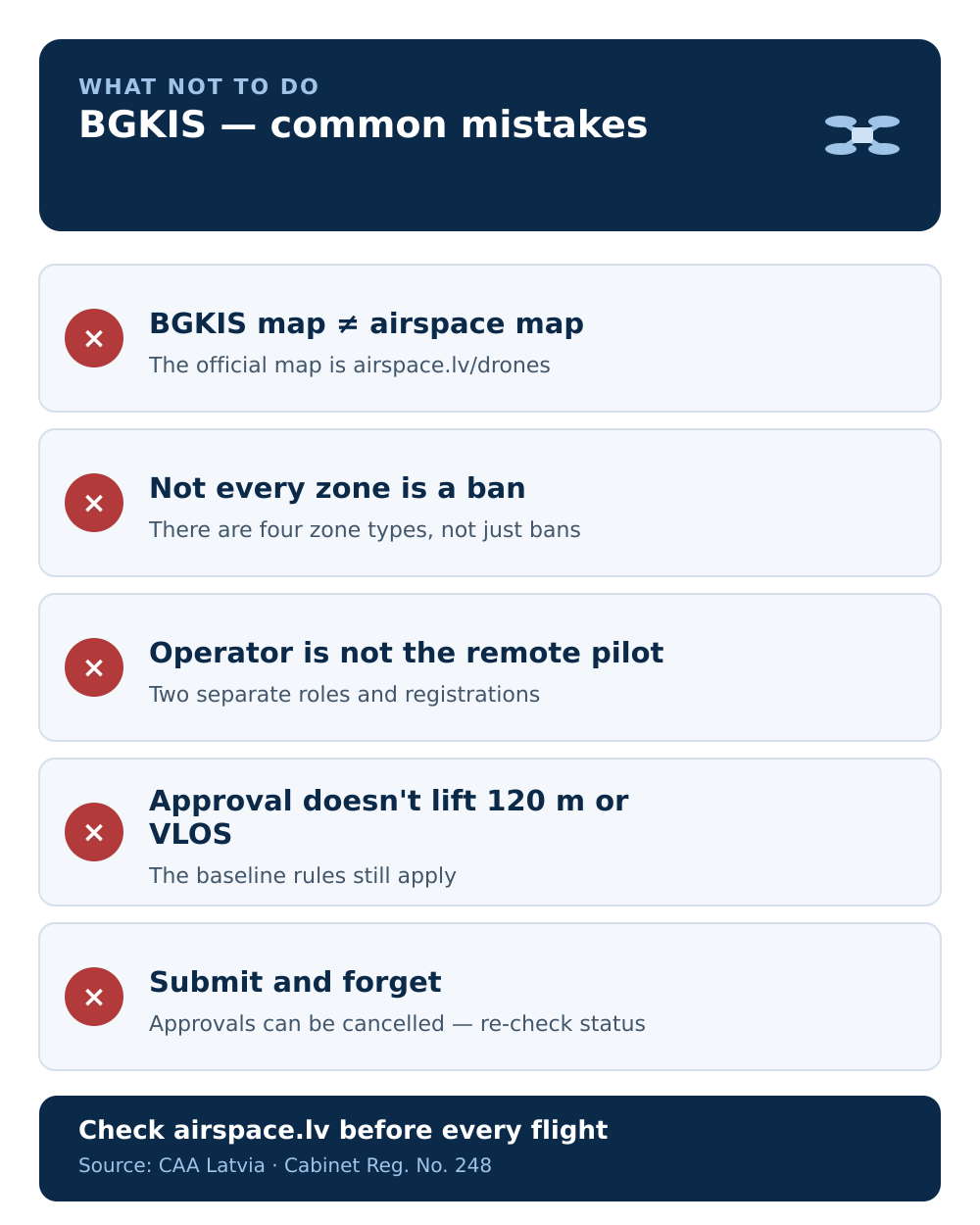
Mistake 1 — Treating the BGKIS map as the full airspace picture
The map shown inside BGKIS is not a live picture of every restriction in the country, and the CAA says so directly. The single official, legally binding source for zone status is airspace.lv/drones, run by Latvijas gaisa satiksme — and it can change several times a day. Use BGKIS to submit and coordinate; use airspace.lv to see what actually applies, before every flight. Our full breakdown is in the BGKIS pillar guide.
Mistake 2 — Calling every UAS geographical zone a "no-fly zone"
Most zones are not bans. The CAA defines several types: informational (no extra restriction), restrictive (coordinate, notify, or meet conditions), prohibited (flights banned unless an exemption exists), and even facilitating zones that grant relief from some open-category conditions. Reading every zone as a hard "no" makes you cancel flights you could legally make — and miss the coordination step on the ones that actually need it.
Mistake 3 — Confusing the operator and the remote pilot
These are two distinct roles. The UAS operator is the person or company on whose behalf flights are carried out, with an operator registration valid for a year. The remote pilot is whoever actually controls the drone and holds a CAA-assigned remote-pilot number. For a hobbyist they are usually the same person; for a company they are typically different, and the request must name both. Mixing them up — or leaving one registration invalid — is enough to stall a submission.
Mistake 4 — Assuming approval waives the basic rules
A coordination decision settles the zone-specific restriction and nothing else. It does not raise your ceiling above 120 m in the open category, and it does not waive visual line of sight unless you hold the proper specific-category authorisation. If an overlapping zone is stricter, the stricter limit wins. Approval is permission for the zone, not a blank cheque for the flight.
Mistake 5 — Submitting once and forgetting
An approval is not permanent. Conditions change, and approvals can be cancelled. Submission in a coordination zone is not permission either — you fly only once the decision is positive. Re-check the request status and the airspace conditions on the day, before takeoff, not the night before.
Mistake 6 — Letting your operator registration lapse
Operator registration is valid for one year. Once it expires, the "UAS operations (flights)" section is effectively unavailable — you cannot build or submit a request until you renew. Pilots discover this at the worst possible moment: standing in the field, ready to fly. Check the expiry date well ahead of any planned operation in a zone.
Mistake 7 — Trusting the drone's built-in geo-awareness
Manufacturer geo-awareness is a convenience, not the legal answer. The CAA warns that built-in geo-data is often incomplete or out of date. A green light on the controller does not mean the zone is clear, and it never replaces the airspace.lv check or a required BGKIS submission.
The pattern behind all of them
Every one of these mistakes is a shortcut: trusting the wrong map, assuming a zone type, skipping a role, reading an approval as more than it is. The fix is the same boring routine every time — check airspace.lv, confirm your operator and pilot registrations are valid, submit in BGKIS where the zone requires it, wait for the decision, and re-check the status before you launch.
The BGKIS walkthrough lesson covers operator setup, the flight request, and zone coordination step by step. Test what you know on the Airspace Limitations practice set.