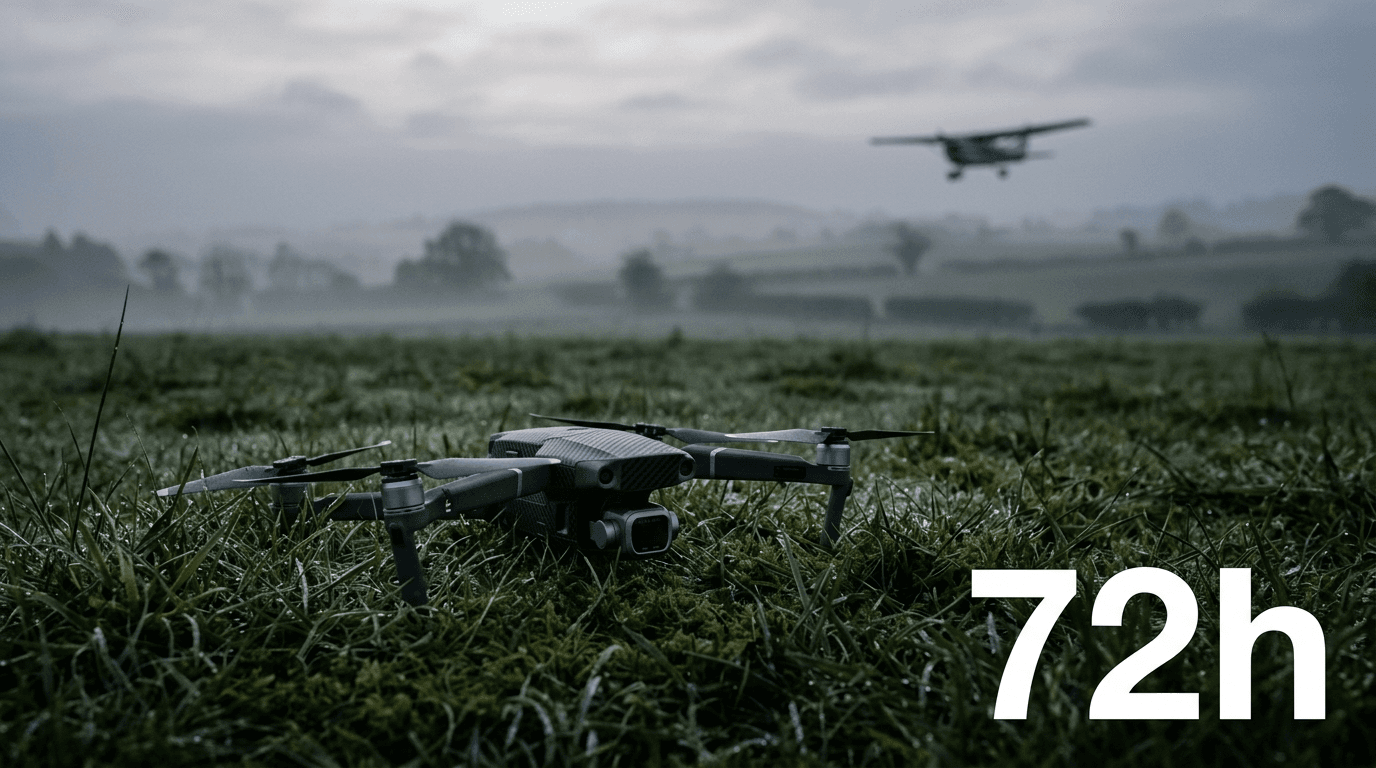
Most drone pilots never have to think about incident reporting. But the ones who need to — need to know it before the event, not after. EU law sets a hard 72-hour deadline from the moment of a serious occurrence. Miss it, and you are in breach of Regulation (EU) 2018/1139. The CAA Latvia incident reporting page states the requirement plainly; most pilots have never seen that page.
Here is what the regulation actually requires, what it does not require, and why the fear of getting in trouble for filing is almost always misplaced.
Where the obligation comes from
The legal basis is Article 57 of Regulation (EU) 2018/1139 — the framework regulation that covers all civil aviation in the EU, manned and unmanned. That article mandates occurrence reporting for aviation safety, and Regulation (EU) 376/2014 operationalises it: mandatory reporting for certain categories of events, a protected voluntary system for everything else.
For drone pilots operating in the 'open' category, CAA Latvia applies these rules directly. The content of the obligation is found on the CAA Latvia incident reporting page and in the EASA Easy Access Rules for UAS (UAS.OPEN.060).
Mandatory reporting: what falls inside the 72-hour rule
Two categories trigger the mandatory obligation.
Serious injury to a person. Not every bump or bruise — the regulation is specific. A reportable injury means one or more of:
- hospitalisation for more than 48 hours, starting within 7 days of the incident
- fracture of any bone, except simple fractures of fingers, toes or nose
- laceration causing severe haemorrhage, nerve, muscle or tendon damage
- damage to any internal organ
- second- or third-degree burns, or burns affecting more than 5% of the body
- confirmed exposure to an infectious substance or harmful radiation
Involvement of a manned aircraft. Any dangerous proximity to a manned aircraft — or an actual collision — triggers mandatory reporting regardless of whether injuries occurred.
If either of these applies, you file within 72 hours. In Latvia the online form is at e.caa.gov.lv/incidents. If you prefer English, the EU-wide Aviation Reporting portal at e2.aviationreporting.eu/reporting accepts reports in all EU languages including Latvian.
One practical note: if you are dealing with an emergency — a collision with a manned aircraft, serious injuries requiring immediate help — call 112 first. The incident report comes after the immediate situation is handled, not instead of it.
Voluntary reporting: what you should file even when you don't have to
The voluntary system exists for everything that matters for safety but falls below the mandatory threshold. CAA Latvia lists the following categories explicitly:
- the drone fell or crash-landed (regardless of cause)
- you exceeded the VLOS boundary
- you lost control link during a VLOS operation
- the drone suffered serious structural or equipment damage
- near-collision with another UAS
- failure of a safety system — autonomous fail-safe activation or return-to-home triggered by a fault
Voluntary reports are not about admitting fault. They feed an anonymised database that regulators and EASA use to spot patterns — recurring technical failures, airspace conflict hotspots, equipment problems that affect a whole drone model. Your single report might not change anything. A hundred similar reports about the same fail-safe bug will.
The same portals accept voluntary reports. There is no separate form.
Just culture: why filing won't get you in trouble
This is the part most pilots get wrong. Incident reporting in civil aviation operates under the "just culture" principle, codified in Regulation (EU) 376/2014. The idea is straightforward: a system that penalises people for reporting near-misses gets fewer reports and learns nothing. So the regulation explicitly separates safety reporting from liability.
In practice this means:
- Unintentional errors do not lead to administrative liability when reported. The CAA's stated position is that the purpose of reporting is to learn, not to find fault.
- Reports submitted under the voluntary system are protected by confidentiality — the reporter's identity is not disclosed.
- Intentional and grossly negligent violations are carved out: just culture does not protect deliberate misconduct.
The fear that filing an incident report triggers a fine or licence action is widespread and mostly wrong. Regulators are structurally interested in getting data, not in deterring the data with punishment.
Why this appears on the A1/A3 exam
The EASA A1/A3 syllabus covers aviation safety culture and occurrence reporting as a distinct topic. Exam questions test whether candidates understand the mandatory/voluntary distinction, the 72-hour deadline, and the just culture framework. Getting this wrong is an easy source of lost marks on an otherwise short exam.
The syllabus framing is straightforward: a pilot who knows when to report, where to report, and why the system protects them is a safer pilot than one who lands, puts the drone away, and hopes nobody noticed.
A quick reference before you fly
- Emergency (collision, serious injury): call 112 first.
- Mandatory report (≤72h): serious injury to a person OR dangerous proximity / collision with manned aircraft → file at e.caa.gov.lv/incidents or e2.aviationreporting.eu/reporting.
- Voluntary report (anytime): crash, VLOS breach, link loss, serious damage, near-miss with another UAS, safety system failure → same portals.
- Just culture applies: unintentional errors reported in good faith do not result in administrative penalties.
FAQ
How long do I have to file a mandatory report? 72 hours from the moment the occurrence happened. The clock starts at the incident, not when you get home.
What if I'm not sure whether my incident qualifies as mandatory? File anyway under the voluntary system. Over-reporting carries no penalty; the system is designed to receive it. CAA Latvia can reclassify the report if needed.
Do I need to file in Latvian? No. The EU Aviation Reporting portal at e2.aviationreporting.eu/reporting accepts reports in all EU official languages. English works fine.
Will the CAA find out who filed a voluntary report? Voluntary reports submitted under Regulation (EU) 376/2014 are protected by confidentiality rules. The reporter's identity is not disclosed to third parties.
Does just culture apply to all mistakes? No. Intentional rule violations and gross negligence are explicitly excluded. Just culture protects honest reporting of errors made in good faith — not deliberate misconduct.
Is a broken propeller after a hard landing a reportable incident? Not mandatory, unless someone was seriously injured. It is the type of event the voluntary system exists for — "serious drone damage" is listed explicitly in the CAA Latvia voluntary reporting categories.
The exam expects you to know the mandatory categories and the 72-hour deadline. It also expects the just culture answer: unintentional errors reported in good faith do not result in administrative liability. Review the Open category rules and the A1/A3 licence guide, and drill the reporting topic in the practice sets — it comes up more often than most candidates expect.