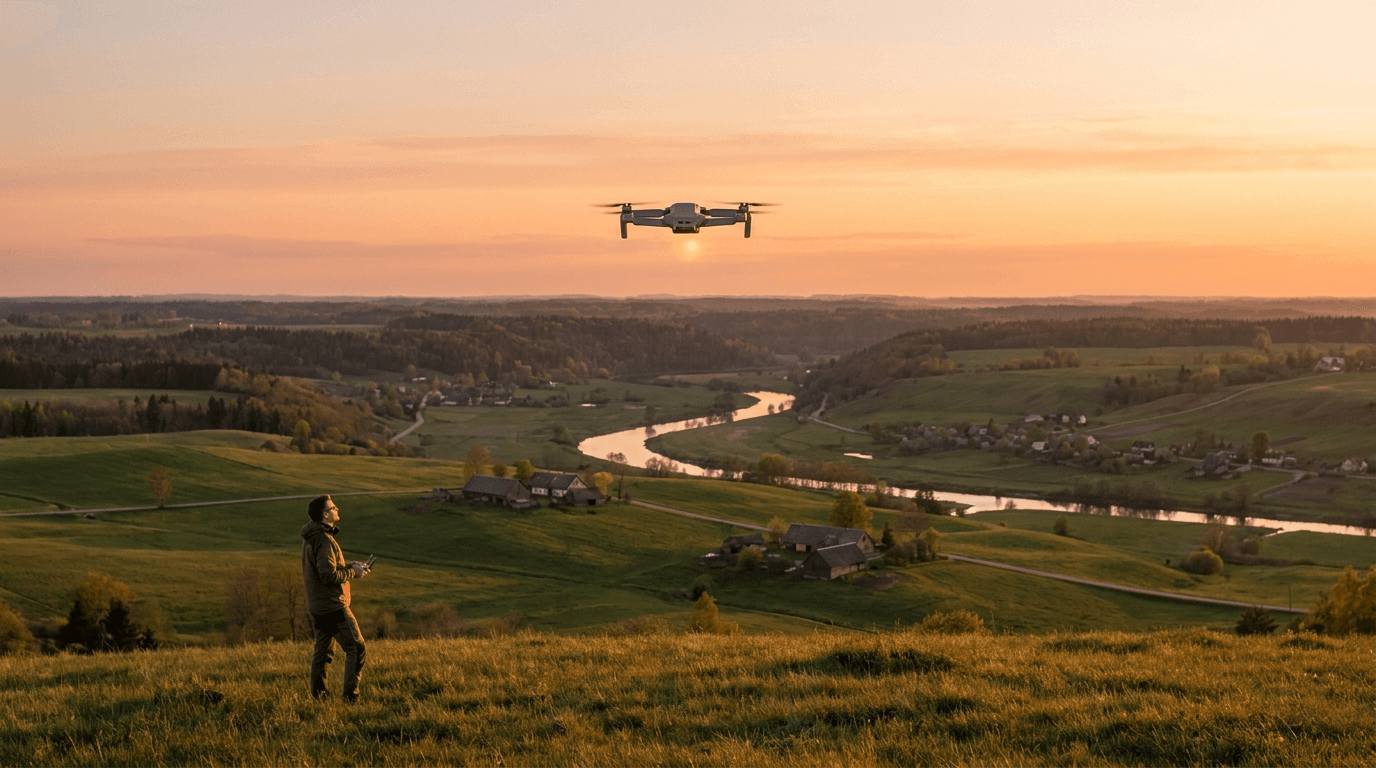
The rules for flying near people change with every open-category subcategory: how close you may get depends on your drone's class mark and where you are. But there is one line the open category draws that no subcategory ever moves — you may never fly over an assembly of people. Not with a C2 in A2, not far out in A3, and not even with a featherweight sub-250 g drone that is otherwise allowed over individuals.
The word "assembly" is where people go wrong. Most assume it means some number — a hundred people, a thousand, a stadium. The regulation defines it differently, and the difference is exactly what an exam question is built to catch. Here is what "assembly of people" actually means, why it is not a headcount, and how it sits apart from the distance-to-people rules you already learned.
The definition, word for word
The term is defined in Regulation (EU) 2019/947 itself. Article 2(3) says an assembly of people means "gatherings where persons are unable to move away due to the density of the people present."
Read what that does not say. It sets no number. It names no venue. The whole test is one physical question: if the drone above you failed and fell, could the people below step aside in time, or are they packed too tightly to move? If they cannot move away, it is an assembly — whatever the count.
That is why the UK CAA, working from the same EU text, notes plainly that there are "no strict numbers defined above which a group of people would turn into an assembly of people," because different situations produce different densities. The threshold is behavioural, not arithmetic.
Why it is not about how many people
EASA's own guidance material (GM1 Article 2(3)) frames it as an objective criterion — the ability of an individual to move to avoid an out-of-control drone. A dozen people crammed shoulder to shoulder can be an assembly; a few hundred spread thinly across a large field may not be. Density and freedom to escape decide it, not the size of the gathering.
EASA and national authorities publish the same worked examples of what counts. An assembly of people includes:
- sport, cultural, religious or political events — spectators at a match, a concert crowd, a procession, a demonstration;
- beaches or parks on a sunny day, when they fill up;
- commercial streets during the opening hours of the shops;
- ski resorts, tracks and lanes.
Notice how ordinary most of these are. A busy pedestrian street at midday and a popular beach in July are assemblies for the purpose of this rule, even though nobody calls them "a crowd" in everyday speech. The regulation is drawn around the risk — a falling drone over tightly packed people who cannot scatter — not around the label.
Assemblies are not the same as "uninvolved persons"
This is the distinction the open category is built on, and the one the exam probes. There are two separate ideas:
- Distance to uninvolved persons — the rules that vary by subcategory. In A1 with a C1 drone you may not deliberately overfly uninvolved people; a sub-250 g or C0 drone may overfly individuals. In A2 you keep at least 30 m horizontally, or 5 m with the low-speed function active. In A3 you fly where no uninvolved person is present at all. These are graded limits, and they are what most of the subcategory training is about.
- Assemblies of people — an absolute prohibition that does not vary. No open-category flight, in any subcategory, may take place over an assembly. There is no distance, no class mark, and no low-speed mode that unlocks it.
So the leniency you earn in a subcategory is leniency toward individuals, not toward crowds. A2's 30 m and A1's freedom to overfly a single bystander both stop dead at the edge of an assembly. Getting this pair straight is half of the "flying near people" topic in the open category A1, A2 and A3.
The sub-250 g trap
Here is the version that catches careful students. The under-250 g and C0 class is famous for being allowed to fly over people — you may overfly uninvolved individuals with one, which is more than a C1 drone is granted. People stretch that into "so a light drone can fly over a crowd." It cannot.
The permission is to overfly individuals, and it stops exactly where the assembly rule begins. A sub-250 g drone over one person in a park: fine. The same drone over the packed beach twenty metres away: prohibited, because that is an assembly and the assembly rule applies to every open-category drone regardless of weight or class. Light weight buys you the freedom to fly near individuals; it never buys you the crowd. If you are still sorting out what your class mark does and does not allow, the weight classes that actually matter is the place to start.
What if you actually need to fly over a crowd
Sometimes the shot or the job genuinely requires it — event footage, a mapping run over a busy site. The answer is not a clever reading of the open-category rules; it is that the flight is not an open-category operation at all. Flying over an assembly of people pushes the operation into the specific category, where you need an operational authorisation built on a risk assessment. The regulation makes this explicit: "flying over an assembly of people" is one of the named risk criteria the authority weighs when assessing a specific-category operation. Higher-risk cases can reach into the certified category entirely.
The practical takeaway: if your plan involves a crowd, budget for the authorisation and the lead time, or change the plan. There is no open-category shortcut.
In Latvia
Latvia applies the EU rule as written. CAA Latvia's open-category guidance lists the distance-to-people limits by subcategory and treats cilvēku pulcēšanās vietas — assemblies of people — as off-limits across the board, using the same "density that prevents free avoidance of the UAS" wording as the regulation. There is no national softening and no local permit that lets an open-category flight pass over a crowd. As always, that sits on top of the geographical-zone checks you run before every flight, which can restrict a location for reasons that have nothing to do with the people on the ground.
Why this is on the A1/A3 exam
Assemblies of people are a named item in the A1/A3 syllabus, and the question bank tests it directly: are flights over assemblies of people allowed in the open category? The correct answer is a flat "no — never, in any subcategory," and the wrong answers are the tempting ones ("yes, with C0 marking" or "yes, if announced in advance"). A candidate who over-learned "sub-250 g can fly over people" walks straight into the C0 trap; a candidate who thinks an assembly is defined by a number cannot answer the density-based version. The exam rewards the precise definition and the absolute nature of the ban.
Quick reference before you launch
- Assembly of people = people so densely packed they cannot move away from a falling drone. Not a headcount.
- Absolute ban. No open-category flight over an assembly, in A1, A2 or A3 — no distance or class mark unlocks it.
- Uninvolved persons ≠ assemblies. Distance to individuals varies by subcategory (A2: 30 m, or 5 m low-speed; A3: none present). The assembly ban does not vary.
- Sub-250 g / C0 may overfly individuals, never a crowd. Light weight is not a pass over an assembly.
- Everyday places count: busy beaches, packed parks, shopping streets in opening hours, sport and cultural events, ski slopes.
- Need to fly over a crowd? That is the specific category — an operational authorisation and a risk assessment, not an open-category flight.
The assembly rule is short, absolute, and easy to misread — which is exactly why it earns a question. Once the definition is clear, line it up with the open category A1, A2 and A3 and the regulation behind it all, then drill the near-people questions in the practice sets — "is a flight over an assembly allowed" looks trivial until the wrong answers start sounding reasonable.