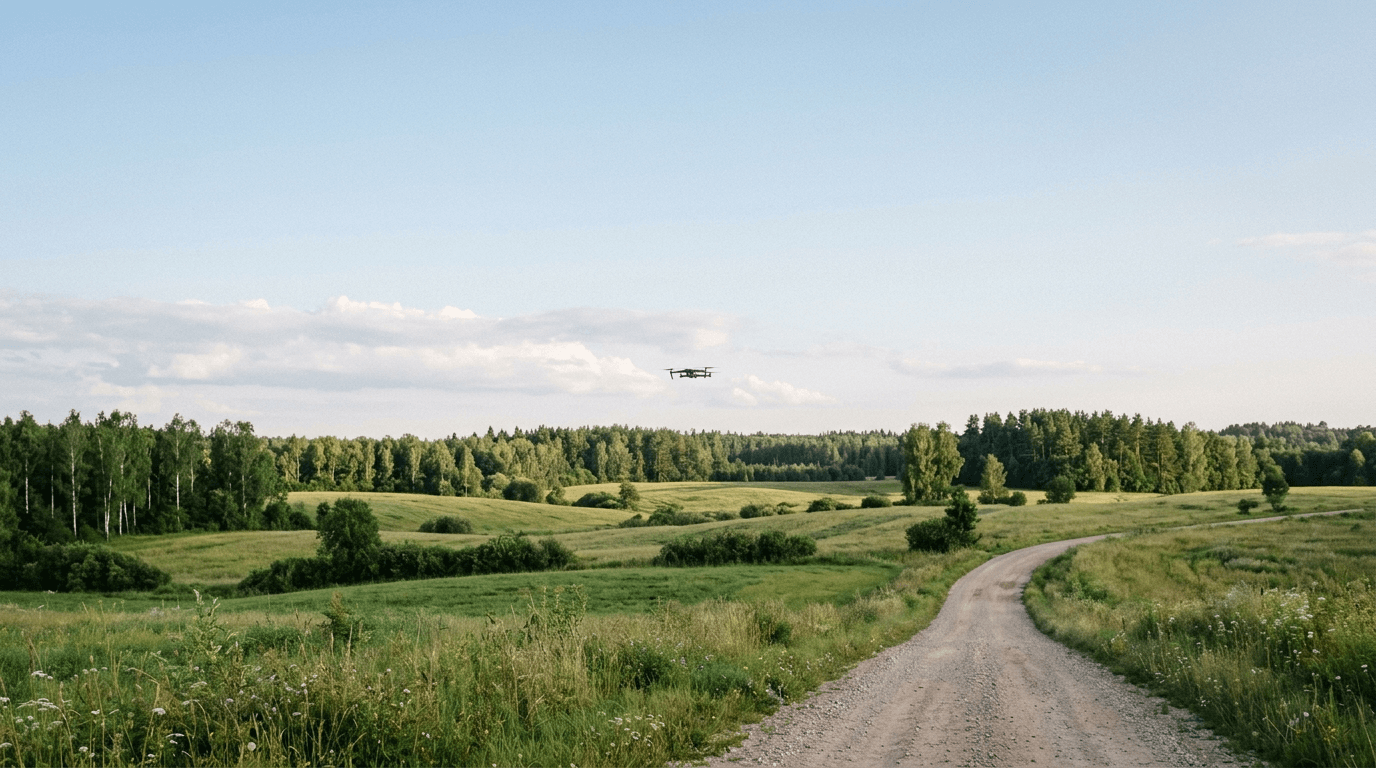
For civilian drone pilots in Latgale, the picture changed a lot in May 2026. Two things drove it: on 7 May, a Ukrainian drone, knocked off course by Russian electronic warfare, hit a fuel depot in Rezekne — and Latvia's armed forces responded by sending mobile intercept teams to the eastern border. Both have real consequences for anyone planning a flight in the region.
We keep the politics short here. The questions that matter for pilots are operational.
What happened on 7 May
In the early hours of 7 May 2026, three drones crossed into Latvian airspace from Russia. Two came down on Latvian soil; a third later left again. One hit the fuel depot in Rezekne, roughly 40 km inside the border. It damaged four oil storage tanks. The tanks were empty. No casualties were reported.
French military aircraft flying under NATO's Baltic Air Policing mission were scrambled during the alert. Flight restrictions reaching up to about 6 km altitude were put in place across Latvia's eastern border region. They were lifted later the same day.
On 10 May, Latvia confirmed the drones were Ukrainian and had been pushed off their intended targets by Russian electronic warfare. Ukraine's foreign minister publicly tied the incident to that cause.
The politics, briefly
Latvia's Defence Minister Andris Sprūds announced his resignation on 10 May. Prime Minister Evika Siliņa's government collapsed on 14 May. We note these for the record; they do not change the operating environment directly.
What is now on the ground
On 27 May 2026, Latvia's armed forces announced mobile intercept teams for the eastern border: four soldiers in 4x4 vehicles, carrying interceptor drones from Latvian makers Origin Robotics and Eraser. Target start date: early next month. Named source: Major Modris Kairišs, head of the Autonomous Systems Competence Center.
The eastern border with Russia and Belarus runs about 400 km. These teams move around — their position is not fixed. You cannot tell from a map where they will be on a given day.
One more number: Novaya Gazeta Europe, an independent Russian outlet, has counted at least 24 drone incidents across the three Baltic states since early 2025. Rezekne is not a one-off.
Our reading for civilian pilots
What follows is our operational reading, not official guidance from CAA Latvia or the armed forces.
The NOTAM picture has changed
The 7 May restrictions — up to 6 km altitude, put in place and lifted the same day — set a precedent. Airspace in the eastern region can close with very little warning. Your sub-120 m EASA Open Category flight sits well below any altitude cap of that scale, but the airspace can close entirely, not just above some line.
So a NOTAM check from the day before is no longer enough when you fly in Latgale. Check NOTAMs on the morning of the flight, as close to takeoff as you can manage. Things that affect your area can show up overnight.
Intercept teams fly their own drones
Mobile intercept teams carry interceptor drones — active aircraft in the same airspace you fly in. The teams work in the border zone, but the public announcement does not draw that zone precisely. Treat Latgale as a busier, more contested environment than it was three months ago. That is not a reason to avoid the region; it is a reason to run a tighter routine.
What to add to your pre-flight checklist
- Re-check NOTAMs the same morning. Restrictions can appear overnight or within hours as a situation develops.
- Check that your phone can receive alerts. If you fly with a phone on you, confirm that emergency cell-broadcast alerts are switched on. Latvia's NBS now uses a two-tier Yellow/Orange system for airspace threats. If your phone cannot receive it, you are flying without a warning channel.
- Have an abort plan ready before takeoff. If civil ATC declares a restriction in your sector while you are in the air, you need a plan you made earlier, not one you improvise. Know your nearest safe landing spot before you launch.
If you spot unfamiliar wreckage while flying
Land, log it, and call 112. Do not approach any debris on the ground or any unfamiliar low-flying object from the air. This is standard civilian guidance in Latvia, and it applies whether you are on foot or flying a drone.
What this does not change
The legal framework for EASA Open Category flights in Latvia has not changed. CAA Latvia authorizations, subcategory rules, and the standard pre-flight requirements all stay the same. What has shifted is the risk in the operating environment, not the text of the rules.
The new baseline for Latgale flights
Flying in Latgale takes more care than it did before May 2026. The additions to your routine are small and need no new gear. They need more attention in the pre-flight window and a practiced abort plan.
- Check NOTAMs the same morning.
- Confirm your phone receives alerts before takeoff.
- Know your abort procedure and your nearest landing spot before you are in the air.
- Log any alert or restriction you run into, with the time and coordinates.
Airspace limitations, including NOTAM and temporary restrictions, are covered in the NOTAM and Temporary Restrictions lesson. Emergency procedures and in-flight response are in the Emergency Procedures lesson. You can test your knowledge on the Operational Procedures practice set.