"Keep the drone in sight at all times." Every open-category pilot has read that line. Almost nobody can say exactly what it means — whether binoculars count, whether a glance at the controller screen breaks it, or how you are supposed to fly with FPV goggles when the whole point of goggles is that you cannot see the drone. The rule has a precise legal definition, two narrow exceptions, and one of those exceptions is the only thing that makes FPV legal in the open category.
Here is what visual line of sight actually requires, where the FPV observer comes from, and why this turns up on the A1/A3 exam more often than candidates expect.
What "visual line of sight" means in law
The term is defined in Article 2(7) of Regulation (EU) 2019/947. A visual line of sight operation — VLOS — is one in which "the remote pilot is able to maintain continuous unaided visual contact with the unmanned aircraft." Three words carry the weight: continuous, unaided, visual.
Unaided is the one pilots miss. Corrective glasses or contact lenses are fine — they correct your vision to normal, they do not extend it. Binoculars, a spotting scope, or a long zoom lens do the opposite: they let you "see" a drone that is already too far away to track with the naked eye. The moment you need an optical aid to keep contact, you are no longer in VLOS. You can use binoculars briefly to scan for traffic or check on the aircraft, but you cannot use them to push your legal range further out.
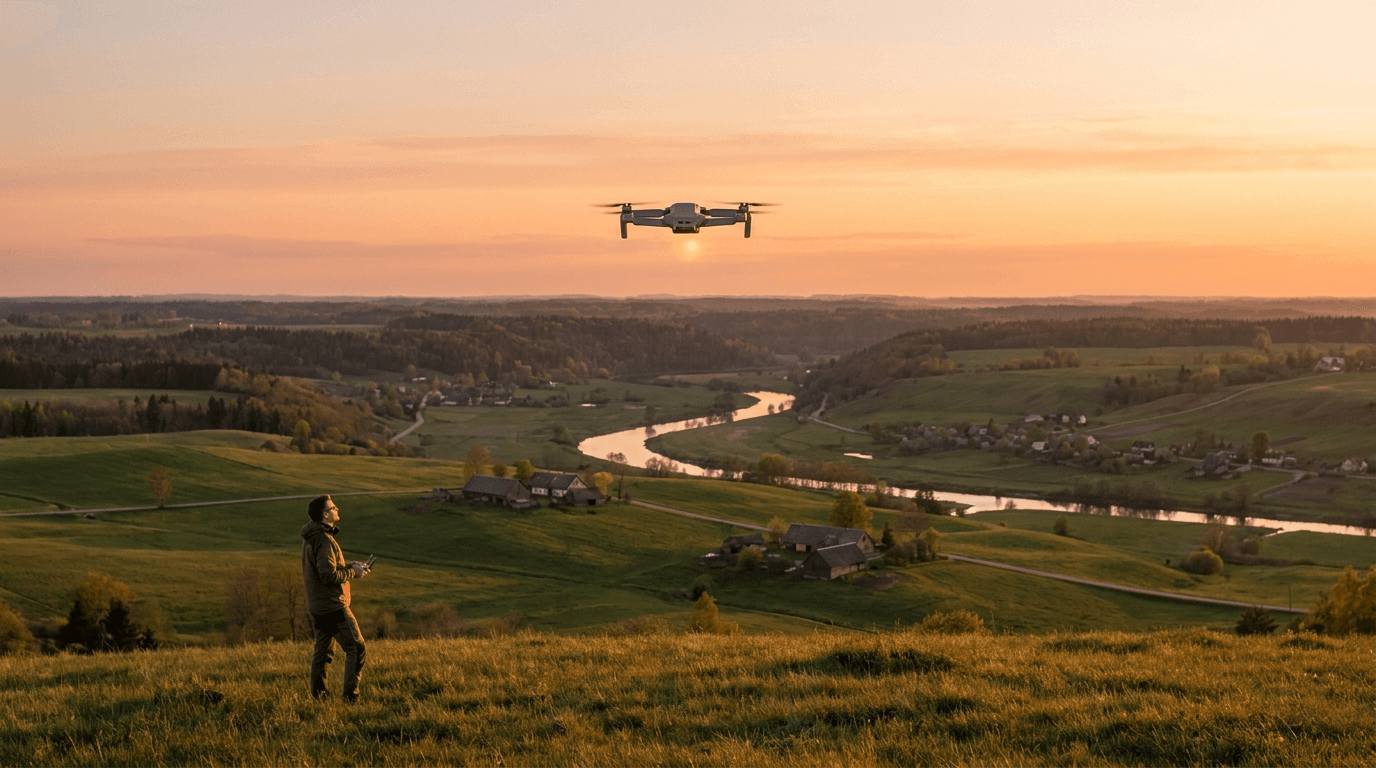
Continuous means exactly that. VLOS is not a position you return to between glances at your screen. CAA Latvia puts it plainly on its open-category page: you must keep the drone in direct sight, abbreviated VLOS, and you must also see the airspace around it.
VLOS is about the airspace, not just the drone
This is the part most pilots get backwards. Keeping the drone in sight is only half the obligation. Point UAS.OPEN.060(2)(b) of the regulation requires the remote pilot to "keep the unmanned aircraft in VLOS and maintain a thorough visual scan of the airspace surrounding the unmanned aircraft" — specifically to avoid a collision with manned aircraft. The same point says you must stop the flight if it starts to pose a risk to other aircraft, people, animals, the environment, or property.
In other words, VLOS exists so you can see a helicopter or a light aircraft coming before it becomes a problem. A pilot who stares at the drone the whole flight, locked onto it like a camera operator, is technically holding VLOS and still failing the purpose of the rule. The scan matters as much as the contact.
The two exceptions — and only two
The regulation lets you fly without keeping direct eye contact with the drone in exactly two situations. Article 4(1)(d) lists them as the cases where an operation still counts as VLOS even though the pilot is not looking at the aircraft:
- Follow-me mode. The drone tracks the pilot automatically. This is allowed for lightweight aircraft — a C0 or C1 label, or below 250 g — and the drone must stay within 50 metres of the remote pilot (UAS.OPEN.020(3)). Beyond 50 m, follow-me is no longer a valid VLOS substitute.
- First-person view with an observer. You fly looking through goggles or at a screen fed by the onboard camera, and a second person — the unmanned aircraft observer — keeps the drone in unaided sight for you.
Everything else still requires you, the pilot, to keep your own eyes on the aircraft.
Flying FPV legally: the observer is not optional
FPV is where the confusion does real damage, because the goggles are the problem and the solution is a person standing next to you.
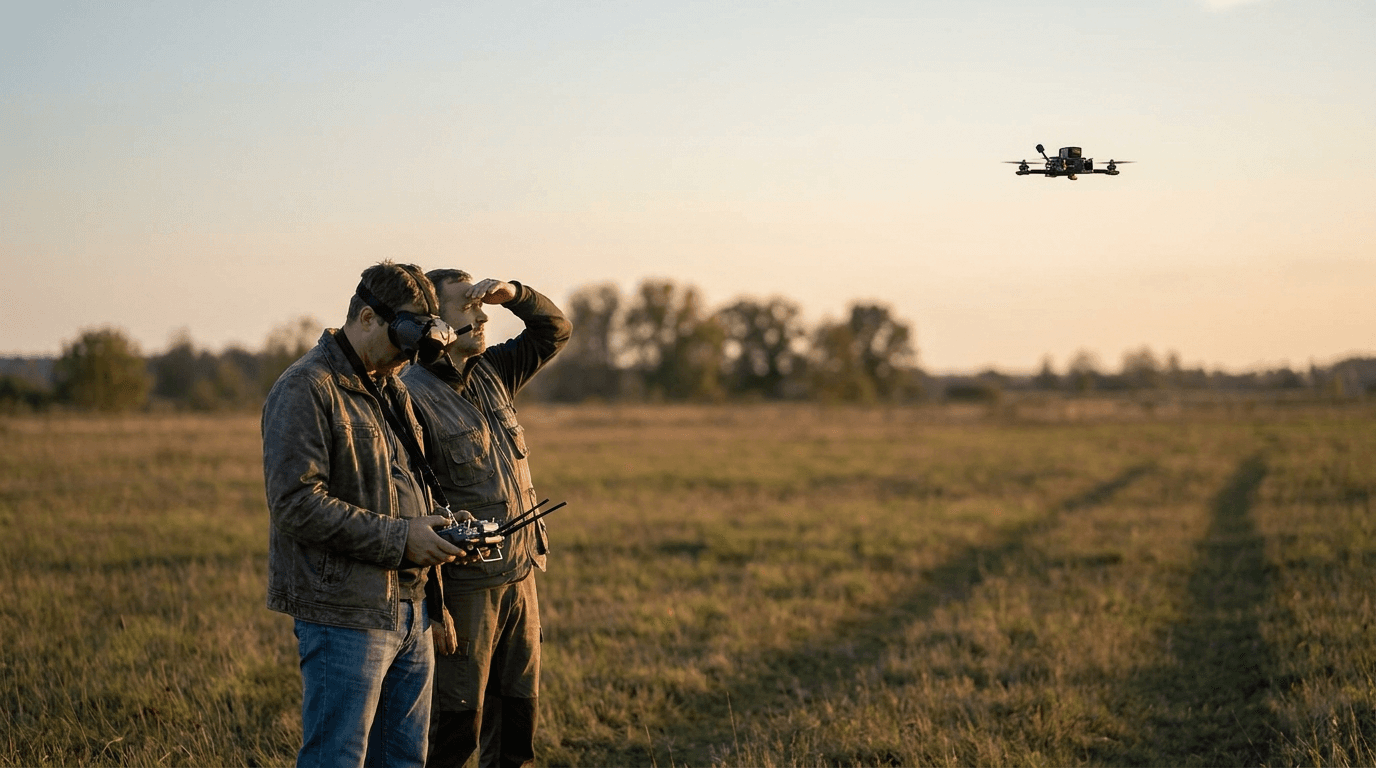
EASA states the reasoning directly: FPV goggles by their nature do not give a wide field of view to spot threats around the drone, so they do not provide VLOS. That is why an unmanned aircraft observer is required for any FPV flight in the open category. The legal mechanism is Article 4(1)(d) combined with point UAS.OPEN.060(4), which allows the pilot to be "assisted by an unmanned aircraft observer, situated alongside them, who, by unaided visual observation of the unmanned aircraft, assists the remote pilot."
The conditions are specific:
- The observer must be next to the pilot — "situated alongside them" — close enough to talk directly. CAA Latvia spells this out: the observer stands beside the remote pilot without any technical means of communication in between, no phone, no radio. Direct voice only, because the whole point is an instruction that reaches you in the second it matters: traffic, land now.
- The observer keeps the drone in unaided visual contact and scans the surrounding airspace — the same standard the pilot would otherwise hold.
- The no-overflight rules still apply. In the open category you may not fly over uninvolved people, which for FPV means there can be no spectators gathered to watch. EASA notes this explicitly for non-racing FPV operations.
A spotter checking their own phone, standing fifty metres away, or relaying warnings over a radio does not satisfy the rule. The observer is doing the pilot's legally required job of seeing the aircraft and the sky around it, and they can only do that standing beside you, looking up.
One narrow note: organised drone racing inside a model-aircraft club or association operates under Article 16 of the regulation rather than these open-category conditions. The observer rule described here is for ordinary open-category FPV.
Why this is on the A1/A3 exam
The A1/A3 syllabus treats VLOS and FPV as a named subject, not a footnote. Exam questions test whether you know that VLOS means unaided contact, that the obligation includes scanning for other airspace users, that FPV requires an observer beside the pilot, and that follow-me mode is capped at 50 m. These are easy marks to lose because the everyday phrase "keep it in sight" sounds simpler than the legal definition actually is.
The practical version is shorter than the regulation: you are the eyes on the aircraft and the sky around it. The only way to hand that job off is to put another set of unaided eyes right next to you.
Quick reference before you fly
- VLOS = unaided. Glasses and contacts are fine. Binoculars and zoom lenses do not extend your legal range.
- Scan the airspace, not just the drone — the rule exists to keep you clear of manned aircraft.
- Follow-me: only for C0/C1 or sub-250 g drones, only within 50 m of you.
- FPV: legal only with an observer standing beside you, watching the drone unaided, talking to you by direct voice — no phone, no radio relay.
- No spectators under FPV: the open-category ban on overflying uninvolved people still holds.
VLOS is one of the rules the open category is built on, and the exam knows it. Brush up on the open category A1, A2 and A3 and how the A1/A3 exam works in Latvia, then drill the operational-limits questions in the practice sets — "keep it in sight" is the kind of phrase that looks obvious until it is a multiple-choice question.