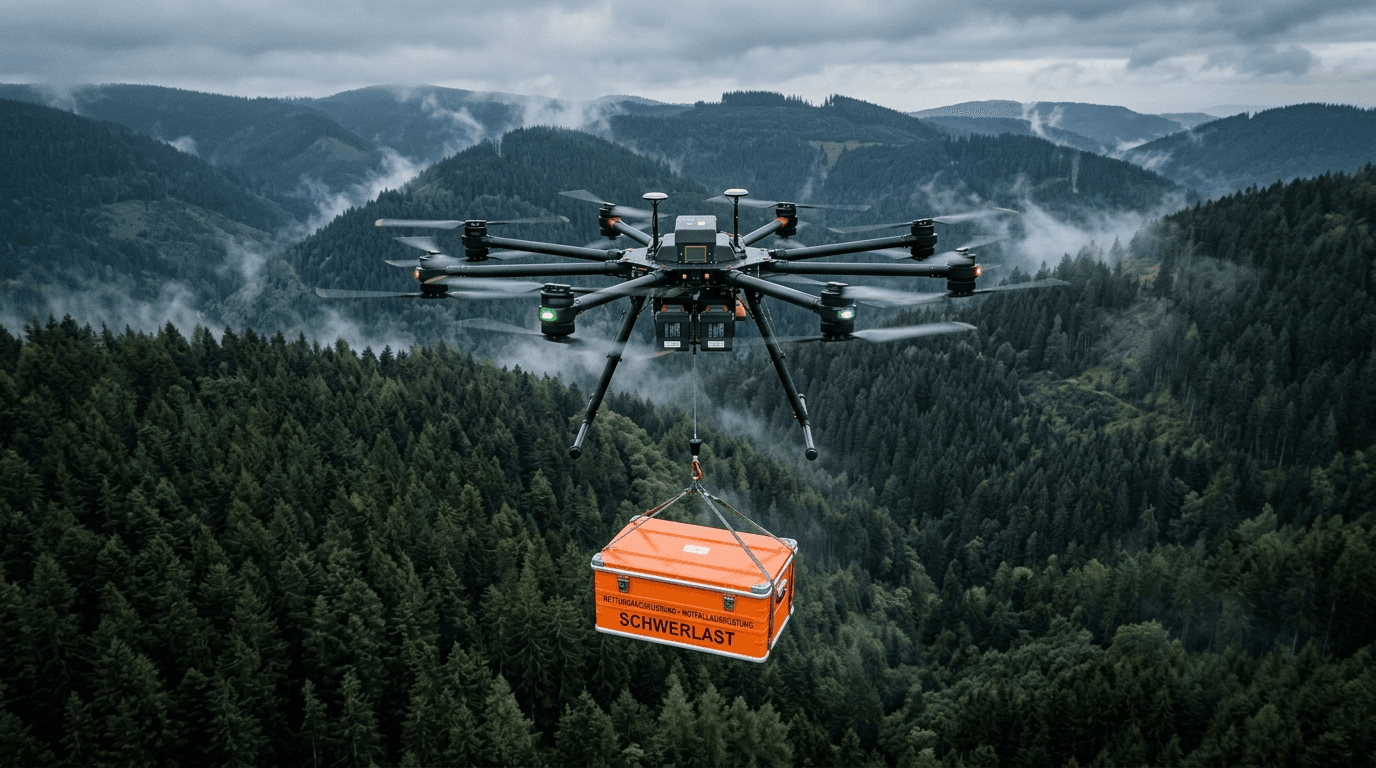
On 27 June 2026, during Germany's National Civil Protection Day in Freiburg, Bergwacht Schwarzwald — the Black Forest mountain rescue service — is set to enter a DJI FlyCart 100 into official operational service. The aircraft can carry up to 100 kilograms of equipment, making Bergwacht Schwarzwald among the first emergency services in Germany to fly a cargo drone of this class. The team is currently in a testing and training phase, working through scenarios and building flight experience — but the direction is clear: mountain rescue is gaining a tool of a different order entirely.
What Bergwacht Schwarzwald put in the air
The FlyCart 100 is a heavy-lift logistics drone launched in July 2025 as the successor to DJI's FlyCart 30. The headline figure is a 100 kg payload, delivered either in an enclosed cargo bay or on an external sling load via a winch. The aircraft is rated for rain and sub-zero temperatures, carries redundant flight and power systems, and includes advanced obstacle sensing.
For Bergwacht Schwarzwald, the useful loads are ropes, rescue gear, medical supplies, and evacuation stretchers — flown into the kind of Black Forest terrain where a helicopter is expensive and a footpath is slow. The aircraft cruises at over 50 km/h. Drone pilot Timon Ebert described it as a "small revolution" for mountain rescue. A second identical aircraft is planned for Offenburg, though timing is not yet confirmed.
Why 100 kilograms changes a rescue
The largest cargo drone previously operated by Bergwacht Bayern — the Bavarian mountain rescue service — carries roughly 40 kg. That is already useful: a defibrillator, a first-aid kit, an oxygen bottle. But it cannot carry an evacuation stretcher, and it cannot carry several heavy items at once.
At 100 kg, the calculus shifts. A full trauma kit, a rigid stretcher, extra rope, and a thermal blanket can go in a single flight. Rescuers arriving on scene find the equipment already there rather than carrying it up themselves — that compresses the time between a call coming in and treatment beginning. Matthias Rütten, head of the drone team, framed this as a major innovation project and called the aircraft a potential "game changer" for both mountain rescue and civil protection.
The capability jump from 40 kg to 100 kg is not marginal. It is the difference between sending consumables ahead and sending a real intervention kit.
Flying heavy in the mountains is the hard part
The FlyCart 100 is built for demanding conditions. Rain and sub-zero temperatures are within its envelope. What the aircraft cannot simply engineer away is mountain wind: gusts in the Black Forest, and in alpine terrain generally, remain a significant challenge for any aircraft at any size.
Bergwacht Schwarzwald is currently in an extended training and scenario-testing phase, working through how procedures need to change when the payload is this large. Wind assessment, flight path planning around ridges, and load configuration are all more consequential at 100 kg than at 10. Rütten's public statements emphasize that the coming months are about operational experience, not just technical capability. Knowing reliably when to use the aircraft — and when not to — is the harder discipline.
Speed above 50 km/h helps with response time. It does not help if the aircraft cannot safely fly the route. The training work underway now is what determines whether this capability becomes routine or stays occasional.
Cargo yes, people no — where certification draws the line
The FlyCart 100 could technically carry a person — the airframe and payload capacity are there. But that is not permitted, and it is not likely to be permitted soon.
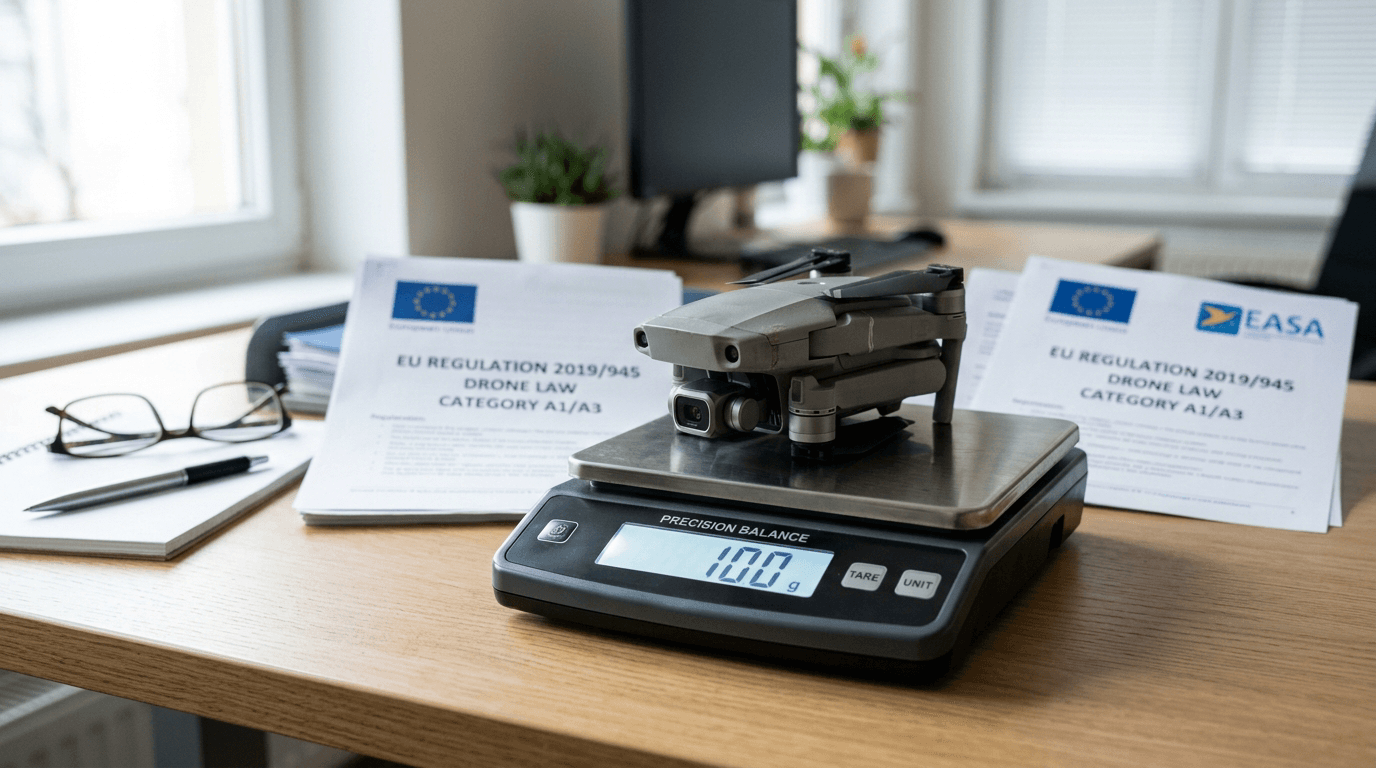
EASA's regulatory framework divides drone operations into three categories. The Open category covers low-risk flight with small drones in sight of the pilot. A 100 kg cargo drone is well outside it. The Specific category covers higher-risk operations that need a risk assessment or a predefined authorization — this is where a heavy cargo drone like the FlyCart 100 operates, under a risk-assessed authorization such as SORA. The Certified category is where passenger-carrying sits: it requires aircraft-like certification, airworthiness approval, and operator certification equivalent to commercial aviation standards.
Carrying equipment under a Specific-category authorization and carrying a human under the Certified category are not the same regulatory step. The FlyCart 100 operates under the former today. The latter requires a level of certification that no current uncrewed aircraft of this type holds in the EU. This is why cargo is operational and human transport is not — a legal distinction, not a technical one, and one that reflects the asymmetry in what goes wrong if something fails.
Beyond the Black Forest: civil protection and disaster response
Rütten's framing of civil protection alongside mountain rescue is deliberate. The team is explicit that the aircraft is most valuable for longer, more complex operations — floods, wildfires, large-scale disaster response — rather than the majority of routine call-outs.
That distinction matters for how the capability develops. A drone that flies a small first-aid kit to a twisted ankle is useful but not transformative. A drone that pre-positions 100 kg of supplies at a forward staging point during a wildfire, while roads are blocked and helicopters are occupied elsewhere, fills a gap that nothing else currently covers at the same cost.
A second aircraft is already planned for Offenburg, extending coverage. The model being built is less about replacing existing response and more about adding a logistics layer that did not exist. Whether that scales beyond mountain rescue into broader civil emergency response across Germany — and eventually elsewhere in the EU — depends on the operational data the team is gathering now.
The categories of operation — Open, Specific, and Certified — are covered in the Categories of Operation lesson. Test what you know on the Aviation Regulation practice set.