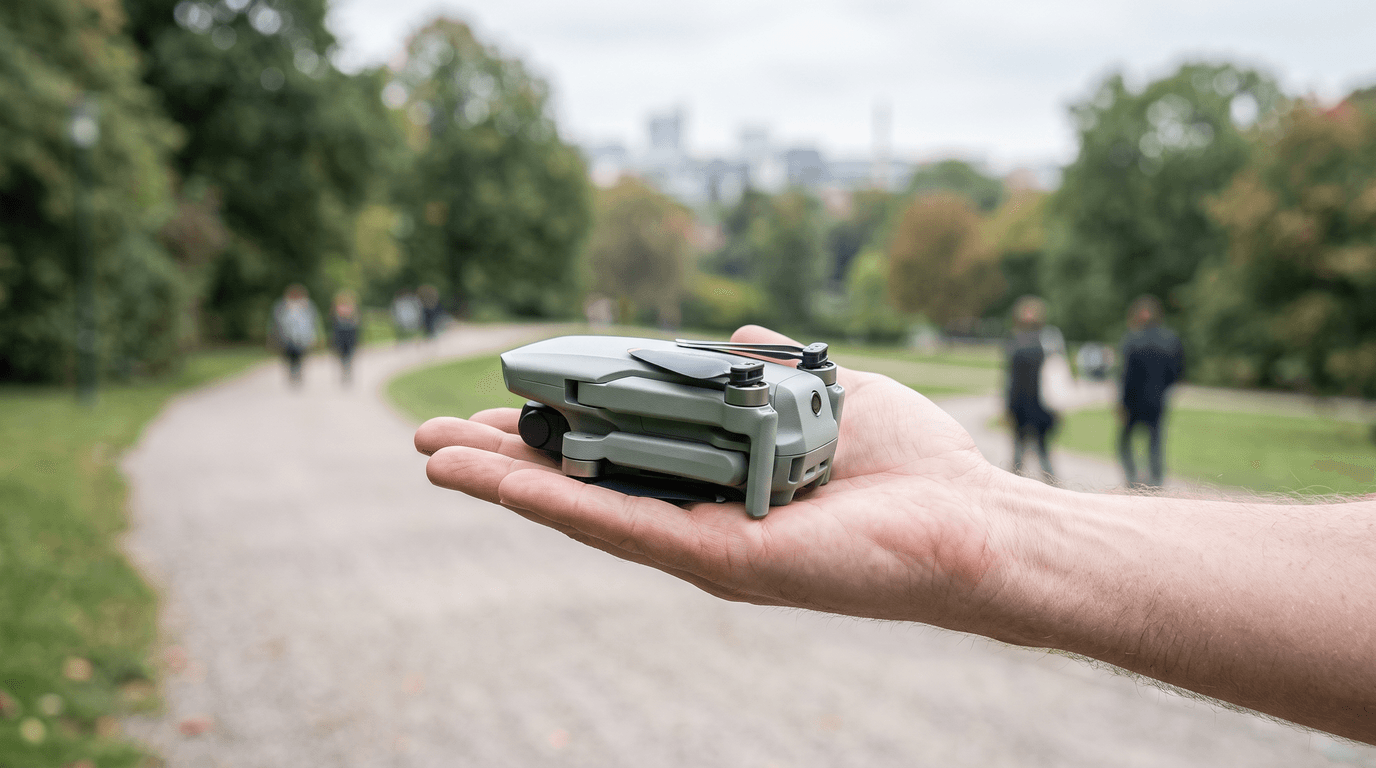
You registered as a drone operator in Latvia, passed the A1/A3 exam, and now you are packing the drone for a trip to Germany, Spain, or Italy. The obvious question: does any of that still count once you cross the border, or do you start again from zero in each country? The short answer is that most of it travels with you — and two things do not. This guide separates the two so you do not get caught out.
One registration covers the whole EASA area
EU drone rules are not 27 separate national systems bolted together. Since 2021 the same framework applies across all EASA member states — the EU plus Iceland, Liechtenstein, Norway, and Switzerland — for operator registration, remote-pilot competency, and the basic conditions of the Open category.
That gives you one clean rule for registration. Under Regulation (EU) 2019/947, you register once, in the state where you live (for a private person) or where your business is based (for a company). You cannot be registered in more than one member state at a time, and your operator number is valid in all of them. So your Latvian LVA-... operator number is the number you use in Germany, Portugal, or anywhere else in the area. You do not — and must not — register again at your destination.
The registration threshold is the same everywhere too. You need to be registered if your Open-category drone has a take-off mass of 250 g or more, or it can transfer more than 80 J of energy on impact, or it carries a sensor that can capture personal data (a camera, in practice) and is not a toy. Whatever made you register in Latvia makes you registered everywhere. Keep your operator number displayed on the aircraft, as the regulation requires.
If you have not registered yet, our Latvia registration walkthrough covers the local steps first.
Your A1/A3 licence is recognised abroad
Pilot competency travels on the same principle. An A1/A3 proof of completion — or an A2 certificate — issued by one member state is recognised by all the others. EASA states this plainly, and so does the Latvian CAA: a qualification obtained in one EU country is valid in the rest.
In practice that means your Latvian A1/A3 lets you fly in the Open category abroad under exactly the subcategory rules you already learned. A1 with a light drone, A3 far from people, the 120 m height limit, visual line of sight — those conditions are harmonised, so they read the same in Tallinn as in Lisbon. If you hold A2, the C2-close-to-people privilege comes with you as well. Nothing about the licence needs to be re-issued or re-stamped at the border.
This is also why the Open-category subcategory breakdown is worth knowing cold before you travel: the categories are the part that stays constant, so they are your fixed reference point in an unfamiliar place.
What does not travel: geographical zones
Here is the catch that ends most "but my licence is EU-wide" arguments. Where you may actually fly is set nationally, not by Brussels. Each member state defines its own UAS geographical zones — the no-fly areas, the restricted areas, and the zones where you may fly only with prior permission or under specific conditions. They differ from country to country, and they change.
So your Latvian registration and licence answer whether you are allowed to operate; they say nothing about where in another country. The map you trust at home does not apply abroad. Before you fly in a new country you have to find that country's geographical-zone map and its national rules, the same way you would check BGKIS or the no-fly zones in Latvia at home.
The reliable starting point is EASA's "Flying in your country" page, which links every national aviation authority and its drone information. Use it to find the destination's official zone map and any local conditions — minimum distances, urban restrictions, registration of foreign visitors where it still applies — before the trip, not at the launch point.
What does not travel cleanly: insurance
Insurance is the second local variable. EU law makes third-party liability insurance mandatory for aircraft, but the firm EU-level requirement bites at higher mass; for the light drones most Open-category pilots fly, whether insurance is compulsory is left to national rules.
The result is a patchwork. Some states require third-party liability cover even for small drones; others do not. Latvia has its own requirement, and a policy bought for Latvia will not automatically satisfy another country's rule or its required limits. Treat insurance as something to confirm per destination — check the national authority's guidance, and if you carry a policy, check that its territorial scope and liability limit actually cover the country you are flying in. Our drone insurance overview explains the EU baseline that this sits on top of.
Getting the drone there: batteries and the flight
One non-regulatory point that catches travellers out: getting the drone onto the plane. Drone batteries are lithium batteries, and airlines treat them by watt-hour rating. Spare batteries generally must go in carry-on, never in checked baggage, and capacity limits apply. Airlines can impose stricter rules than the baseline, so check your specific carrier before you fly. It is a logistics problem, not a licensing one — but a flat refusal at the gate grounds the whole trip just as effectively as a missing certificate.
Flying outside the EASA area
If your destination is not an EASA member state, none of the above is guaranteed. You follow that country's national law and, if in doubt, contact its civil aviation authority before you travel. The EU recognition simply stops at the edge of the area.
What matters now
Your Latvian operator number and A1/A3 are genuinely portable across the EASA area — that part is settled, and you do not re-register or re-qualify. The work before each trip is narrow and specific: pull up the destination's geographical-zone map, confirm its insurance requirement, and check your airline's battery rules. Do those three things and the licence does the rest.
Travelling soon? Lock in the fundamentals first: the A1/A3 exam guide and the Open-category subcategory breakdown cover the rules that stay the same wherever you land, and the practice sets keep them sharp.