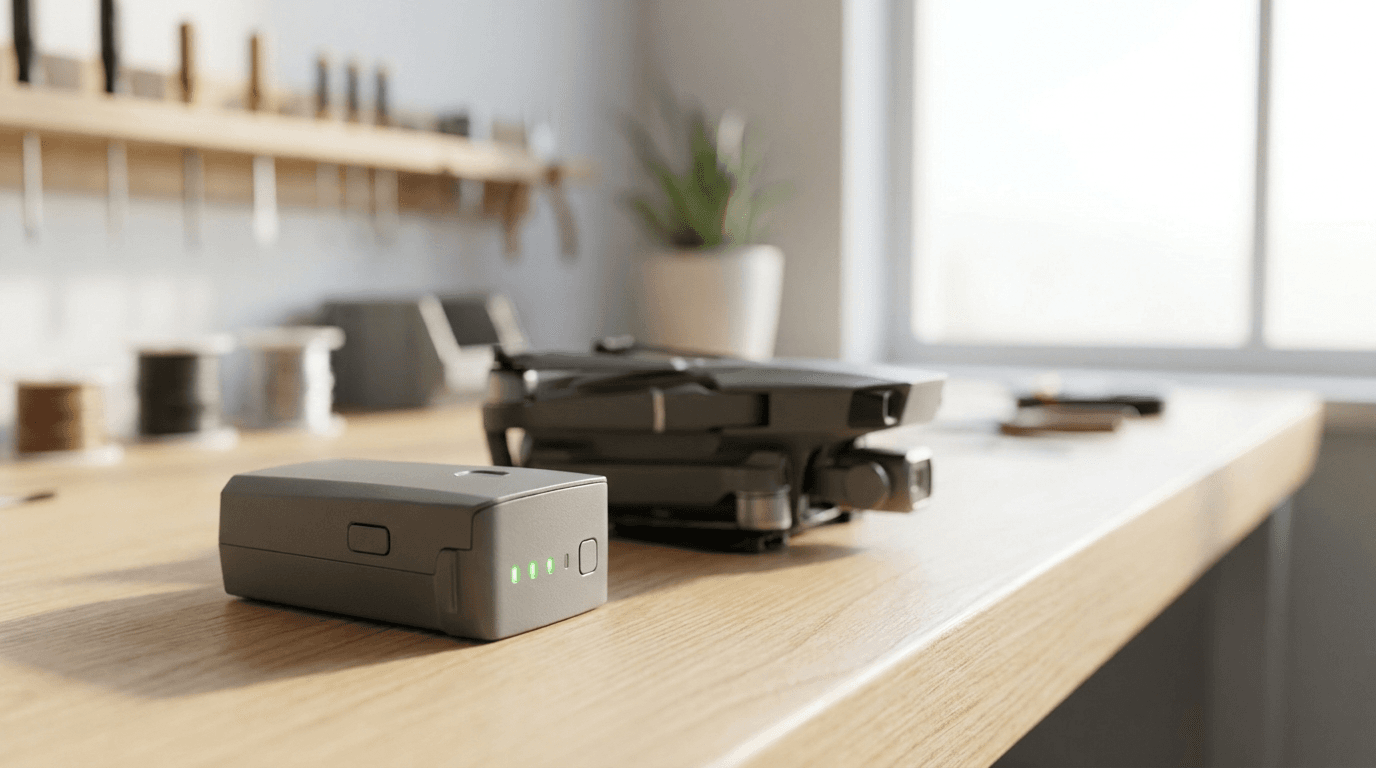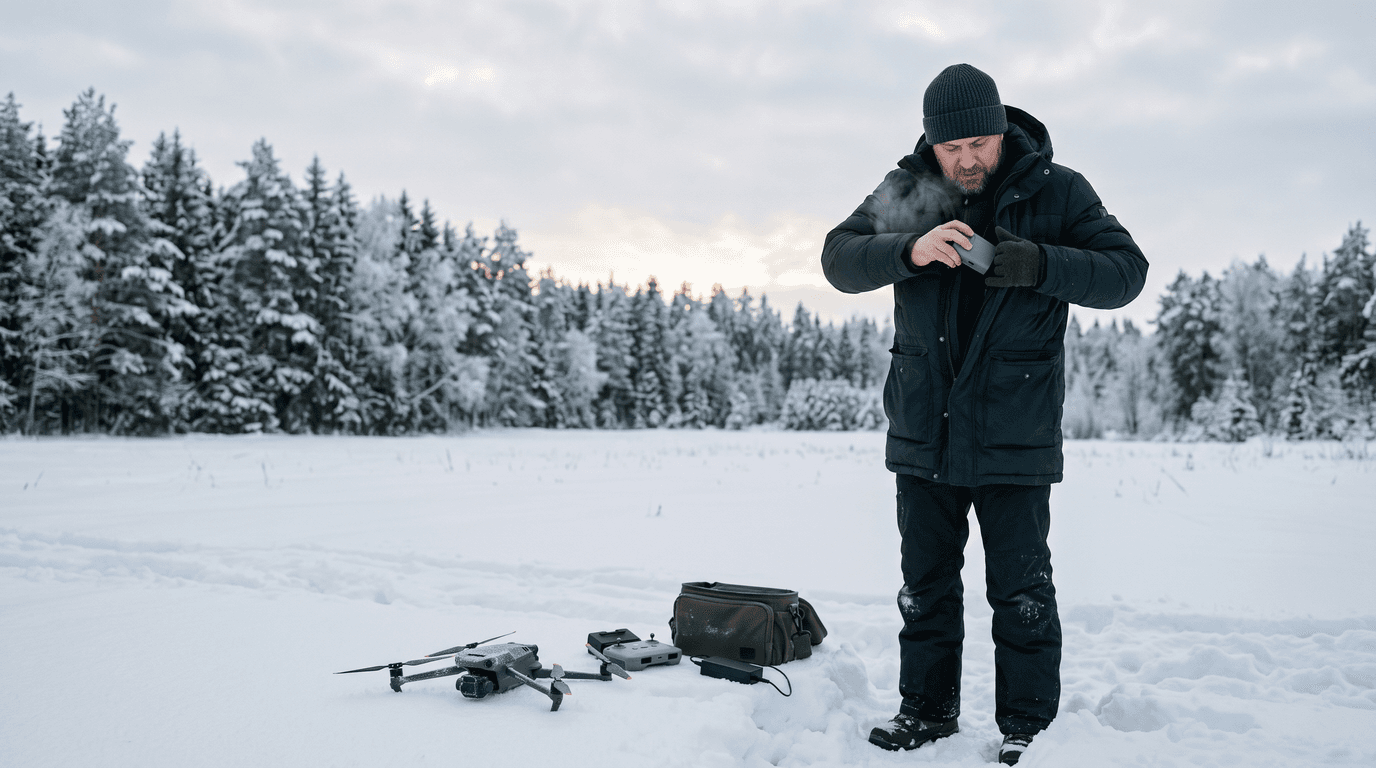
The drone that gave you 25 minutes of flight in July suddenly demands to land after 12 in January — often with a critical-battery warning while the indicator still shows half a charge. In a Latvian winter this is not a defect and not a worn-out pack. It is how lithium batteries behave in the cold, and it is predictable enough to plan around.
What cold does to a lithium battery
A LiPo or Li-ion pack produces current through a chemical reaction: lithium ions move between the electrodes through the electrolyte. Cold slows that movement. Two things follow directly.
First, internal resistance rises. The pack fights itself harder to deliver the same current, so more of its energy turns into waste heat instead of motor thrust.
Second, usable capacity shrinks. The energy is still chemically there, but the cold cell cannot deliver it at the rate the motors demand. Battery University's reference data puts the scale of it plainly: a battery that delivers 100 % of its capacity at 27 °C typically gives only about 50 % at -18 °C. The effect starts well before real frost — DJI notes that LiPo performance already drops below roughly 15 °C.
The good news: this loss is temporary. A cold-soaked pack that seems half dead recovers its full capacity once it warms back to room temperature. Cold does not destroy the battery — flying it wrong in the cold can.
Why the drone panics at 60 percent
The percentage on your screen is an estimate. The protection logic underneath it watches something more honest: cell voltage.
Under load, every battery's voltage dips. In a cold pack with high internal resistance, that dip becomes a plunge — especially during full-throttle climbs or when fighting wind. The flight controller sees voltage falling toward the cutoff and reacts the only way it can: critical-battery warning, forced descent, or auto-landing. The indicated percentage at that moment can still read 50–60 %.
This explains the classic winter symptoms:
- the percentage drops in sudden steps instead of a smooth decline
- flight time is a third to half shorter than in summer
- critical warnings arrive at an indicated charge that would be comfortable in July
- the drone feels sluggish on aggressive inputs
DJI's own guidance draws the hard line at voltage, not percentage: do not continue flying if it drops below 3.2 V per cell. If your app can show voltage on the main screen, turn it on for winter flying — the habit also belongs on your pre-flight checklist.
The manufacturer's numbers
DJI publishes concrete figures for its packs, and they are a reasonable reference for most consumer drones:
- battery operating range: -10 °C to 40 °C
- below 5 °C outside: preheat the pack indoors to above 20 °C before flight
- warm batteries to 25 °C or more before takeoff, with a battery heater if available
- DJI advises not flying below 0 °C at all
Other manufacturers set their own envelopes — check the manual for your model rather than assuming DJI's numbers transfer.
A winter routine that works
The whole discipline fits into five habits:
- Fly only fully charged packs. A half-charged battery starts closer to the voltage cutoff, and cold pushes it there faster.
- Keep batteries warm until the moment of takeoff. An inside jacket pocket, an insulated case, or a dedicated battery heater — anything that keeps the pack near room temperature instead of car-boot temperature. Insert it into the drone last.
- Hover for about a minute after takeoff. A gentle hover warms the pack under its own load before you ask it for hard climbs or sprints. Skipping this and going straight to full throttle is a textbook beginner mistake that winter punishes immediately.
- Fly gently. Smooth stick inputs keep the current draw — and the voltage sag — moderate.
- Land earlier than feels necessary. Plan missions for roughly two-thirds of your summer flight time and treat the first critical warning as a landing order, not a suggestion. Return-to-home consumes energy too, and a cold pack has less to give.
Cold is only one of the winter variables — wind and visibility decide just as many flights, so run a proper drone weather briefing before you drive out.
Charging, condensation and the winter break
Three ground-side rules matter as much as anything in the air.
Never charge a cold-soaked battery. Bring it indoors and let it warm fully to room temperature first. Charging lithium cells below freezing causes lithium plating on the anode — invisible, permanent damage that degrades capacity and safety. The same logic applies in reverse: let a pack cool after landing before you charge it.
Respect condensation. Move a cold drone and cold packs into a warm room and moisture condenses on every surface, including contacts and electronics. Leave the equipment in its closed case for a couple of hours to acclimatise before opening, charging or powering anything on.
Store at storage charge. If the drone hibernates until spring, leave the packs at roughly half charge in a cool, dry place — most smart batteries self-discharge to that level on their own after a few idle days. The full storage routine is covered in our guide to battery safety, storage and charging.
The takeaway
Cold does not break lithium batteries — it shrinks their margins. Less usable capacity, deeper voltage sag, earlier warnings. A pilot who launches a warm, fully charged pack, hovers a minute, flies smoothly and lands early gets most of the performance back and none of the forced landings.
Next step: make the warm-battery check part of your pre-flight checklist — and if you are still preparing for the A1/A3 exam, battery behaviour and human factors in cold weather are exactly the kind of material the course drills until it sticks.