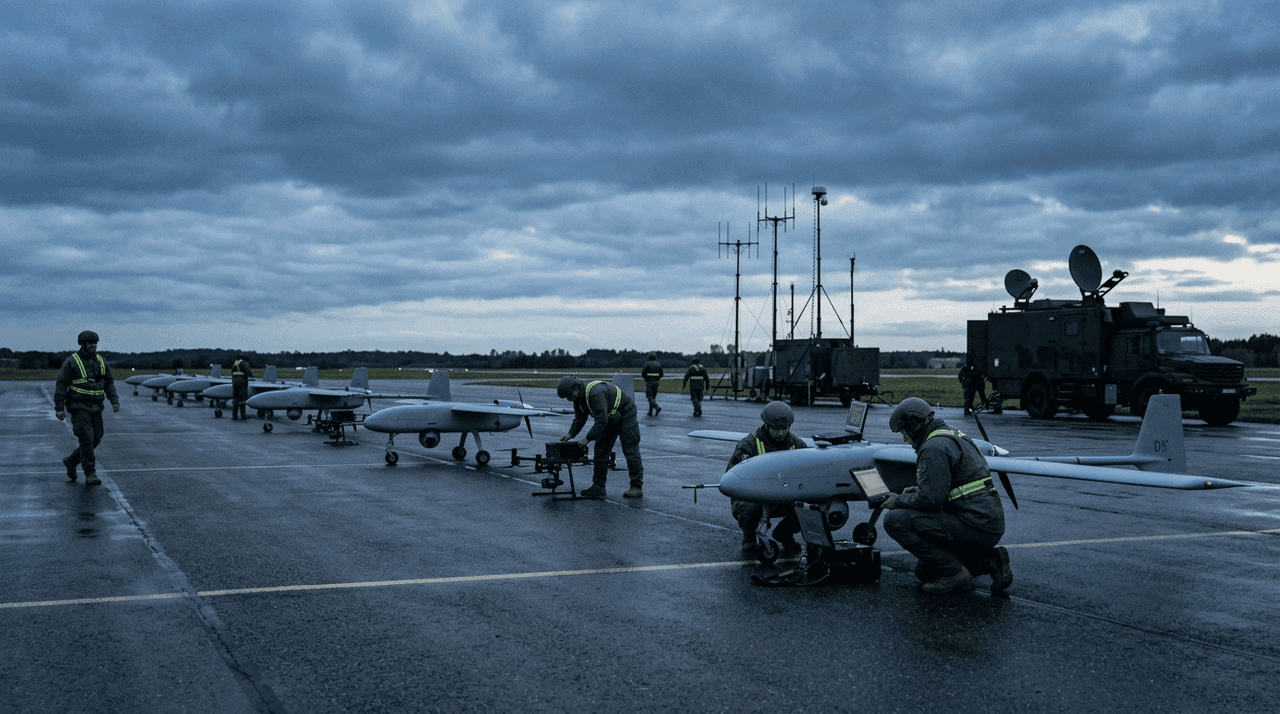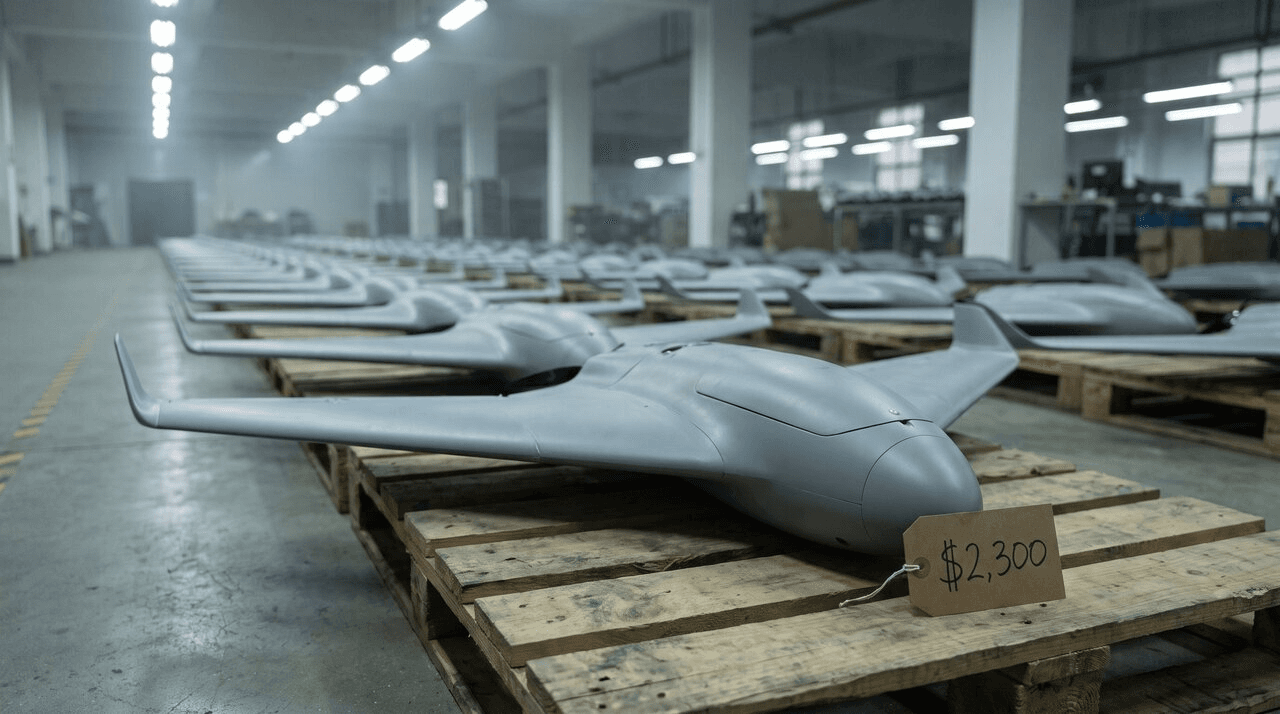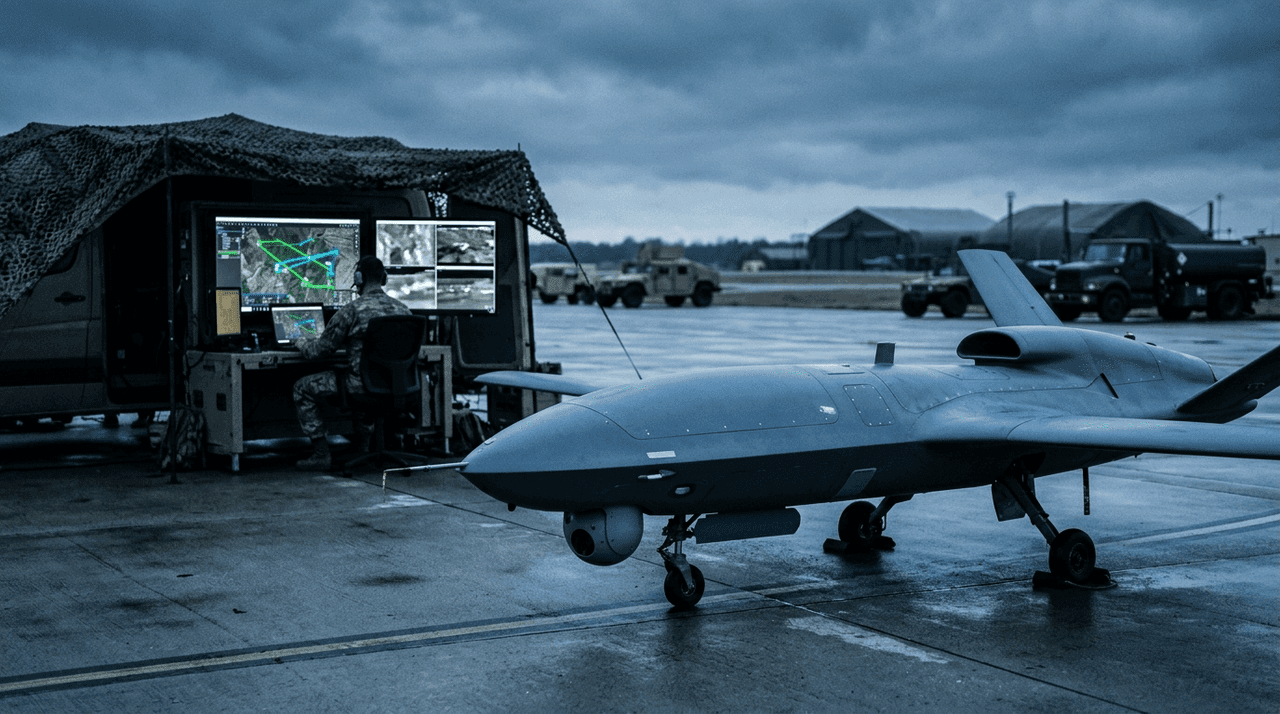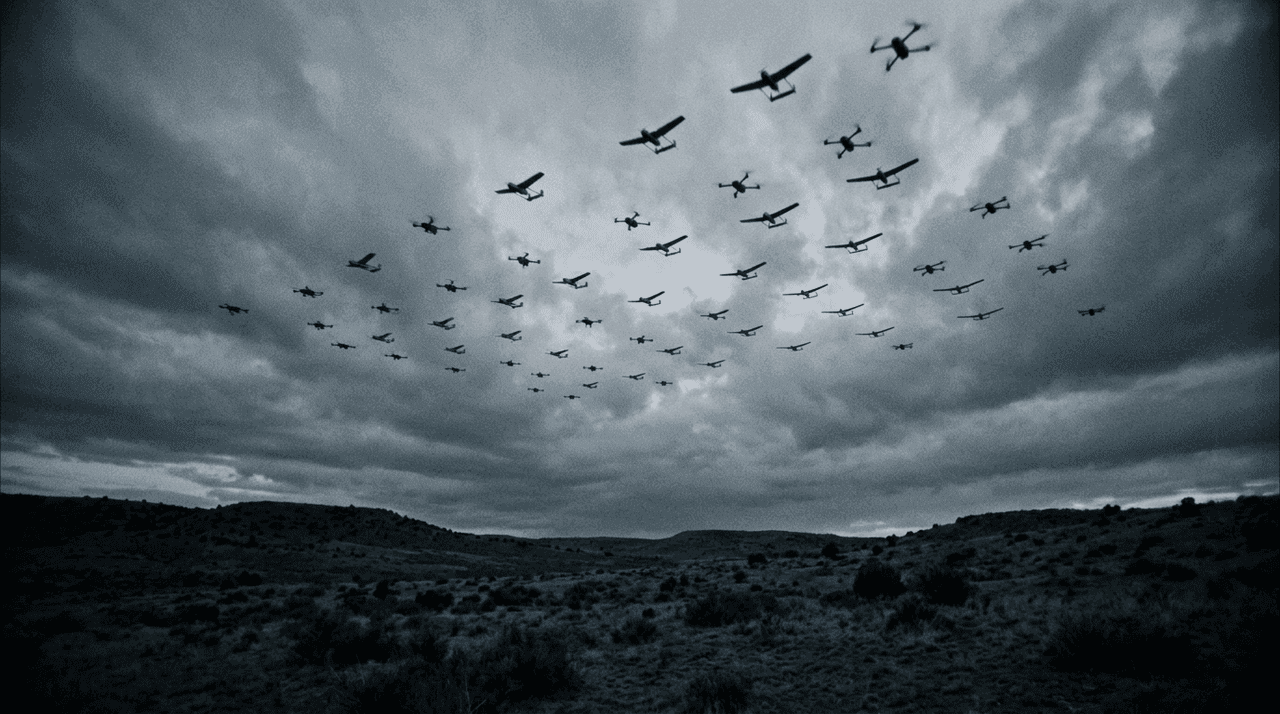
Drone swarms matter not because they look futuristic. They matter because they change the economics and the command logic of autonomous warfare. Once a force can coordinate dozens, then hundreds, of low-cost unmanned systems under one operational intent, the question stops being "how good is this one drone?" and becomes "how does the force sense, assign, adapt, and survive at scale?"
That is the real military significance of drone swarms in 2026. A swarm is not just a big launch. It is a system-of-systems problem that pulls in autonomy, human-swarm teaming, communications, attritable mass, logistics, and counter-swarm defense all at once. DARPA's OFFSET program framed this clearly years ago by focusing not just on platforms, but on human-swarm interfaces, generating swarm tactics, and directing potentially hundreds of unmanned systems in real time. NATO's autonomy roadmap now pushes the same discussion toward scale, interoperability, responsible use, and deployable "systems of systems." The U.S. Department of Defense's Replicator effort adds the industrial layer by tying autonomy to fielding at volume.
A drone swarm is really a command-and-control model
The public image of a swarm usually focuses on the spectacle: many drones moving at once. That is the least interesting part.
The harder and more important question is how the swarm is controlled.
A meaningful autonomous drone swarm needs at least five things working together:
- mission logic that hands out tasks across many vehicles
- communications tough enough to keep working through partial degradation
- human oversight that can guide the effect without micromanaging each aircraft
- enough onboard autonomy to keep the formation useful when conditions change
- recovery, retasking, or attrition logic for when vehicles are lost
This is why swarm warfare sits between software and doctrine. If the operator has to fly every platform by hand, it is not much of a swarm. If a human cannot redirect the system under stress, it cannot be trusted in operations. The real value shows up when one team can oversee many coordinated systems and push them toward one effect: search, decoy, sensing, suppression, strike, relay, or saturation.
DARPA got the conceptual architecture right early
DARPA's OFFensive Swarm-Enabled Tactics program is still one of the clearest official descriptions of what serious swarm warfare actually takes.
OFFSET imagined small-unit forces using swarms of upwards of 250 small unmanned air and ground systems for varied missions in complex urban areas. More important than the number was the architecture behind it. The program focused on:
- human-swarm interfaces
- swarm interaction grammar
- rapid tactics generation
- testing swarm tactics in simulated and live environments
- an extensible ecosystem for trading tactics
That stays highly relevant in 2026 because the central challenge of drone swarms is not just launch density. It is putting together tactics at machine speed. Swarm effectiveness depends on how quickly a force can generate, test, adapt, and field new collective behaviors.
In other words, future autonomous warfare is unlikely to be won by the side with the most impressive demo. It is more likely to favor the side with the fastest loop for adapting swarm tactics.
The military appeal of swarms is attritable mass with coordination
A single high-end autonomous UAV can be useful. A swarm matters when low-cost systems become coordinated enough that losing part of the force does not collapse the mission.
That is where the term attritable autonomous systems becomes important. Replicator's framing is useful here. DIU describes Replicator 1 as delivering all-domain attritable autonomous systems at the scale of multiple thousands, with the point being speed, scale, lower risk to personnel, and faster update cycles.
That logic changes operational planning.
Instead of preserving every aircraft, forces start to ask:
- how many platforms have to survive to finish the mission?
- how much sensing can be spread out?
- how much decoy value can be created?
- how much defensive saturation can be generated?
- how cheaply can losses be replaced?
This is why swarm warfare is not only about autonomy. It is also about the industrial base, the supply chain, and software-defined force design.
Human-swarm teaming is the real threshold problem
The hard operational problem is not building autonomy on its own. It is deciding what the human should still do.
DARPA focused squarely on human-swarm teaming. NATO's autonomy framework likewise stresses responsibility, explainability, traceability, reliability, and governability. Those are not abstract ethics phrases bolted onto a weapons debate. They reflect a real operational problem: a swarm becomes militarily useful only if humans can trust what it is doing and step in when needed.
In practice, that means the future of AI drone swarm operations is likely to settle on a few working principles:
- humans set the objectives and the constraints
- software handles local coordination and adaptation
- operators watch the exceptions, not every movement
- command systems have to make swarm behavior readable under stress
- tactical autonomy has to degrade gracefully when links, sensors, or vehicles fail
If that balance is wrong, the force gets either overload or unpredictability. Neither one scales.
Swarms change offense in several distinct ways
1. They compress sensing and action
A swarm can spread sensors, relay nodes, and effectors across a wider area than a single platform. That shortens the time between detection and action.
2. They complicate defense through volume and geometry
A defender may have to detect, classify, and respond to many low-cost vehicles arriving from different directions, altitudes, or mission roles all at once.
3. They allow mixed-role packages
One part of the swarm can relay communications, another can map, another can act as decoys, and another can carry out strike or suppression.
4. They increase tactical resilience
If the mission rests on the group's combined behavior rather than one exquisite platform, losses are easier to absorb.
This is why swarms keep showing up in the same conversation as loitering munition families, anti-drone systems, FPV adaptation, and software-defined C2. They are not a niche category. They are an operating logic.
Swarm warfare also changes defense
The offensive side gets most of the attention, but swarms may matter even more for what they do to defenders.
A defender facing a swarm cannot lean on one comfortable layer. The response has to be layered and selective.
That usually means some combination of:
- early detection and classification
- AI-assisted prioritization
- electronic warfare where it works
- kinetic effectors for leakers or high-priority vehicles
- passive hardening and mobility
- battle-management software that helps operators sort the threat quickly
This defensive burden is one reason the future of drone swarm defense is tightly tied to AI-enabled decision support. Humans on their own struggle when volume, speed, and ambiguity all rise together.
Replicator-2 reflects this clearly by focusing on C-sUAS challenges through modular, mutually reinforcing combinations of sensing, AI-enabled decision support, and defeat capabilities.
The swarm problem is as much industrial as tactical
Large-scale swarm operations are impossible without industrial discipline.
To sustain swarm capacity, a force needs:
- high-volume production
- simple maintenance workflows
- supply chains for batteries, motors, radios, and payloads
- software integration across mixed fleets
- training pipelines for operators and maintainers
- test ranges and experimentation cycles
This is one reason the most serious policy documents no longer treat autonomy as just a technology novelty. They talk about speed and scale.
Replicator's language about the commercial sector is telling here. The program plainly frames autonomy as ripe for scaling and stresses expanding the industrial base, broadening the supplier pool, and sending demand signals that let companies build capacity. That is the right frame. Swarm warfare will not scale on prototypes alone.
Marines and other services are already shifting toward scale and doctrine
Official U.S. Marine Corps writing in 2025 makes the institutional direction fairly explicit. The service launched its drone task force summits to organize, train, and equip Marine Air-Ground Task Force elements to use lethal and non-lethal UAS at scale. That wording matters.
The article also highlights:
- the role of the Marine Corps Attack Drone Team
- a common ecosystem and command-and-control architecture
- best-practice handbooks
- operator training pipelines
- signature management
- advanced manufacturing for repair in austere environments
This is exactly how swarm logic matures inside a force. It stops being a novelty unit or a one-off experiment and becomes doctrine, training, repair, competition, and architecture.
The Marine piece is also useful because it links massed drone effects to cost. It notes live-fire FPV strike activity at a fraction of the cost of traditional battalion organic missiles. That does not prove swarms replace everything else. It does show why services are so interested in scaling low-cost unmanned effects.
NATO's swarm future is about interoperability and responsible scale
NATO's autonomy implementation framework is not a swarm doctrine manual, but it matters because it sets the political and operational conditions under which allied autonomy can scale.
The key points are practical:
- interoperable systems of systems
- routine experimentation with autonomy-enabled solutions
- responsible-use principles for AI in defense
- security measures against the new threats autonomous systems create
- public and institutional trust
For coalition warfare, this is essential. A swarm architecture that cannot integrate across allied systems, or that becomes politically unusable under scrutiny, is not much of an operational asset. So the future of autonomous warfare in NATO settings will depend not only on engineering performance, but on shared standards, doctrine, legal confidence, and discipline with data.
The most dangerous misconception is that swarm warfare means no humans
It does not.
The more realistic direction is not removing the human, but compressing the human's attention. Fewer people supervise more machines. Human attention moves up from direct piloting toward mission intent, exception handling, prioritization, and authorization.
That makes the interface problem decisive. A bad interface turns a swarm into chaos. A good interface turns a swarm into manageable military leverage.
This is exactly why human-swarm interfaces sat so centrally in OFFSET, and why responsible-use frameworks matter alongside them. Swarms do not get rid of the human problem. They redesign it.
What the next phase of swarm warfare probably looks like
The next phase is unlikely to be one dramatic leap into science-fiction autonomy. It is more likely to be a layered progression.
Near term
- larger groups of semi-autonomous systems
- better route coordination and deconfliction
- mixed sensing and decoy roles
- stronger counter-swarm software and battle management
Mid term
- more dynamic retasking within the swarm
- stronger onboard perception and local cooperation
- broader integration across air, ground, and maritime uncrewed systems
- more dock, launcher, and reload automation
Strategic level
- procurement built around attritable mass
- doctrine that assumes unmanned volume on both sides
- industrial competition around autonomy stacks and open architectures
- rising pressure for legal, policy, and escalation controls
That future is demanding because it requires progress in software, manufacturing, training, doctrine, and defense all at the same time.
Common errors in swarm analysis
Confusing quantity with capability
A large launch is not automatically a capable swarm. The quality of coordination matters more than the raw count.
Treating autonomy as magic
Autonomy does not remove communication, logistics, or doctrine problems. It changes them.
Ignoring defense
Any swarm discussion that focuses only on offense misses half the military problem.
Overlooking the interface
If humans cannot understand and redirect swarm behavior, the concept will not scale reliably.
Swarm warfare will favor forces that learn faster than they buy
One of the deeper implications of drone swarms is that buying alone will not be enough. A military can buy large numbers of aircraft and still fail if it cannot update behaviors, rehearse tactics, and retrain operators fast enough.
Swarm usefulness depends on learning speed in areas like:
- collective route behavior
- deconfliction under pressure
- decoy and deception timing
- handing off between human control and local autonomy
- adapting after losses or communications disruption
This is why DARPA's emphasis on tactic generation and experimentation stays so relevant. Swarms reward forces that can test, discard, and improve quickly.
The political and escalation problem will grow with the technology
As military drone swarms become more credible, the strategic questions around control, authorization, and escalation will get harder, not easier.
States will need clearer answers to questions like:
- how much lethal autonomy is acceptable inside a swarm package
- how coalition partners share control and accountability
- what happens when a swarm degrades unpredictably under attack
- how defenders read large autonomous packages near sensitive targets
These are not reasons to dismiss swarm warfare. They are reasons to understand that the future of autonomous warfare is not only a software and industrial challenge. It is also a command-authority challenge.
Swarm logistics may decide things faster than swarm intelligence
There is a tendency to talk about swarms mainly through autonomy and software. But if militaries try to use them seriously at scale, they also run into a simpler question: can they keep them supplied?
Swarm-capable forces will need:
- large inventories of cheap aircraft
- reliable batteries and propulsion parts
- fast field reconstitution after losses
- training that scales beyond one specialist cell
- software distribution and testing pipelines that can keep pace with the iteration
This matters because a swarm concept that cannot be resupplied quickly becomes a demo, not a durable combat layer.
Swarms may matter most when they force the defender into bad choices
A swarm does not need every aircraft to hit a target to create value. It can succeed simply by forcing the defender into poor choices: emitting too early, wasting interceptors, overloading operators, or putting attention in the wrong place. That is one reason swarm warfare is such a demanding systems problem.
FAQ
What is a drone swarm in military terms?
It is a coordinated group of unmanned systems acting under shared mission logic rather than as isolated single platforms.
Why are drone swarms important in 2026?
Because they combine low-cost mass, autonomy, and distributed effects in ways that pressure both offensive doctrine and defensive architecture.
Are drone swarms fully autonomous?
Not usually in the strongest sense. The operational trend is toward human-supervised autonomy, not total human absence.
What is the main challenge in swarm warfare?
Command-and-control at scale: assigning intent, managing adaptation, keeping trust, and keeping the system useful under attrition and disruption.
What makes swarm warfare different from ordinary drone warfare?
The shift from how one platform performs to how the coordinated system behaves. Swarms change planning, control, logistics, and defense all at once.
Conclusion
Drone swarms are becoming central to the future of autonomous warfare not because they look dramatic, but because they compress mass, software, and command into one military problem. DARPA's OFFSET work, NATO's autonomy framework, Replicator's industrial push, and the current Marine Corps adaptation all point the same way. The real future is not a sky full of identical robots acting alone. It is coordinated attritable systems, guided by humans through better interfaces, backed by industrial scale, and contested by defenses that adapt just as fast.