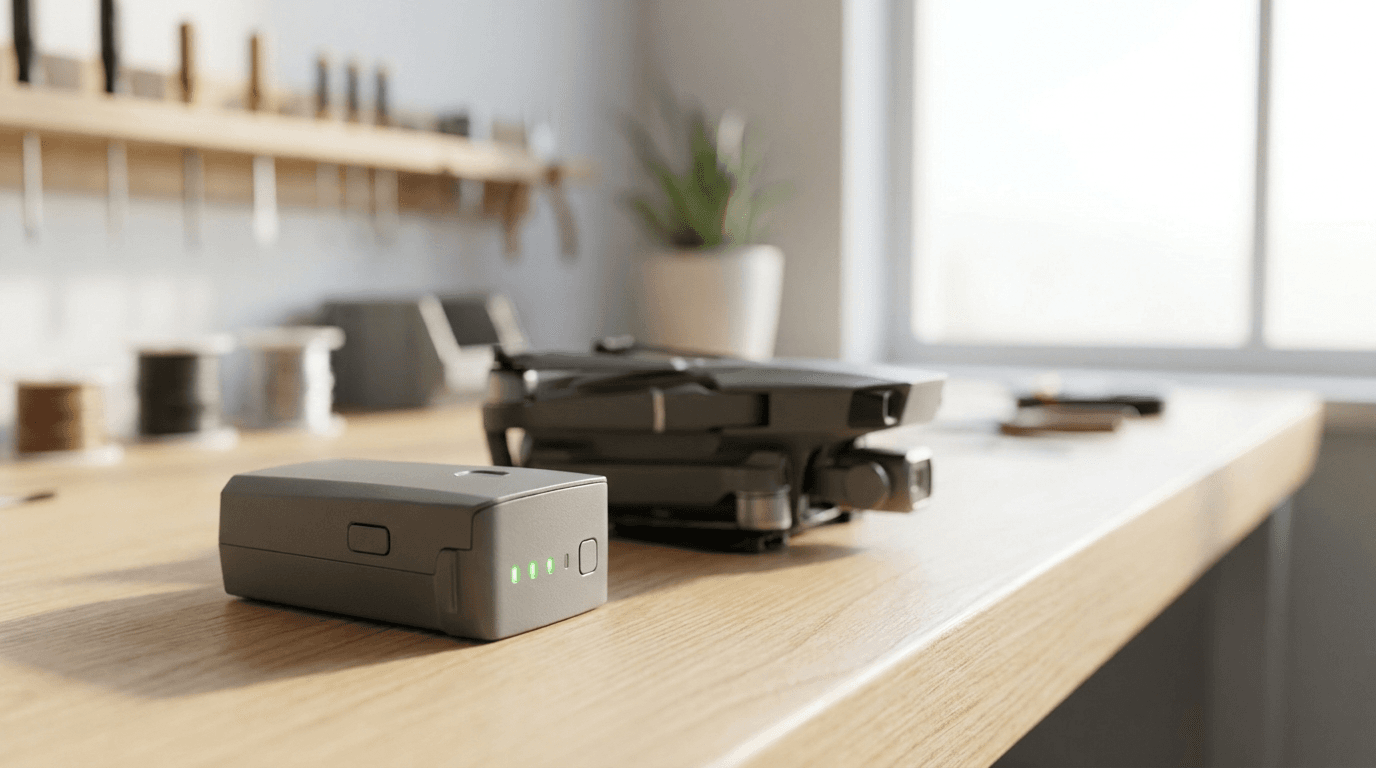
The most dangerous part of your drone is not the propellers. It is the flat grey pack that clicks into the back of it. A modern drone battery holds a lot of energy in a soft lithium-polymer pouch, and when one of those pouches is over-charged, over-discharged, crushed, or simply left sitting full for months, it can swell, vent, or catch fire — and a lithium fire does not behave like a paper fire you can smother.
None of this is exotic or rare. It comes down to a handful of habits around how you store, charge, fly, carry, and eventually retire the pack. It is also a named A1/A3 exam subject, sitting inside UAS General Knowledge. Here is the version worth actually knowing.
What is inside, and why it bites
Almost every consumer drone runs on a lithium-polymer (Li-Po) or lithium-ion pack. The appeal is energy density: a lot of watt-hours for very little weight, which is exactly what a flying machine needs. The trade-off is that the same chemistry is unforgiving when it is abused.
Two numbers describe a pack. Voltage (V) is set by how many cells are wired in series — a "3S" pack is three cells, roughly 11.1 V nominal. Capacity is given in amp-hours (Ah) or milliamp-hours (mAh). Multiply them and you get the energy the pack stores: watt-hours = volts × amp-hours. A DJI Mavic 3 battery, for example, is 15.4 V and 5000 mAh (5.0 Ah), so about 77 Wh. That single figure — the Wh printed on the pack — decides your airport rules later, so it is worth being able to read it.
When a cell is pushed past its limits, it can enter thermal runaway: an internal short heats the cell, the heat drives more reactions, and the reactions produce more heat, until the pack vents flammable gas and ignites. The whole point of good battery habits is to never give a cell a reason to start.
Storage: the number is about 60 percent, not full
This is the single habit that saves the most batteries, and the one most people get wrong. A lithium pack does not like being stored full, and it does not like being stored empty. It likes sitting a little over half charged.
DJI's own maintenance guidance is explicit: if you will not use a battery for more than 10 days, discharge it to 40–65 percent before storing it, and keep it in a cool, dry, well-ventilated place — ideally around 22–28 °C. This is not folklore. DJI Intelligent Flight Batteries actively self-discharge on their own for exactly this reason: a Mavic 3 pack left idle drops itself to about 96 percent after three days and down to 60 percent after nine, specifically "to prevent swelling."
The opposite failure is quieter and just as fatal. Store a pack that is nearly empty and it keeps leaking charge until it falls into over-discharge, below roughly 10 percent, where the cell chemistry takes permanent damage. Leave it there long enough and the pack simply will not come back. So the rule cuts both ways: do not store a battery full, and never store one flat. If a pack will sit unused for months, top it back to the storage band every so often, and run a full charge-and-discharge cycle at least every three months to keep it healthy.
Charging: let it cool, watch the room, do not walk away
Charge a battery straight after landing and you are charging it hot — DJI warns that this can damage the pack. Let it cool to room temperature first. In the other direction, do not charge a battery that is freezing cold either; lithium does not accept charge well near or below 0 °C.
Beyond temperature, the safe-charging habits are the same ones fire services repeat about every lithium device:
- Charge on a hard, non-flammable surface — not on a bed, a sofa, or a pile of paper.
- Use the charger that came with the drone, or a genuine replacement. Cheap third-party chargers are a common ignition source.
- Do not leave it charging unattended or overnight. A pack that fails does so fast, and you want to be in the room.
Cold and heat change how the battery flies
Temperature does not just affect storage — it affects the flight itself. In the cold, a lithium pack delivers less of its capacity, so your flight time drops, and the voltage can sag suddenly under load, which is how a cold battery triggers an abrupt power warning or an automatic landing.
DJI's cold-weather guidance is practical: fully charge before each flight, warm the battery to about 25 °C before take-off (below 5 °C, preheat it indoors until it is well above 20 °C), and once airborne, hover for a minute to let the pack warm under a gentle load before you fly off. Heat is the other end of the same problem: a pack is warm and swollen straight after a hard flight, which is normal and usually settles as it cools — but it is exactly the wrong moment to put it on a charger.
Damage and swelling: know when a pack is finished
A battery that has been dropped hard, punctured, soaked, or swollen is not a battery to nurse along. The signs that a lithium pack is failing are worth memorising, because the US Fire Administration lists them as the warning signs of thermal runaway: bulging or swelling, cracking, hissing or popping, an odd chemical smell, smoke, or unusual heat.
A pack that stays swollen after it has cooled, or shows any of those other signs, is done. Stop using it, do not charge it, and retire it. If a battery actually vents or ignites, treat it as a serious event: get people away from the gas and smoke, and use large amounts of water to cool it if you safely can — a small household extinguisher will knock down flames but will not stop a lithium cell from reigniting, so the goal is cooling and distance, and calling emergency services. Do not put a damaged or swollen lithium battery in a household bin or a mixed-recycling bin; it is a well-documented cause of fires in bin lorries and sorting plants. Take used and dead lithium batteries to a battery collection point or a shop that sells them — separate battery collection is the rule across the EU.
Taking your drone on a plane
Drone batteries are lithium batteries, and airlines treat them as dangerous goods. The core rule from EASA is simple and non-negotiable: spare batteries and power banks must travel in your carry-on baggage, never in checked baggage, and each one must be individually protected against short-circuits — the original case, a dedicated battery bag, or tape over the terminals. Do not recharge spare batteries or power banks on board.
There is also a size ceiling, expressed in watt-hours. Batteries up to 100 Wh travel freely in carry-on; 101–160 Wh need airline approval and are limited in number; above 160 Wh they are not allowed on a passenger aircraft at all. This is where reading the Wh figure pays off — almost every consumer drone battery sits comfortably under 100 Wh, but larger prosumer packs edge close, so check the number printed on each pack before you pack your bag. The drone itself, with a battery installed, is best carried in the cabin too.
Why this is on the A1/A3 exam
Batteries are Topic 6, UAS General Knowledge, in the A1/A3 syllabus, and the exam can test the concrete points: that energy is watt-hours = amp-hours × volts, that lithium packs are stored at roughly 50–60 percent, that you do not charge them when they are too hot or too cold, and that they travel fire-safe. It overlaps with the parts of the syllabus you already drill — the pre-flight checklist includes checking battery state and seating before every flight, and low battery is a named in-flight emergency where the correct answer is to bring the aircraft back and land, not to squeeze out the last percent.
There is also a reporting angle. A battery that vents, catches fire, or causes an in-flight power loss can be exactly the kind of safety event that belongs in an occurrence report. The exam rewards the candidate who treats the battery as a flight-safety component, not an accessory.
Quick reference before you store or fly
- Store at ~50–60 percent, never full and never flat; cool, dry, well ventilated. Top up idle packs every few months.
- Let a pack cool before charging; do not charge it hot or freezing, on a soft surface, or unattended.
- In the cold, expect shorter flights, warm the battery to ~25 °C first, and hover briefly before flying off.
- Retire any swollen, cracked, hissing, or water-damaged pack — do not charge it.
- Flying somewhere? Spare batteries in carry-on only, terminals protected; check the Wh — under 100 Wh is fine.
- Dispose properly: battery collection point or a shop, never a household or mixed-recycling bin.
Battery care is the quiet half of drone safety — it never shows up in a good flight, only in a ruined pack or a fire that a few habits would have prevented. Fit it alongside choosing your first drone and its weight class and what the A1/A3 exam in Latvia expects, then run the UAS general-knowledge questions in the practice sets — the ones about watt-hours and storage look trivial right up until you have to name the number.