A pilot buys a new DJI drone, adds DJI Care Refresh at checkout, and mentally files the insurance question as solved. It is not. Care Refresh and drone insurance protect different parties against different losses — and in Latvia, one of them can be legally mandatory while the other never satisfies that requirement. Mixing them up is not a paperwork detail: it decides who pays when your drone breaks, and who pays when your drone breaks something else.
There are three separate protections in play. Worth keeping them apart from the start.
DJI Care Refresh: a replacement service for your drone
DJI describes Care Refresh as a protection plan for DJI products covering accidental damage and natural wear. For camera drones, the listed scenarios are collision, water damage, flyaway and natural wear. The mechanics matter: it is not an insurance payout. You pay an additional replacement fee, send in the damaged aircraft, and receive a product that is brand-new or equivalent to brand-new, with shipping covered both ways.
The plan structure, per DJI's official page:
- 1-Year Plan — 2 replacements, of which 1 may be a flyaway case
- 2-Year Plan — 4 replacements, of which 2 may be flyaway cases
Two caveats DJI itself prints. Flyaway coverage is available only for select products, so check the terms for your exact model. And the fast-track DJI Care Express channel currently does not handle flyaway or data-analysis cases — those go through a regular service request. Plan prices vary by model; check DJI's current price list rather than any blog.
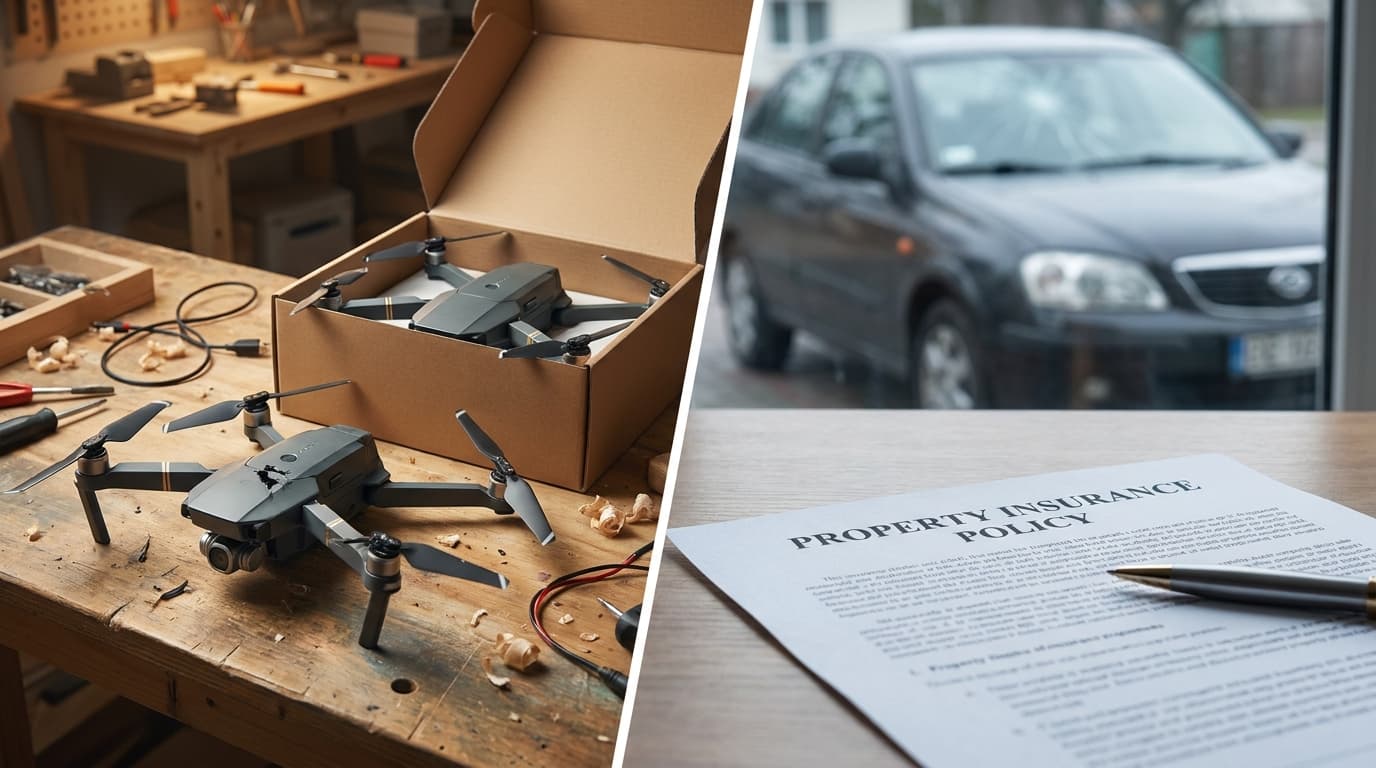
Now the part that gets skipped in checkout enthusiasm: every item in that plan concerns your DJI product. Nothing in Care Refresh pays the owner of the greenhouse your drone went through, the driver whose windscreen it cracked, or the person it injured. It is not a liability policy, and it does not satisfy any insurance requirement in Latvian law.
Third-party liability: the one Latvia actually requires
Latvia's mandatory drone insurance is defined by Article 117.10 of the Aviation Law and Cabinet Regulation No. 447 (2021). It is third-party civil liability cover — compensation for damage your drone causes to other people and their property. The CAA publishes the minimum limits as a matrix by category, class and mass:
| Operation | Minimum liability limit |
|---|---|
| Open category, A1 with a drone under 250 g or C0 | none listed |
| Open category, A1 with C1 | 50,000 EUR |
| Open category, A2 with C2 | 50,000 EUR |
| Open category, A3 under 20 kg | 50,000 EUR |
| Open category, A3 at 20–25 kg | 750,000 SDR |
| Specific category, 250 g to 500 kg | 750,000 SDR |
The CAA adds one sentence that settles this whole comparison: the requirement applies only to general civil liability for losses to third parties — it does not extend to damage to the drone itself or to its user. In other words, the mandatory policy is the mirror image of Care Refresh. One protects everyone around you; the other protects your hardware. Neither does the other's job.
One more boundary condition: for drones under 20 kg, the EU leaves mandatory insurance to national rules. Flying in Estonia, Lithuania or anywhere else means checking that country's requirement first — EASA keeps a list of national aviation authorities for exactly this. For how the Latvian rules themselves are structured, see drone insurance in Latvia and the EU.
Hull insurance: the third, optional layer
Between those two sits a product regular insurers sell: voluntary hull cover for the aircraft itself, KASKO-style. Functionally it overlaps with Care Refresh — both respond when your own drone is damaged or lost — but the mechanics differ. An insurer pays money against a policy with a deductible and exclusions; DJI swaps hardware for a fixed replacement fee through its own service network. Which is better value depends on the model, the policy terms and how you fly; the terms of the specific policy decide, so read them rather than assume. For a hobby pilot with one mid-range drone, Care Refresh usually fills this slot. For an operator with several aircraft and payloads, an insurer's hull policy can cover what a manufacturer plan cannot.
What breaks → what pays
| Scenario | Care Refresh | Liability insurance | Hull insurance |
|---|---|---|---|
| You fly into a tree | replacement, for a fee | pays nothing | yes, per policy |
| Drone lands in a lake | water damage is covered | pays nothing | per policy |
| Drone flies away | select products, limited count | pays nothing | per policy |
| Drone cracks a parked car's windscreen | pays nothing | this is exactly its job | pays nothing |
| Drone injures a bystander | pays nothing | yes — and legal claims follow this route | pays nothing |
| CAA asks for documents before a C1/C2 flight | irrelevant | the mandatory policy must exist | irrelevant |
The table is the argument. There is no scenario where Care Refresh and liability insurance answer the same question.
Which combination fits which pilot
Sub-250 g hobbyist. No mandatory cover in the Open category. Care Refresh is a comfort decision about your own hardware. A voluntary liability policy is still worth pricing — a 249 g drone through a window is a real claim, just not a legally pre-insured one.
C1 or C2 pilot flying near people. The 50,000 EUR liability policy is mandatory — buy it before the flight, not after the incident. Care Refresh remains optional and unrelated. If you lose a drone entirely, know what to do after a flyaway — the liability policy may matter more than the lost hardware if it came down on someone.
Commercial operator. Liability cover is mandatory and clients increasingly ask to see it. Downtime economics push towards Care Refresh or hull cover too: a lost week of jobs often costs more than the replacement fee. Factor all of it into your rates from day one — the numbers belong in the same spreadsheet as starting a drone business, especially now that Latvia's 2026 fine regime prices non-compliance off turnover.
The takeaway
Care Refresh protects your drone. Liability insurance protects everyone else — and it is the only one Latvian law asks about. Hull insurance is an optional second way to protect your drone through an insurer. They stack; they never substitute. If a seller or a forum post implies one covers the other, that is the moment to stop and check the CAA table.
Next step: before you buy any policy, confirm which category and class you actually fly under — that decides the minimum limit. The dronelingo course covers insurance requirements alongside everything else on the A1/A3 exam.