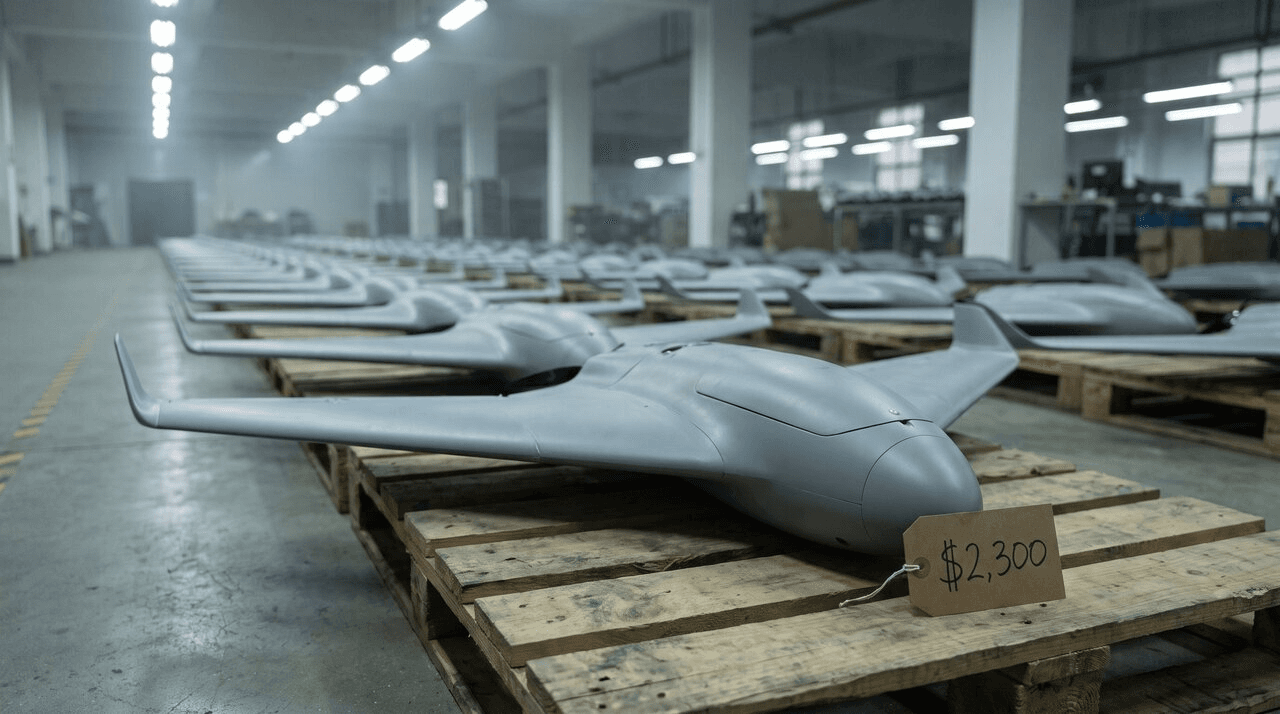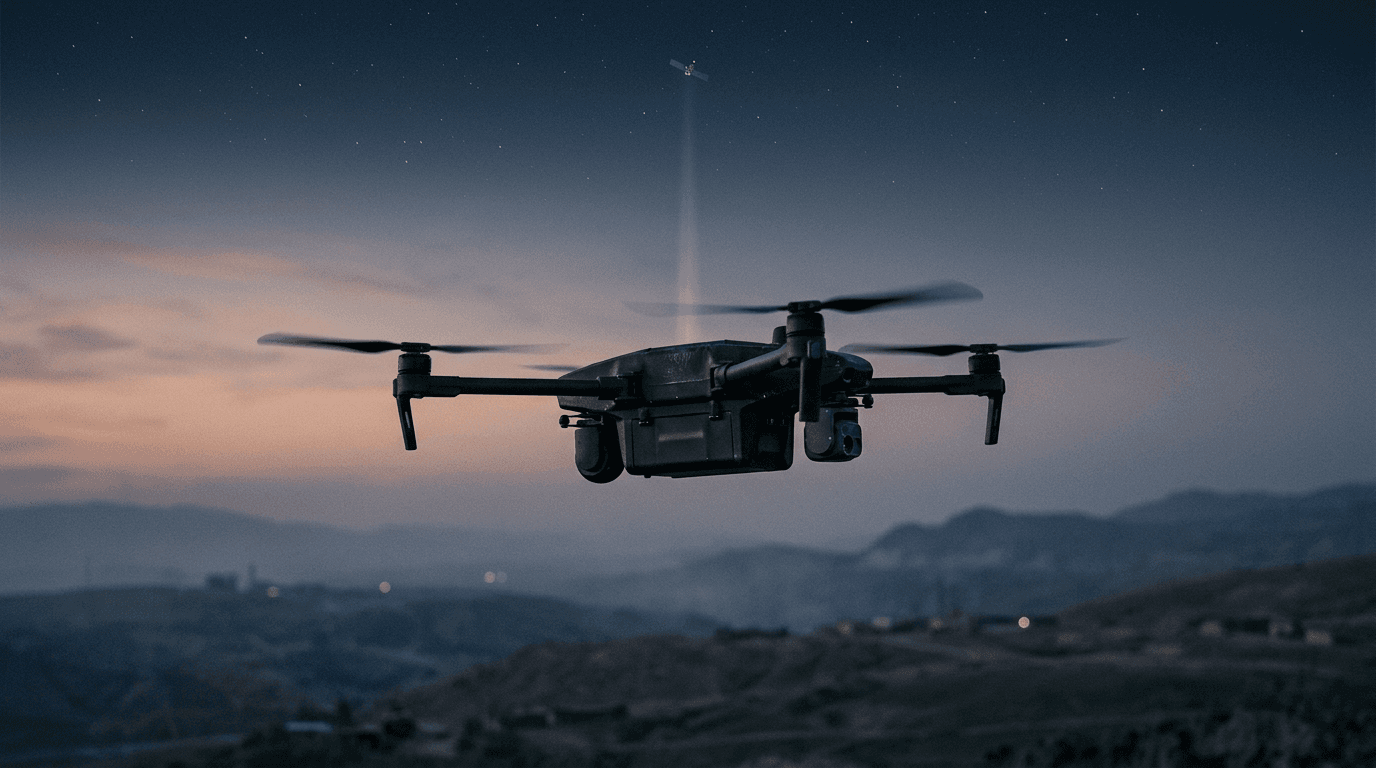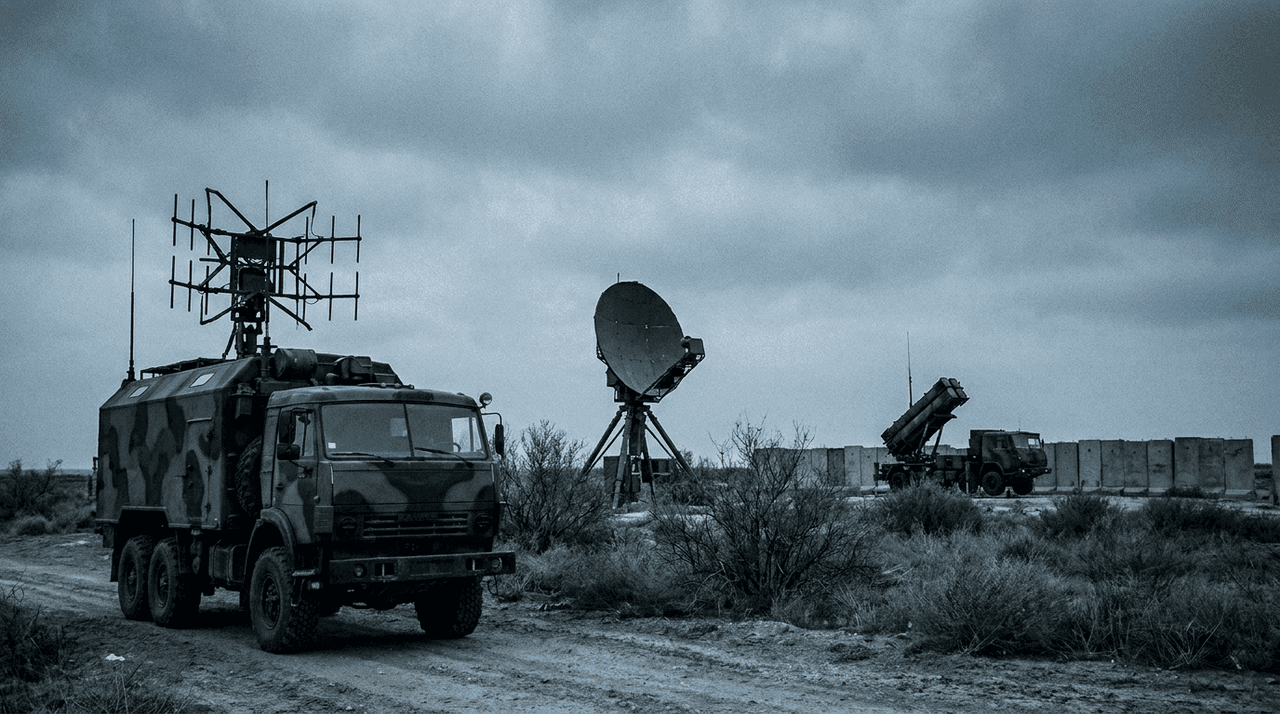
Anti-drone systems are no longer a niche add-on to air defense. They are turning into a daily survival need, because cheap unmanned aircraft now pack surveillance, strike, and swarm pressure into a threat that moves faster than the usual procurement cycle, and often faster than the usual chain of command can react.
That is why the counter-UAS conversation in 2026 looks very different from the old "just jam the drone" mindset. Electronic warfare still matters, but on its own it is no longer enough. Modern anti-drone defense has become a layered job that ties together sensing, identification, battle management, proportional ways to take a drone down, spectrum awareness, and the ability to keep working under cyber and EW pressure. NATO's 2025 Integrated Air and Missile Defence policy says this plainly: you have to counter the full range of air threats, from every class of UAS to cruise and ballistic missiles, in a contested and degraded environment. The U.S. Army's 2025 electromagnetic warfare update makes the same point from another angle. The spectrum is not a side topic. It is part of maneuver.
Anti-drone defense is no longer one jammer or one gun
The simplest mistake in counter-drone planning is to treat anti-drone systems as a single product class. They are not.
A workable counter-UAS architecture usually needs several layers:
- detection and classification
- command-and-control or battle management
- electronic warfare and spectrum tools
- kinetic or hard-kill defeat options
- mobility, concealment, and procedural defense
Each layer exists because drone threats vary far too much for one answer. A consumer quadcopter, a hard-to-spot one-way attack drone, an RF-linked FPV system, an autonomous loitering munition, and a swarm of small cheap aircraft do not produce the same signature or the same engagement problem.
That is why serious anti-drone systems are increasingly described as architectures, not gadgets.
Detection is the real starting point
No defeat layer matters if the system cannot find and classify the threat in time.
This sounds obvious, but it is where many deployments still fall apart. Small drones are hard to catch because they fly low and slow and often blend into the background of a civilian or battlefield scene. Their radar return can be weak, their sound faint, and their radio behavior inconsistent. Some transmit nonstop. Others are quieter and more autonomous.
So good counter-UAS sensing increasingly blends several sensor types:
- radar
- RF detection
- EO/IR cameras
- acoustic cues in certain settings
- all of it fused through command software
L3Harris's public C-UxS material is useful here because it shows how the market now talks about the problem. Drone Guardian is described as combining radar, RF, and EO sensors to deliver timely alerts and support clear decisions. That is the right framing. The point is not one miracle sensor. The point is data fusion good enough to cut an operator's uncertainty fast.
Electronic warfare is central, but it is not universal
EW is still one of the most important anti-drone tools, because so many small UAS threats still rely on radio links, satellite navigation, or other exposed emitters. The appeal is obvious: if you can break the link, degrade navigation, or scramble the control logic without firing a missile, the cost trade can work in your favor.
But the 2025–2026 environment makes the limits just as important as the strengths.
EW can be very effective when:
- the drone depends on an exposed RF command link
- the operator's control setup is known or detectable
- jamming GNSS genuinely breaks the mission
- the defended area can tolerate emissions and their side effects
EW becomes less decisive when:
- the drone uses hardened or adaptive links
- the platform is highly autonomous once launched
- the threat comes in through dense clutter or a crowded urban spectrum
- your own emissions give away your position
- the attacker deliberately floods you with many cheap systems
This is why the future of electronic warfare drones and counter-drone defense is not a return to the fantasy of one all-powerful jammer. It is selective spectrum manipulation inside a wider defensive stack.
The U.S. Army now treats the spectrum as an operational maneuver layer
The Army's 2025 electromagnetic warfare update matters because it makes a bigger point than just procurement. It says plainly that the Army is building lasting EW capabilities and refining systems such as TLS Manpack and MFEW-AL so commanders can shape the electromagnetic spectrum in support of maneuver formations.
For counter-UAS, that signals a doctrinal shift. Spectrum warfare is no longer a narrow support job bolted on after the fact. It is becoming part of how units see, shape, and survive the fight.
In practice, that ties EW ever more tightly to:
- maneuver at brigade level and above
- distributed sensing and SIGINT
- modular fielding
- faster adaptation through COTS and GOTS increments
- integration with the wider air and missile defense picture
This shift matters because the drone threat changes too fast for static electronic solutions. The response has to keep iterating.
Battle management is what turns sensors into defense
Anti-drone defense breaks down fast if too much information reaches the operator with too little prioritization.
That is why battle management software is becoming a core part of counter drone systems. In a real threat environment, an operator has to answer several questions quickly:
- which tracks are real?
- which are dangerous right now?
- which layer should engage?
- is EW the right call here, or a risk?
- which contacts are decoys, scouts, or strike platforms?
This layer matters even more against swarms. No operator can manually reason through a dense, multi-axis drone picture for long without software help. That is why vendors push AI/ML-assisted threat sorting, and why NATO policy now ties information sharing, situational awareness, and cognitive superiority to IAMD success.
Jamming alone is not a full anti-drone strategy
Counter-drone talk often overfocuses on jammers, because they are intuitive and easy to explain. But leaning too hard on jamming creates several problems.
First, not every threat is equally jammable
Autonomous navigation, terrain-following logic, stored routes, relay setups, and hardened control links all chip away at the value of simple jamming.
Second, emissions have consequences
On the battlefield, EW can give away the defender, interfere with friendly systems, or create spectrum-management headaches for nearby units.
Third, jamming is not the same as physical removal
A jammed drone may crash, drift off course, keep going on degraded logic, or leave residual risk right over the area you are trying to protect.
So the better way to think about jamming is as one defeat option inside a layered anti-drone architecture, not as the architecture itself.
Kinetic defeat remains necessary
Even a strong EW posture still needs hard-kill options.
That does not always mean expensive missiles. It can mean guns, fused rockets, vehicle-mounted systems, short-range interceptors, directed-energy systems where they fit, or other tailored effectors. What matters is proportionality.
Firing a costly air-defense missile at a very cheap drone is sometimes unavoidable, but it rarely works as a baseline you can sustain. That is one reason so much current counter-UAS work focuses on lower-cost effectors, proximity-fuzed options, mobile systems, and mixed defeat menus.
L3Harris's public discussion of VAMPIRE is relevant here. The company frames it as a cost-effective answer that combines sensors, mission software, and precision kill components, while signaling that future variants will add better sensors, new EW effectors, and AI/ML support. The lesson is bigger than one vendor. Kinetic layers increasingly have to live inside integrated C-UAS stacks rather than stand alone.
NATO now frames drone defense as part of a full-spectrum IAMD problem
NATO's 2025 IAMD policy matters because it places small UAS threats inside a much wider defensive framework.
Several parts of the policy speak directly to anti-drone thinking:
- NATO IAMD has to detect, decide, and engage across the full range of air and missile threats
- all classes of UAS are now part of that range
- the environment is assumed to be contested and degraded
- electronic warfare and network connectivity count as force multipliers
- both the quantity and the quality of defensive systems are critical
That is the right strategic frame. A modern anti-drone posture is not a separate side program. It is one layer of a larger integrated defensive architecture that has to handle everything from quiet small attacks to multi-axis salvo threats.
Counter-swarm defense is harder than counter-drone defense
A single drone is one detection and defeat problem. A swarm is several problems at once.
Counter-swarm defense has to deal with:
- the sheer number of targets
- a compressed timeline
- different roles inside the attacking package
- false targets and decoys
- sensor saturation
- a lopsided cost trade
This is why AI-enabled prioritization and distributed sensing matter so much. The defender has to work out which aircraft actually matter, which layer should engage them, and how to save resources for the next wave. If the attacker can force a bad cost trade or push the defender into emitting too early, the swarm can succeed before any single drone reaches the target.
The best anti-drone systems reduce the decision burden
A strong counter-UAS architecture does not just pile on more hardware. It eases the mental load on the operator.
Usually that means:
- a better fused picture
- a clearer threat ranking
- faster handoff between sensor and effector layers
- fewer false alarms
- manageable engagement choices under time pressure
This is one reason portable, modular systems are getting so much attention. L3Harris's CORVUS-RAVEN, for example, is described as a lightweight system with passive detection and a bearing display that plugs into command-and-control or battle-management applications. The point is not the product name. The point is that portability, passive sensing, and software integration are increasingly valued as much as brute force.
The next phase is faster adaptation, not one final solution
Drone threats change by the week. Vendor roadmaps, military exercises, and official doctrine all point to the same uncomfortable conclusion: there will be no stable end state where one anti-drone product "solves" the problem.
The next phase is more likely to involve:
- modular sensor stacks
- portable and vehicle-based EW layers
- wider use of AI-assisted detection and prioritization
- more integrated kinetic and non-kinetic menus
- tighter links between the air defense and electronic warfare communities
- constant iteration against new drone behaviors
This is why procurement speed matters so much. L3Harris argues that traditional multi-year production timelines do not match a threat whose software matures by the minute and hardware changes by the hour. The company has its own interest in saying so, but the underlying problem is real.
Common mistakes in anti-drone planning
Treating counter-UAS as one product
It is an architecture, not a single device.
Assuming jamming always works
It works against some threats under some conditions. It is not universal.
Ignoring operator workload
Without good battle management, more sensors can mean more confusion, not more protection.
Forgetting the cost trade
A defense that only kills cheap drones with expensive interceptors is strategically fragile.
Fixed-site defense and maneuver defense are diverging problems
One reason anti-drone planning is so hard is that air-base defense, infrastructure defense, and maneuver defense do not need the same counter-UAS stack.
A fixed site can often support:
- heavier sensor installations
- longer setup times
- more reliable power and network links
- a deeper hard-kill layer
A maneuver formation needs something different:
- mobile sensing
- a lower signature
- faster setup and displacement
- simpler operator workflows while on the move
This matters because many counter-drone failures come from pushing one architecture into the wrong environment. The best anti-drone systems are increasingly designed around mission geometry, not just threat type.
Procurement is shifting toward layered menus rather than single answers
The 2026 market direction strongly suggests that military buyers no longer believe in one final anti-drone device. They are moving toward menus of capabilities they can mix by use case.
Usually that means combining:
- passive or active sensing layers
- selective EW tools
- lower-cost interceptors where possible
- stronger battle-management software
- procedural defense and local concealment discipline
This menu approach is less elegant than the old search for one silver bullet, but it is much closer to how real drone threats behave.
Counter-UAS doctrine is becoming a training issue, not just a hardware issue
Even the best anti-drone systems underperform if units do not know how to operate around them. And that goes beyond the specialist crew.
A credible counter-UAS posture needs broader unit habits around:
- reporting and track handoff
- emission discipline near EW activity
- moving under constant drone observation
- knowing which defeat layer is available and when
- not interfering with your own sensing and jamming layers
This matters because anti-drone defense is increasingly part of ordinary fieldcraft, not an isolated technical specialty.
The real goal is not perfect interception, but sustainable protection
In practice, the best anti-drone posture may not be the one that promises to defeat every threat with one method. It may be the one that keeps protection going over time without burning out operators, revealing the force too early, or creating a ruinous cost trade.
FAQ
What are anti-drone systems?
They are systems, or layered architectures, used to detect, identify, track, disrupt, or destroy unmanned aerial threats.
Is electronic warfare the same as anti-drone defense?
No. EW is one major part of anti-drone defense, but effective counter-UAS usually also needs sensors, command software, and kinetic or other defeat layers.
Why is jamming not enough?
Because some drones are more autonomous, more resilient, or less dependent on vulnerable links, and because emissions create operational trade-offs.
What is the main challenge in counter-swarm defense?
Handling volume and prioritization fast enough to avoid sensor overload, a bad cost trade, and a late response.
Why are anti-drone systems now tied to broader air defense?
Because small UAS are no longer isolated threats. They are part of a full-spectrum air-threat environment that increasingly includes salvos, deception, and electronic contestation.
Conclusion
Anti-drone systems and electronic warfare are converging into a larger defensive architecture. The old idea of counter-UAS as one jammer or one point interceptor no longer holds up. The 2025–2026 reality is layered: multi-sensor detection, battle management, selective EW, proportional kinetic defeat, and constant adaptation under contested conditions. NATO policy, U.S. Army EW modernization, and the current direction of the C-UAS industry all point the same way. The strongest anti-drone defense is not the loudest gadget. It is the system that helps defenders see early, decide faster, and spend their defensive effort wisely.