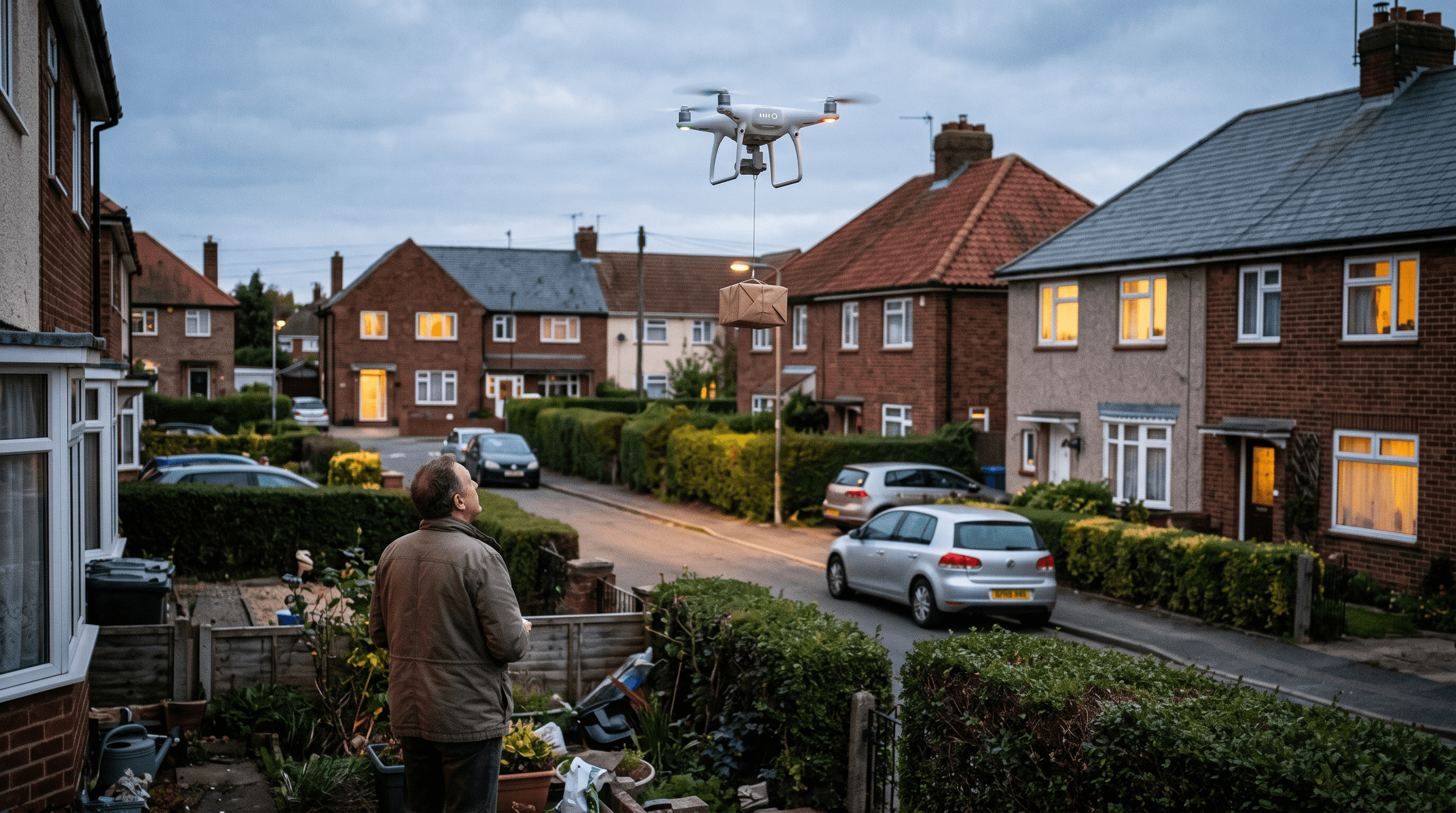
Urban drone delivery for healthcare has been discussed as a near-future prospect across Europe for several years. Matternet and Apian have turned it into present-tense operations. Their joint deployment transporting medical samples for NHS hospitals across central London marks one of the first instances of regular, multi-site drone logistics in a major European capital — not a trial, not a corridor test, but commercial operations running between hospital campuses on a scheduled basis.
For drone operators preparing for EASA certification or tracking the shape of Europe's commercial drone market, this London deployment deserves attention for what it actually is and what it implies about where the regulatory and operational landscape is heading.
What the NHS operation involves
The deployment pairs Matternet's M2 drone platform with Apian's healthcare logistics management layer. Matternet has previously run similar operations in Switzerland and California, including transport of blood samples, pathology specimens, and other time-sensitive medical materials over hospital campuses and across urban environments. Apian focuses on integrating drone logistics into NHS clinical workflows, including scheduling, tracking, and hospital coordination.
In the London context, the operation transports medical samples between hospital campuses, where the alternative is ground transport through central London traffic. The operational logic is straightforward: medical samples often have time-sensitive handling requirements, ground transport in a dense urban environment is unpredictable, and drone routes over rooftops can bypass surface congestion entirely.
Matternet's M2 is a relatively compact electric multi-rotor drone carrying payloads up to 2 kg over distances up to 20 km. It operates within defined flight corridors with remote monitoring, well within the weight and operational parameters that regulators have developed rules for. The platform has accumulated thousands of commercial flights across its deployments in Europe and North America.
The UK regulatory context and the EASA comparison
An important technical fact: this operation runs under UK Civil Aviation Authority authorization, not EASA rules. The UK left the EASA regulatory framework after Brexit, and the CAA has developed its own pathway for drone operations, particularly for the specific category equivalent that covers commercial urban deployments like this one.
That distinction matters for EU-based operators reading this deployment as a direct model. The legal pathway Matternet and Apian followed in the UK is not the same as applying for an Operational Authorization under Article 12 of Regulation (EU) 2019/947. However, the operational logic, technical requirements, and risk management approach are closely parallel. Both frameworks require operators to demonstrate that they can manage third-party risk over populated areas, maintain positive aircraft identification, operate within defined flight volumes, and show a credible safety case for the specific environment.
What this London deployment demonstrates at an operational level is that the technical challenges regulators care about — route definition, contingency procedures, payload integrity, remote pilot oversight — are solvable for multi-site urban hospital logistics. That operational track record matters because EASA and national aviation authorities look at demonstrated evidence from comparable environments when developing standards and assessing new authorization applications.
The EU equivalent to this kind of urban logistics operation would sit in the specific category under EASA's framework, most likely requiring an Operational Authorization rather than a Standard Scenario, given the urban population density and the multi-site nature of the operation. Operators pursuing similar projects in EU member states would need to work with their national aviation authority on a SORA (Specific Operations Risk Assessment) and meet the SAIL criteria relevant to operations over populated areas.
Why urban medical logistics is a structurally important use case
Drone delivery for medical samples is not the most visible application of unmanned aviation, and it does not get the same headlines as urban food delivery or last-mile parcel services. But from a regulatory progression standpoint, it is one of the most strategically important early use cases, for several reasons.
First, the operational environment is demanding. Central London is not a rural test corridor. Multi-rotor drones flying between hospital buildings in an urban environment have to demonstrate that they can handle airspace coordination, maintain separation from other aircraft including helicopters serving hospital helipads, operate in variable weather, and handle emergency procedures in populated areas. If a regulatory framework produces a convincing safety case for hospital-to-hospital operations in central London, it has handled some of the hardest parameters in urban drone logistics.
Second, the client relationship is structured. NHS hospitals are not consumer users of a delivery service. They are institutional operators with clinical governance requirements, procurement procedures, and regulatory accountability of their own. The fact that NHS clinical leadership is integrating drone delivery into patient care pathways means the operation has passed clinical scrutiny, not just technical approval. That kind of institutional validation changes how regulators and policymakers view a use case.
Third, the payload justifies the complexity. Medical samples represent a category where drone delivery offers a clinically defensible advantage over alternatives. The case is not about convenience or speed in a consumer sense. It is about controlled-environment transport, reduced handling, and time-to-result improvements that translate into patient care outcomes. That justification structure is exactly what regulators need to see when they are assessing whether a novel operation is genuinely beneficial rather than commercially opportunistic.
The broader European picture for healthcare drone logistics
The UK deployment is not isolated. Across the EU, several healthcare drone logistics projects are in operational or pre-operational stages, with different national aviation authorities managing the authorization pathways.
In the Nordic countries, hospital drone delivery has been piloted and in some cases scaled, with Sweden and Norway among the early movers. In the German-speaking markets, logistics operators have tested drone delivery for pharmaceutical distribution. The common thread is that healthcare — particularly pathology samples, blood products, and pharmaceutical supplies — consistently emerges as the use case where the operational benefits are clearest and the institutional will to absorb regulatory complexity is strongest.
This matters for EU member states working through the EASA specific category framework. As more national aviation authorities accumulate experience with healthcare drone logistics authorizations, the pathway for new applicants becomes more defined. EASA's work on standard scenarios has already created an STS-02 covering operations over populated areas in VLOS, and further development of specific category standard approaches is part of the agency's work programme.
For Latvian operators and Baltic-market drone service providers tracking where commercial drone logistics is heading, the NHS deployment provides a concrete reference point. Latvia's geography — with hospitals distributed across a relatively small territory and strong road transport connectivity — creates different operational logic than central London. But the healthcare sector represents the same structural opportunity: institutional clients, justified payloads, and a risk framework that operators can build a credible safety case around.
What certification-focused operators should take from this
For drone pilots and operators currently preparing for EASA A1/A3 open category certification, the NHS deployment sits in a different regulatory space — specific category operations require separate authorizations beyond the open category competency certificate. But the trajectory matters.
Open category competency demonstrates baseline knowledge of the EASA framework, airspace rules, and operational risk principles. Operators who understand the framework at that level are positioned to develop into specific category operations if the commercial opportunity arises. The certification pathway from open to specific category is not automatic — it requires additional operational experience, safety case development, and authorization from the national aviation authority — but understanding how the open category concepts connect to more complex operations is exactly what study at the A1/A3 level prepares operators for.
The NHS deployment also illustrates a point that is easy to underweight during exam preparation: real commercial drone operations are almost entirely about risk management and regulatory compliance, not about flying skill alone. The authorization that allowed Matternet and Apian to operate in central London required demonstrating operational protocols, emergency procedures, airspace coordination, and a CONOPS (Concept of Operations) that regulators could assess. That is the direction all commercial drone operations are heading, and it is the reason EASA's certification framework places such emphasis on understanding airspace rules, hazard assessment, and operator responsibilities.
The operational future is already running
Matternet and Apian's NHS deployment is not a proof of concept. It is a production operation. That distinction is worth stating directly, because much of the discourse around urban drone logistics still treats it as a future aspiration rather than a present reality — at least in markets where authorization pathways and institutional demand are already aligned.
For European operators, the relevant question is not whether urban medical drone delivery is technically feasible. The London deployment has answered that. The relevant questions are about authorization pathways, institutional partnership development, and the specific category operational experience that will be required to run comparable services in EU member states.
EASA's framework, and the national implementations in countries like Latvia, Germany, France, and Sweden, is being designed around exactly this kind of use case. The operators who will be positioned to pursue it are those who have built the foundational knowledge now — understanding the framework, the risk categories, the authorization requirements — and who treat the open category certification as the first step in a longer professional trajectory.
The NHS drone delivery story is not primarily a technology story. It is a story about what happens when regulatory frameworks, institutional demand, and operational capability converge. In the EU, that convergence is ongoing. The question for individual operators is when and how they want to be positioned when it arrives in their market.
Sources: Commercial UAV News | https://www.commercialuavnews.com/matternet-launches-uk-drone-delivery-operations-nhs