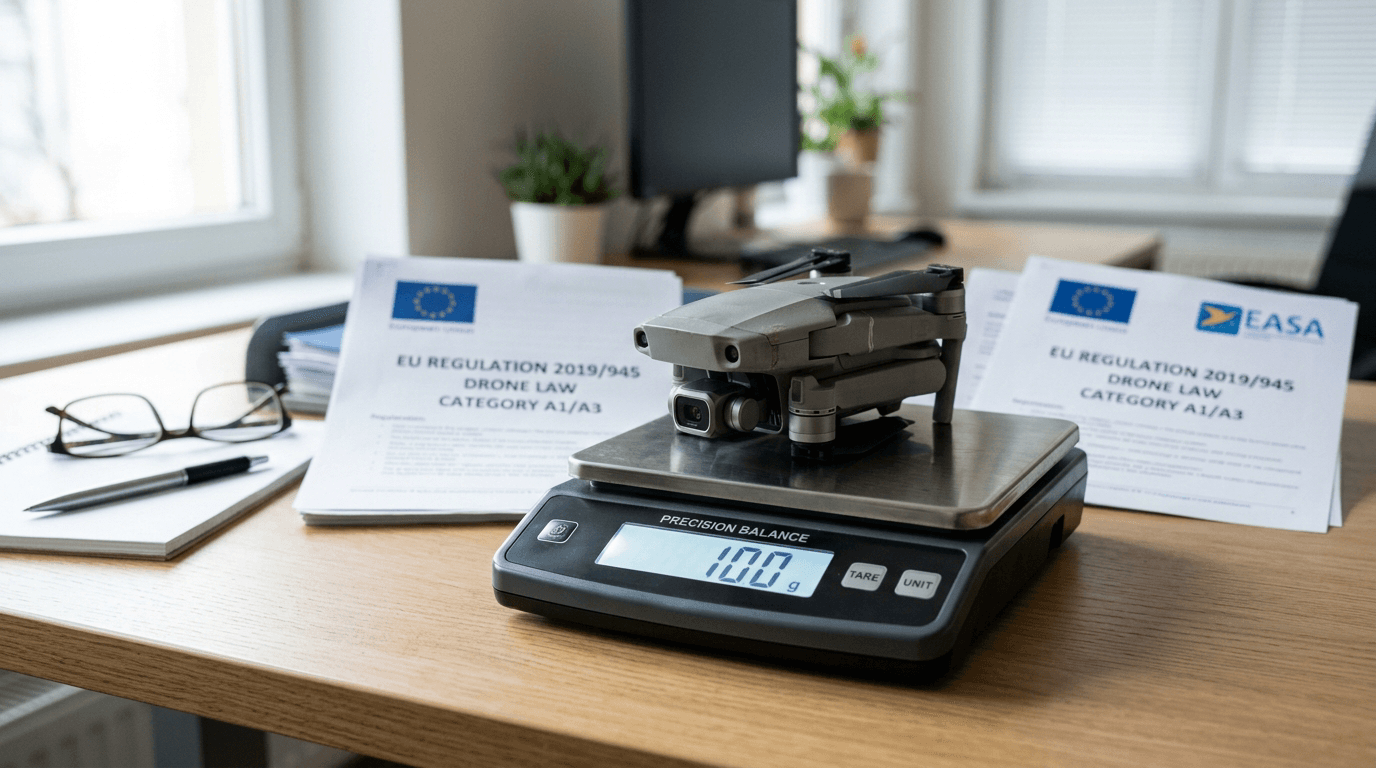
For six years, 250 grams has been the most consequential number in consumer drone design. Whole product lines — the DJI Mini family most famously — exist because staying under it meant no training, no Remote ID, and the lightest regulatory footprint the EU offers. In June 2026 EASA circulated the draft that would retire that number: NPA 2026-103, a package of amendments to Regulations (EU) 2019/945 and 2019/947 that moves the key threshold down to 100 grams.
Nothing changes this flying season, or the next. Under the current timeline the first amendments would apply from mid-2028 at the earliest, and the full revised framework is not expected before 2031. But the 100-gram line has now gone from a policy slide to written regulatory text, and it is worth reading what that text actually says — because alongside the tightening for hobbyists, it hands professional operators the biggest simplification of the Specific category since the framework launched.
What NPA 2026-103 proposes for the Open category
Three changes matter for recreational and light-commercial pilots.
Training from 100 grams. Today the Open category requires no pilot training below 250 grams. The NPA would extend the basic requirement down to 100 grams: pilots of camera drones between 100 and 250 grams — the DJI Mini and Neo class — would have to complete an online theory course of the A1/A3 type. Operator registration is a separate matter and, for camera drones, already applies at any weight; the genuinely new obligations are competency and hardware.
Direct Remote ID above 100 grams. Remote ID — the broadcast "licence plate" that transmits the drone's serial number, operator registration number and position — currently stops at the 250-gram line: C0-class aircraft are exempt. The NPA would make it mandatory for essentially every drone above 100 grams. Mandatory ADS-L, which would also make drones electronically visible to other airspace traffic, did not make it into the proposal.
A takeoff lockout. The draft goes one step further than broadcasting: a Remote ID-equipped drone would refuse to take off unless a valid operator registration number has been entered into the aircraft. That is a quiet but significant shift in how the rules work. Enforcement stops depending on an inspector with a receiver and moves into the drone's own firmware.
The Specific category gets lighter, not heavier
The same document pulls in the opposite direction for professionals, and this half deserves more attention than it has received.
EASA's own diagnosis is that thousands of Specific category operations pose low real-world risk yet still require an individual authorisation from the national aviation authority — pointless workload for operators and regulators alike. The NPA's answer comes in three parts:
- More Standard Scenarios. Expanding the use of STS, particularly at the SAIL II risk level, so that more operations proceed on a simple operational declaration instead of a prior authorisation.
- SORA work shifts to manufacturers. Where a drone and its operational concept have already been assessed against predefined standards, the operator may no longer need to run a full Specific Operations Risk Assessment themselves.
- New BVLOS scenarios. Proposed new and updated standard scenarios cover BVLOS flights close to infrastructure and obstacles in atypical airspace, and operations with large agricultural drones up to 750 kilograms maximum take-off mass — flights that today each require their own SORA case.
If the consumer half of the NPA is about accountability, this half is about throughput: getting routine inspection, survey and agricultural work out of the authorisation queue.
Where the 100-gram line comes from
The NPA is the regulatory follow-through on the European Commission's Action Plan on Drone and Counter-Drone Security, published on 11 February 2026. The political momentum behind that plan came largely from the wave of drone sightings that shut European airports in late 2025 — Munich twice in two days, Copenhagen and Oslo for hours, repeated closures in Belgium.
There is an obvious tension here, and it is fair to name it. Registration databases catalogue the people willing to be catalogued. Whoever was behind the serious airport incursions was never going to type a valid operator ID into their aircraft before launch. Lowering the threshold to 100 grams will not stop that class of operator; what it does is make the compliant majority more visible, so that the non-compliant stand out. That is a legitimate policy goal — it is how vehicle plates work — but it is an accountability measure, not a counter-drone weapon, and the security framing around it promises more than a registry can deliver.
The EU is also not first across this line. The UK lowered its registration threshold from 250 to 100 grams on 1 January 2026, pulling an estimated half a million pilots into the system. Japan's experience shows the second-order effect: when its law exempted aircraft under 200 grams, DJI shipped a Japan-only Mavic Mini at 199 grams. Hard weight thresholds do not just regulate pilots — they redesign the products on the shelf.
The timeline: a proposal, not a law
NPA 2026-103 opens a multi-year process, and the draft on the table now is unlikely to be the text that enters into force. EASA discussed the package with industry at a workshop in Cologne in June 2026 and is folding feedback into the next revision; an addendum covering the U-space Regulation 2021/664 is expected in July. After consultation, the European Commission and member states still have to adopt the final amendments.
Under the current schedule the first changes could apply from mid-2028, with the complete revised framework operational no earlier than 2031. Every number in the proposal — including the 100-gram threshold itself — can still move during consultation.
What this means for a pilot in Latvia
Today, nothing changes. If your drone has a camera, you already register as an operator with the CAA — that has been true at any weight since the current framework arrived, and the registration walkthrough still applies as written. Sub-250-gram drones still require no exam.
The planning horizon is what shifts. Two practical conclusions:
- Buying sub-250 "to avoid paperwork" now has a visible expiry date. The A1 subcategory's operational privileges for light drones — flying near uninvolved people — are not under threat, and lighter aircraft will keep their advantages. But "no exam, ever" is no longer a promise the 249-gram class can make. If the NPA survives consultation intact, a Mini-class pilot in 2028 will need the same basic theory as everyone else.
- The A1/A3 certificate is cheap insurance. The training the NPA would impose on 100–250-gram pilots is exactly the online theory that the A1/A3 exam in Latvia already covers. Taking it now costs an evening of study, works EU-wide, and removes the one obligation the proposal would add for light-drone pilots. The step-by-step guide covers the process.
For Remote ID, the sensible move is the same one we recommended when the 100-gram idea first surfaced: when choosing a new drone, prefer models that already broadcast Remote ID or can enable it in firmware, because the exemption that today's sub-250 drones enjoy is the exact clause the NPA deletes.
What matters now
The 250-gram era of European drone regulation is ending — slowly, with consultation rounds and a timeline that stretches to 2031, but the direction is now committed to paper. Hobbyists get more obligations; professional operators get a genuinely lighter Specific category; manufacturers get a new number to design around. None of it is final, and the consultation is where thresholds get contested. What a pilot controls today is simpler: register what must be registered, know the theory, and stop treating 249 grams as a permanent regulatory shelter.
FAQ
Does the 100-gram rule already apply in the EU? No. NPA 2026-103 is a draft proposal at the start of a multi-year process. Under the current timeline the first amendments would apply from mid-2028 at the earliest, and the full revised framework not before 2031.
Do I already have to register a DJI Mini in Latvia? As an operator — yes, if it has a camera, regardless of weight; that is the current rule, not the proposal. What the NPA would add for 100–250-gram drones is mandatory basic training and Remote ID, not registration.
Would sub-250-gram drones lose their advantages? Partially. The operational privileges of light drones in the A1 subcategory remain. What would end is the exemption from training and Remote ID — the "buy and fly with no exam" status that made the 249-gram class popular.
What is the proposed takeoff lockout? Under the NPA, a drone with Remote ID would not take off unless a valid operator registration number has been entered into it. Compliance checking would move from authorities on the ground into the aircraft's own firmware.