Drone delivery in Europe did not stall this year because of an airspace problem. In June 2026, Fingal County Council refused Manna Air Delivery permission to keep operating its drone hub at Coolmine Industrial Estate in Dublin 15 — a site that had already flown tens of thousands of deliveries. The stated reason was not safety and not a violation of aviation rules. It was noise: the council concluded that the company's own noise assessment failed to show that the impact on residents could be kept acceptable. The aviation side of drone delivery is largely solved. Whether the ground side — planning law, noise, neighbours — will let it scale is now the real question.
A county council grounded what aviation regulators had approved
The Dublin case matters because Manna is not a pilot project. The company reports more than 82,000 deliveries in Dublin 15 since February 2024, over 47,000 of them in the last twelve months, and household adoption above 60 percent in some neighbourhoods. The hub was already operating — the application was for retention permission, planning-law language for "let us keep what is already here." The council's refusal order said the submitted Noise Impact Assessment did not provide sufficient evidence that the operation would avoid unacceptable noise impacts, and that in the absence of such evidence the development results in "serious noise pollution" and may be prejudicial to public health.
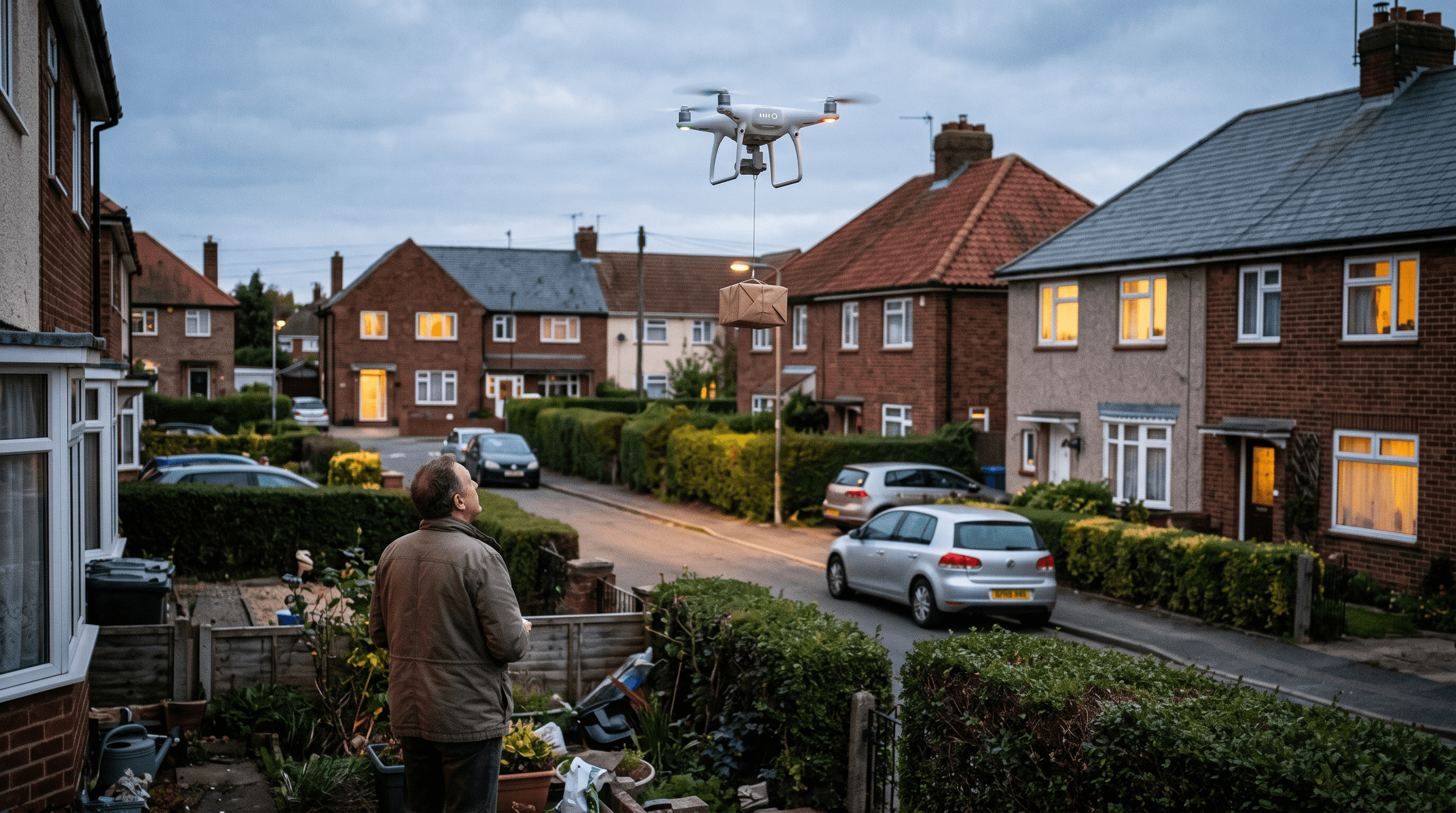
The decibel argument between the two sides is instructive. Manna states its drones generate about 59 dB in flight, which it describes as quieter than normal conversation. Opponents point to the company's own assessment, which records higher levels during overflight and delivery. Manna counters that the same assessment concluded the operational impact would be "insignificant," and cites independent measurements by Trinity College Dublin academics that reached similar conclusions. Both readings can be honest at once: a small drone in cruise at height is genuinely quiet, and the same drone descending over a garden to lower a package is genuinely not. Planning authorities do not weigh a single number — they weigh a new, repeated, distinctive sound over homes, concentrated around a hub, hundreds of times a day.
The community is split rather than united against the service. A petition supporting expansion of drone delivery in Dublin gathered over 6,000 signatures; a counter-petition by the local campaign group Drone Action D15 demanding restrictions gathered around 1,500. Manna's second Dublin 15 hub, at Blanchardstown Shopping Centre, keeps flying — but on a time-limited permission of its own. The company says it is reviewing its options; it also operates in Finland and in Fort Worth, Texas.
Dublin is a pattern, not an incident
Six months earlier, the ground problem ended a bigger programme. Amazon had spent two years preparing drone delivery at San Salvo in Italy — Prime Air trials from December 2024, close work with the regulator ENAC, the traffic-management provider D-Flight and the air navigation service provider ENAV — inside what was set to become one of the EU's first operational U-space areas. Days before the area went live on 1 January 2026, Amazon announced it was stopping its Italian drone delivery plans. The company's statement blamed no aviation authority: "the broader business regulatory framework in the country does not, at this time, support our longer-term objectives." ENAC called the decision unexpected.
The UK offers a third data point. In November 2025, Amazon cut its planned drone delivery flights in Darlington by more than half — from 21 to 10 per hour — after the local authority granted only temporary planning permission for its facility.
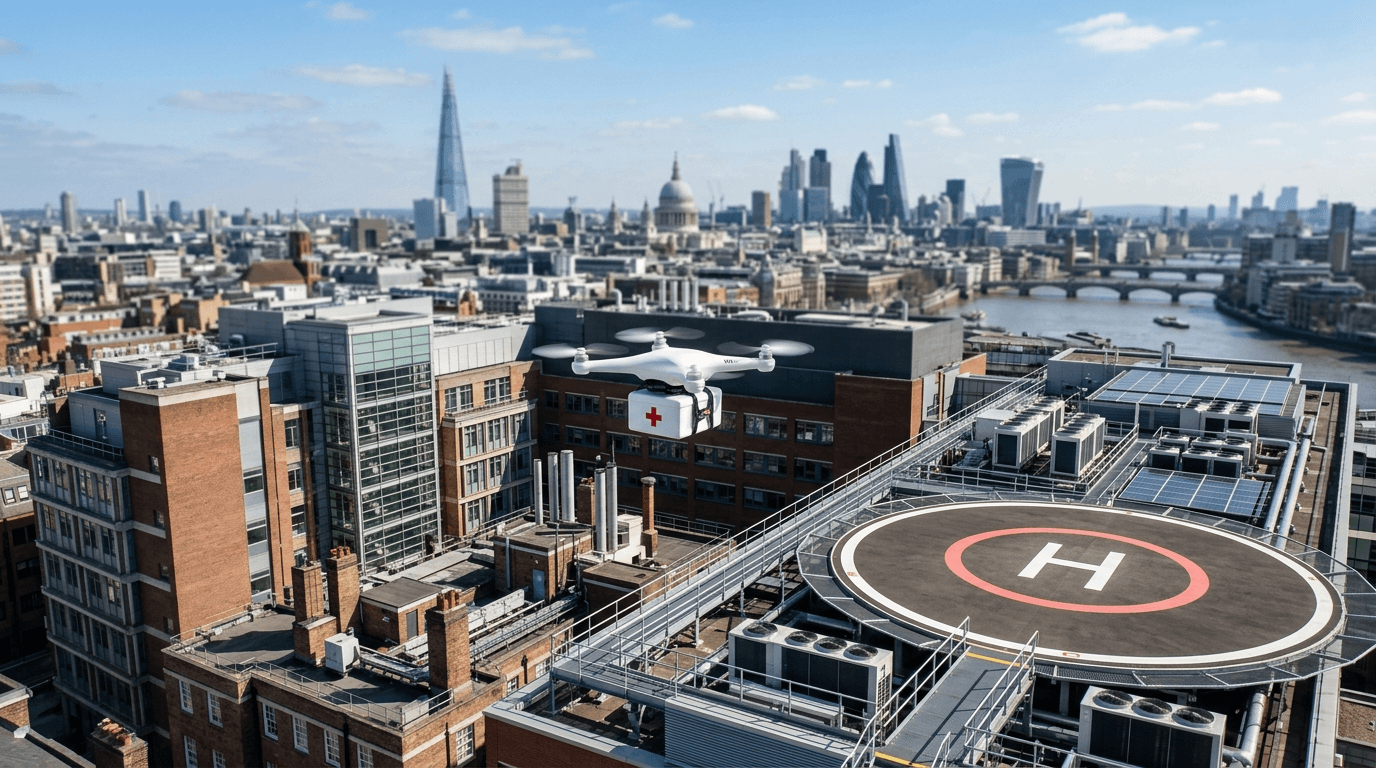
Three cases, one shape. Nobody failed a safety assessment. Nobody lost an aviation authorisation. What bound each operation was the ground layer: planning permission, noise assessment, local acceptance, and the economics that follow from them. It is worth noticing what does keep working: medical drone logistics between London hospitals carries blood samples, not burgers — a payload whose public benefit is much easier to defend to the people under the flight path.
The EU regulates drone noise at the point of sale, not over your street
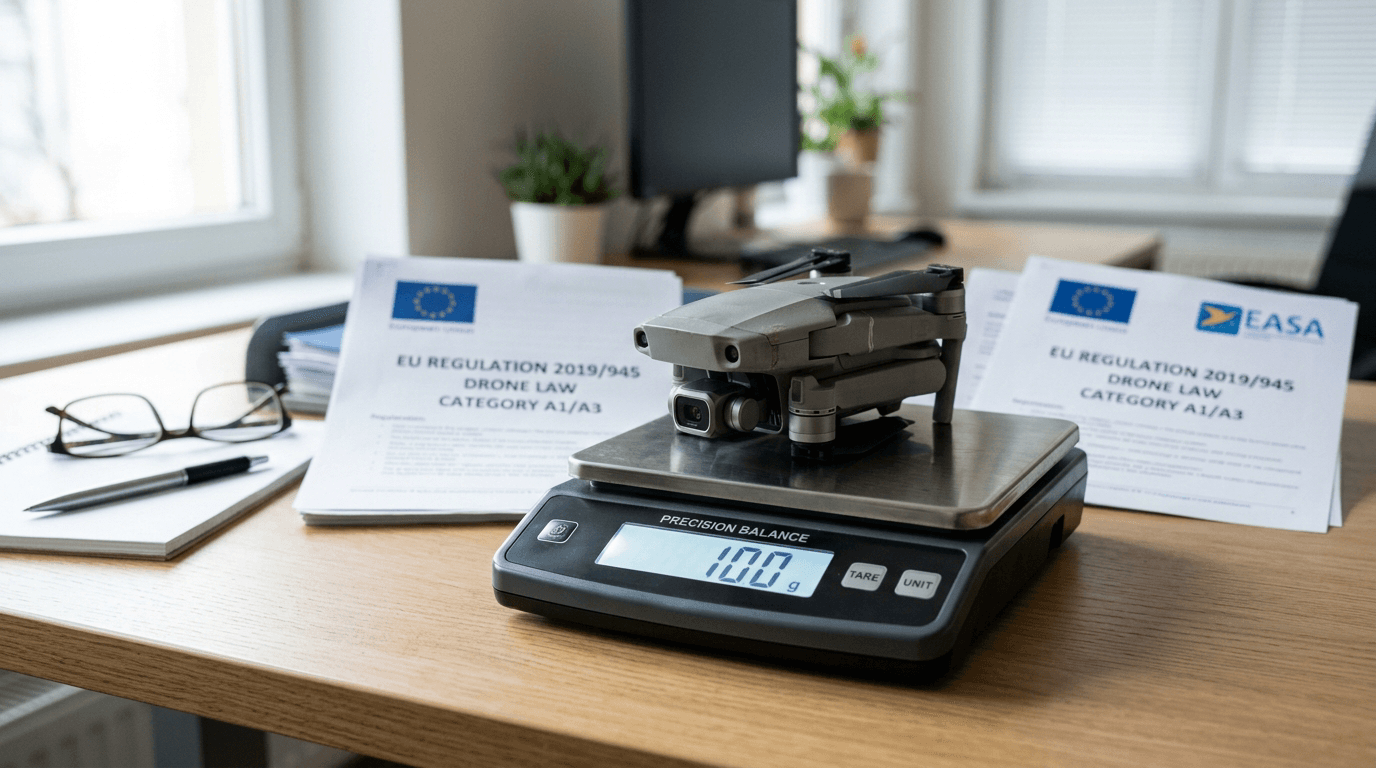
The EU does have drone noise law — but it lives in an unexpected place. Regulation (EU) 2019/945, the product rulebook behind the C-class labels, requires every class C1 and C2 multirotor sold in Europe to carry a guaranteed sound power level (L_WA) label — the same energy-style sticker you find on a lawnmower. The annex caps that level: after the final transition step, a C1 or C2 drone under 900 grams may not exceed 81 dB(A), and heavier C2 aircraft up to 4 kg get a mass-based allowance that works out to roughly 93 dB(A) at the top of the range. The measurement procedure is fixed too — hovering at maximum take-off mass, measured to EN ISO 3744.
That framework binds manufacturers placing drones on the market. It says nothing about how a fleet may sound over a street, how many overflights per hour a neighbourhood must accept, or where a hub may be sited. Delivery aircraft like Manna's fly in the specific category, where no EU-wide operational noise limit exists. EASA published guidelines in 2023 for measuring the noise of drones under 600 kg in the specific category — a harmonised measurement method that national authorities can use in authorisations, not a limit. The result is a vacuum that generic local law fills: land-use planning, environmental health, nuisance rules. That is how a county council, not an aviation authority, became the effective noise regulator of European drone logistics. This is not an anomaly — heliports have always answered to planning law — but it means an aviation authorisation is necessary and not sufficient. It is not a licence to scale.
Noise sits at the top of what the public actually worries about
None of this should surprise anyone who read EASA's own research. The agency's 2021 study on societal acceptance of urban air mobility — the first EU-wide survey of its kind — found the public broadly positive about drone services, with three concerns at the top: safety, environment and noise, and security. The study predates every operational delivery hub in the EU, and it predicted their weak point.
The economics explain why noise complaints concentrate where they do. Delivery flights cluster around hubs; approach and descent — the loudest phases — repeat over the same streets. The benefit of a ten-minute coffee delivery is spread across a whole catchment of customers, while the cost lands on whoever lives under the descent path. Adoption of 60 percent in a neighbourhood does not quiet the household that hears every one of the day's approaches. That asymmetry, not any single decibel figure, is the political engine of cases like Coolmine.
What a pilot or operator in Latvia should take from this
There is no delivery hub over Riga yet, but the Dublin lesson scales down to a single hobby drone. The noise cap and the L_WA label are why class-marked C1 and C2 drones are as quiet as they are — the sticker on the box is the same policy in miniature. And the complaint mechanism scales down too: a drone hovering repeatedly over someone's garden becomes a police matter through exactly the same channel as noise nuisance, usually bundled with a privacy complaint. The practical habits are cheap: do not loiter over homes, vary your routes, keep altitude when transiting residential areas.
For anyone planning a drone business — delivery, inspection, spraying — Dublin belongs in the business case. Site selection, a noise assessment that will survive scrutiny, and early engagement with the people who will hear the aircraft deserve the same budget line as the SORA paperwork. And the EU layer is moving: noise and public acceptance are part of what the Commission's aviation strategy consultation is collecting evidence on. The operators who treat acceptance as an input, not an afterthought, will be the ones still flying in five years.
FAQ
How loud is a delivery drone? There is no single number. Manna states about 59 dB in flight — comparable to conversation — but levels recorded during overflight and delivery in its own Dublin noise assessment were higher. Loudness depends on the flight phase: cruise at height is quiet, descent and hover over the delivery point are not.
Does the EU limit drone noise? At the product level, yes: Regulation (EU) 2019/945 caps the sound power of class C1 and C2 drones (81 dB(A) for aircraft under 900 g after the final transition step) and requires an L_WA noise label. There is no EU-wide operational noise limit for routes or hubs — that gap is governed by national and local law, mostly planning and nuisance rules.
Why did Manna's Dublin hub lose permission? Fingal County Council refused retention permission for the Coolmine hub because the submitted Noise Impact Assessment, in the council's view, failed to demonstrate that adverse noise impacts could be avoided — concluding the operation results in "serious noise pollution" potentially prejudicial to public health. Manna disputes the reading and says it is reviewing its options.
Did Amazon stop drone delivery in Europe? In Italy, yes — Amazon halted its plans days before the San Salvo U-space area launched in January 2026, citing the broader business regulatory framework. In the UK, its Darlington operation was scaled back to 10 flights per hour under a temporary planning permission. Amazon says its UK and US programmes continue.
The aircraft cleared their bar years ago: they are certified, tracked, and quieter than most tools in a garden shed. The constraint that decides whether drone logistics scales in Europe is now measured in council minutes and decibels over rooftops. For individual pilots the lesson is the same social contract in miniature — every flight over someone's home spends a little of the public's patience, and the operators who understand that are the ones the public will keep tolerating.