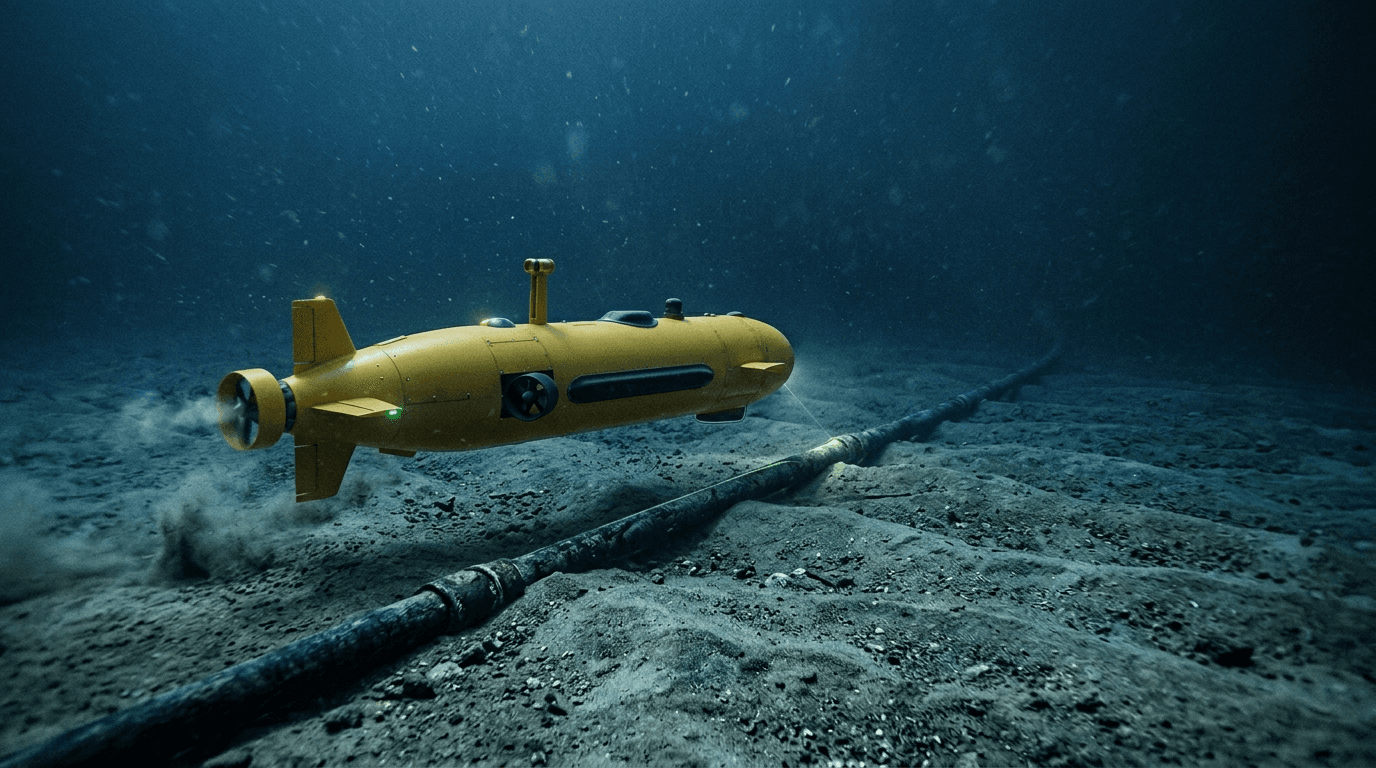
Most of what we cover here flies. This story sits below the waterline. On 30 May 2026, the defence ministers of the UK, Australia and the United States announced a joint programme to develop and field advanced underwater drones, aimed squarely at protecting undersea cables and pipelines. These are uncrewed submersibles, not quadcopters — a different machine in a different medium. But the reason it matters here is the through-line: the word "drone" now reaches from the sky to the seabed, and the fight over critical infrastructure has gone with it.
This is an editorial read of what was announced, what is real, and why a Baltic state should care.
What was announced
The programme falls under AUKUS, the 2021 trilateral pact between Australia, the UK and the US built around deeper defence-technology integration and information sharing. Speaking at the Shangri-La Dialogue security forum in Singapore, UK Defence Secretary John Healey framed it as "what modern defence looks like" — breakthrough undersea capabilities, British industry behind them, allies standing together. The technology is expected to be ready by 2027 and is meant to help protect the undersea cables and pipelines that carry energy and data.
Note the tense. "Expected to be ready by 2027" is an announcement, not a fielded capability. Treat it as a stated direction with a target date, the same way we read any program that has been declared rather than delivered.
Why the seabed is suddenly contested
The infrastructure at stake is easy to underrate because it is invisible. A web of undersea cables and pipelines carries gas, electricity and almost all intercontinental internet traffic. Cut enough of it and you disrupt communications and energy supply across whole regions. The threat is not exotic: increasingly it is ships dragging anchors across the seabed, with suspicion — per the reporting around the announcement — that some Russian and Chinese vessels have done so deliberately.
This is the undersea face of a problem we have covered in the air. Protecting airports and power stations from cheap aerial drones is the same category of fight — defending fixed, vital, hard-to-replace infrastructure against a mobile, deniable threat — which we examined in counter-drone systems for European airports and critical infrastructure. The seabed version simply moves the contest below the waterline, where detection is harder and attribution harder still.
The same autonomy logic, in a new medium
Underwater drones answer the seabed problem the way aerial autonomy answers the air problem: persistent, uncrewed, sensor-laden machines that can watch and patrol far longer than a crewed platform can, at lower risk and cost. The UK had already signalled this in 2025 with Atlantic Bastion, a planned network of autonomous vessels and AI working alongside warships and aircraft to guard cables and pipelines — described at the time as a direct response to renewed Russian submarine activity.
The capability is also battle-tested in a cruder form. Uncrewed surface and underwater craft are a central part of Ukraine's arsenal; sea drones helped Kyiv neutralise much of Russia's Black Sea Fleet early in the war. That is the same conceptual shift we have traced through autonomous systems and the future of warfare and the trends shaping 2026: take the human off the platform, multiply the platforms, and let autonomy hold ground — or, here, hold sea — that a crewed force could not cover.
The Baltic stake
For a reader in Latvia this is not a distant Pacific-alliance story. The Baltic Sea is exactly the kind of shallow, busy, geopolitically tense water where undersea cables and pipelines are vulnerable to the anchor-dragging threat the AUKUS programme is built to counter. A small coastal state depends on subsea links for power interconnection and connectivity, and has limited means to police the seabed alone. Allied investment in autonomous undersea defence is, indirectly, investment in the security of the same waters Latvia sits on.
What matters now
Keep the frame honest on two counts. First, this is an announced 2027 capability, not something patrolling the seabed today — judge it by what gets built and deployed. Second, it is genuinely a different domain from the aerial drones this site is about; a UUV guarding a cable is not a quadcopter, and pretending otherwise flattens a real distinction. What carries across is the idea: autonomy is becoming the default tool for defending critical infrastructure, in the air and now under the sea.
For civilian aerial pilots none of this changes your rules. It is a reminder that "drone" has quietly become a category spanning three mediums, and that the policy attention, funding and regulation following autonomous systems is broad and growing. The part you operate in — the air, under certification — is the most rule-bound corner of a fast-expanding field, and the certification guide is built to keep you current in it.
FAQ
Are AUKUS underwater drones the same as the aerial drones this site covers? No. These are uncrewed underwater vehicles built for naval and infrastructure-protection roles, a different machine in a different medium from the aerial drones civilian pilots fly. They share the word "drone" and the underlying logic of autonomy, but not the rules, the airspace or the certification.
What are the underwater drones meant to do? Protect undersea cables and pipelines — the lines carrying energy, electricity and internet traffic — against threats such as ships dragging anchors across the seabed, where some vessels are suspected of doing so deliberately.
Is this capability operational? No. The AUKUS partners announced the programme on 30 May 2026 and expect the technology to be ready by 2027. It is a declared programme with a target date, not a fielded system.
Why should someone in Latvia care about a Pacific alliance programme? Because the threat it targets — damage to undersea cables and pipelines — applies directly to the Baltic Sea, where Latvia's subsea power and data links run. Allied investment in autonomous undersea defence touches the security of the waters around the Baltic.